

100% Free MCSA 070-768 Dumps PDF Demo Cert Guide Cover
PDF Exam Material 2021 Realistic 070-768 Dumps Questions
Microsoft 070-768 Exam Syllabus Topics:
| Topic | Details |
|---|---|
| Topic 1 |
|
| Topic 2 |
|
| Topic 3 |
|
| Topic 4 |
|
| Topic 5 |
|
| Topic 6 |
|
| Topic 7 |
|
| Topic 8 |
|
| Topic 9 |
|
| Topic 10 |
|
| Topic 11 |
|
| Topic 12 |
|
| Topic 13 |
|
| Topic 14 |
|
| Topic 15 |
|
| Topic 16 |
|
Who should take the 70-768 exam
The Microsoft 70-768 Exam is an internationally recognized validation that identifies persons who earn it as possessing skilled in MCP and MCSA Certification. If candidates want significant improvement in career growth needs enhanced knowledge, skills, and talents. The Microsoft 70-768 Exam provides proof of this advanced knowledge and skill. If a candidate has knowledge of associated technologies and skills that are required to pass the Microsoft 70-768 Exam then he should take this exam.
NEW QUESTION 25
Note: This question is part of a series of questions that present the same scenario. Each question in the series contains a unique solution. Determine whether the solution meets the stated goals.
You deploy a tabular data model to an instance of Microsoft SQL Server Analysis Services
(SSAS). The model uses an in-memory cache to store and query data. The data set is already the same size as the available RAM on the server. Data volumes are likely to continue to increase rapidly.
Your data model contains multiple calculated tables.
The data model must begin processing each day at 2:00 and processing should be complete by 4:00 the same day. You observe that the data processing operation often does not complete before 7:00. This is adversely affecting team members.
You need to improve the performance.
Solution: Install solid-state disk drives to store the tabular data model.
Does the solution meet the goal?
- A. No
- B. Yes
Answer: A
Explanation:
By default, tabular models use an in-memory cache to store and query data. When tabular models query data residing in-memory, even complex queries can be incredibly fast.
However, there are some limitations to using cached data. Namely, large data sets can exceed available memory, and data freshness requirements can be difficult if not impossible to achieve on a regular processing schedule.
DirectQuery overcomes these limitations while also leveraging RDBMS features making query execution more efficient.
With DirectQuery: +
References:https://docs.microsoft.com/en-us/sql/analysis-services/tabular- models/directquery-mode-ssas-tabular
NEW QUESTION 26
Note: This question is part of a series of questions that present the same scenario. Each question in the series contains a unique solution. Determine whether the solution meets the stated goals.
A company has an e-commerce website. When a customer places an order, information about the transaction is inserted into tables in a Microsoft SQL Server relational database named OLTP1. The company has a SQL Server Analysis Services (SSAS) instance that is configured to use Tabular mode. SSAS uses data from OLTP1 to populate a data model.
Sales analysts build reports based on the SSAS model. Reports must be able to access data as soon as it is available in the relational database.
You need to configure and deploy an Analysis Services project to the Analysis Services instance that allows near real-time data source access.
Solution: In the Deployment Option property for the report, you set the Query Mode to InMemory.
Does the solution meet the goal?
- A. No
- B. Yes
Answer: A
Explanation:
With InMemory the queries can use the cache only.
https://msdn.microsoft.com/en-us/library/hh230898(v=sql.120).aspx
NEW QUESTION 27
You are administrating a SQL Server Analysis Services (SSAS) tabular database.
You need to create a new role that allows its members to query data and to refresh data in the model.
Which permission should you use? (More than one answer choice may achieve the goal.
Select the BEST answer.)
- A. Browse and Manage
- B. Read and Process
- C. Explore and Manage
- D. Administrator
Answer: B
Explanation:
* Giving a database role permission to process an Analysis Services database means that the role has permission to perform all processing options on the database. This includes the processing of all cubes, dimensions, mining structures, and mining models in the database.
However, the role does not have permission to read database metadata or access any data in the database itself.
NEW QUESTION 28
Note: This question is part of a series of questions that present the same scenario. Each question in the series contains a unique solution. Determine whether the solution meets the stated goals.
You have an existing multidimensional cube that provides sales analysis. The users can slice by date, product, location, customer, and employee.
The management team plans to evaluate sales employee performance relative to sales targets. You identify the following metrics for employees:
You need to implement the KPI based on the Status expression.
Solution: You design the following solution:
Does the solution meet the goal?
- A. No
- B. Yes
Answer: A
NEW QUESTION 29
Note: This question is part of a series of questions that present the same scenario. Each question in the series contains a unique solution. Determine whether the solution meets the stated goals.
You have a Microsoft SQL Server Analysis Services (SSAS) multidimensional database that stores customer and order data for customers in the United States only. The database contains the following objects:
You must create a KPI named Large Sales Target that uses the Traffic Light indicator to display status. The KPI must contain:
You need to create the KPI.
Solution: You set the value of the Status expression to:
Does the solution meet the goal?
- A. No
- B. Yes
Answer: A
NEW QUESTION 30
Note: This question is part of a series of questions that present the same scenario. Each question in the series contains a unique solution. Determine whether the solution meets the stated goals.
You deploy a tabular data model to an instance of Microsoft SQL Server Analysis Services (SSAS).
The model uses an in-memory cache to store and query data.
The data set is already the same size as the available RAM on the server.
Data volumes are likely to continue to increase rapidly.
Your data model contains multiple calculated tables.
The data model must begin processing each day at 2:00 and processing should be complete by
4:00 the same day.
You observe that the data processing operation often does not complete before 7:00.
This is adversely affecting team members.
You need to improve the performance.
Solution: Install solid-state disk drives to store the tabular data model.
Does the solution meet the goal?
- A. No
- B. Yes
Answer: A
Explanation:
By default, tabular models use an in-memory cache to store and query data. When tabular models query data residing in-memory, even complex queries can be incredibly fast. However, there are some limitations to using cached data. Namely, large data sets can exceed available memory, and data freshness requirements can be difficult if not impossible to achieve on a regular processing schedule.
DirectQuery overcomes these limitations while also leveraging RDBMS features making query execution more efficient.
With DirectQuery: +
https://docs.microsoft.com/en-us/sql/analysis-services/tabular-models/directquery-mode-ssas- tabular
NEW QUESTION 31
HOTSPOT
A company has a multidimensional cube that is used for analyzing sales data. You add a new measure named Transaction - Total Including Tax and include the Supplier, Payment Method, and Transaction Type dimensions in the data model. The Transaction - Total Including Tax measure uses the existing Customer and Date dimensions.
When users have queried the new measure in the past, they saw results as shown in the existing query output exhibit. (Click the Exhibit button.)
The overall total is incorrectly displayed on every row. In addition, the results are no longer formatted correctly.
The query result should appear as shown in the desired query output exhibit. (Click the Exhibit button.)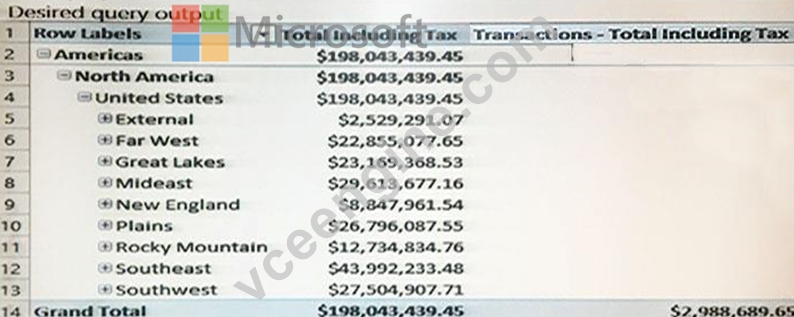
You need to ensure the table is displayed correctly.
What should you do? Use drop-down menus to select the answer choice that answers each question based on the information presented in the graphic.
NOTE: Each correct selection is worth one point.
Answer:
Explanation:
Explanation:
Box 1: Enter a custom MeasureExpression property on the measure
Calculated measures use MDX expressions to supply their values, instead of binding to columns in a data source. The Expression property contains the MDX expression used to supply the values for a Measure only if the Measure is a calculated measure. Otherwise, this property contains an empty string ("").
NEW QUESTION 32
Note: This question is part of a series of questions that use the same or similar answer choices. An answer choice may be correct for more than one question in the series. Each question is independent of the other questions in this series. Information and details provided in a question apply only to that question.
You are developing Microsoft SQL Server Analysis Services (SSAS) tabular model.
The model must meet the following requirements:
Support the RELATED and TRUNC DAX functions.
Show updated data as quickly as possible.
You need to configure model.
What should you do?
- A. Ensure that the Transactional Deployment property is set to True.
- B. Ensure that DirectQuery is disabled for the model.
- C. Ensure that the Transactional Deployment property is set to False.
- D. Process the model in Process Defrag mode.
- E. Ensure that DirectQuery is enabled for the model.
- F. Process the model in Process Full mode.
- G. Process the model in Process Data mode.
Answer: E
Explanation:
Explanation/Reference:
Explanation:
DAX originally emerged from a Power Pivot add-in for Excel, as a formula language extension for creating calculated columns and measures for data analysis (which are also integral elements of one SSAS Tabular model database, too), but when Microsoft added support for DAX queries in SQL Server 2012, BI experts started "daxing" data from Tabular model databases.
That trend continues, because of simplicity and fast query execution (related to DirectQuery mode in SSAS Tabular).
References:https://www.sqlshack.com/query-ssas-tabular-model-database-using-dax-functions/
NEW QUESTION 33
You are developing a SQL Server Analysis Services (SSAS) tabular project. The model includes a table named Sales. The Sales table includes a single date column.
The Sales table must meet the following requirements:
*
Queries must be able to return all rows.
*
Must be able to support four different processing schedules for different date ranges.
*
Date ranges must not include any overlapping data.
You need to implement a solution that meets the requirements.
What should you do?
- A. Convert the Sales table into four smaller tables by using row filter queries. Use one perspective for each of the four tables.
- B. Create four partitions for the Sales table. Use row filter queries for each partition.
- C. Create four partitions for the Sales table. Create four roles. Use the same row filter queries for each role and partition.
- D. Convert the Sales table into four smaller tables by using row filter queries. Use one perspective for all four tables.
Answer: B
NEW QUESTION 34
HOTSPOT
A database named DB2 uses the InMemory query mode. Users frequently run the following query:
You need to configure SQL Server Profiler to determine why the query is performing poorly.
Which three event should you monitor on the SQL Server Profiler trace events configuration page? To answer, select the appropriate options in the answer area.
Answer:
Explanation:
Explanation:
By using SQL Profiler, you can intercept two classes of trace events from Analysis
Services, DAX Query Plan and DirectQuery events, both generated by the DirectQuery engine. Here, in this scenario we have a DAX Query.
DAX Query Plan events are generated by the DAX formula.
By using the In-Memory mode, you store a copy of data in the xVelocity (VertiPaq) storage engine.
Figure: This is how a query is executed by using In-Memory mode.
References: Microsoft SQL Server 2012 Analysis Services, The BISM Tabular Model,
Microsoft Press (July 2012), page 331
From Scenario: Users report that the query takes a long time to complete.
NEW QUESTION 35
Note: This question is part of a series of questions that present the same scenario. Each question in the series contains a unique solution. Determine whether the solution meets the stated goals.
You have an existing multidimensional cube that provides sales analysis. The users can slice by date, product, location, customer, and employee.
The management team plans to evaluate sales employee performance relative to sales targets. You identify the following metrics for employees:
You need to implement the KPI based on the Status expression.
Solution: You design the following solution:
Does the solution meet the goal?
- A. No
- B. Yes
Answer: A
NEW QUESTION 36
Note: This question is part of a series of questions that present the same scenario. Each question in the series contains a unique solution. Determine whether the solution meets the stated goals.
You have a Microsoft SQL Server Analysis Services (SSAS) multidimensional database that stores customer and order data for customers in the United States only. The database contains the following objects:
You must create a KPI named Large Sales Target that uses the Traffic Light indicator to display status.
The KPI must contain:
You need to create the KPI.
Solution: You set the value of the Status expression to:
Does the solution meet the goal?
- A. No
- B. Yes
Answer: A
Explanation:
Explanation/Reference:
Explanation:
NEW QUESTION 37
Note: This question is part of a series of questions that present the same scenario. Each question in the series contains a unique solution. Determine whether the solution meets the stated goals.
You deploy a tabular data model to an instance of Microsoft SQL Server Analysis Services (SSAS). The model uses an in-memory cache to store and query data.
The data set is already the same size as the available RAM on the server. Data volumes are likely to continue to increase rapidly.
Your data model contains multiple calculated tables.
The data model must begin processing each day at 2:00 and processing should be complete by
4:00 the same day.
You observe that the data processing operation often does not complete before 7:00. This is adversely affecting team members.
You need to improve the performance.
Solution: Enable Buffer Cache Extensions.
Does the solution meet the goal?
- A. No
- B. Yes
Answer: A
Explanation:
In this scenario we would need both Buffer Cache Extensions and SSD.
The buffer pool extension provides the seamless integration of a nonvolatile random access memory (that is, solid-state drive) extension to the Database Engine buffer pool to significantly improve I/O throughput.
https://docs.microsoft.com/en-us/sql/database-engine/configure-windows/buffer-pool-extension
NEW QUESTION 38
Note: This question is part of a series of questions that present the same scenario. Each question in the series contains a unique solution. Determine whether the solution meets the stated goals.
A company has an e-commerce website. When a customer places an order, information about the transaction is inserted into tables in a Microsoft SQL Server relational database named OLTP1. The company has a SQL Server Analysis Services (SSAS) instance that is configured to use Tabular mode. SSAS uses data from OLTP1 to populate a data model.
Sales analysts build reports based on the SSAS model. Reports must be able to access data as soon as it is available in the relational database.
You need to configure and deploy an Analysis Services project to the Analysis Services instance that allows near real-time data source access.
Solution: In the Deployment Option property for the report, you set the Query Mode to DirectQuery with InMemory.
Does the solution meet the goal?
- A. No
- B. Yes
Answer: B
Explanation:
With DirectQuerywithInMemory mode the queries use the relational data source by default, unless otherwise specified in the connection string from the client.
References:https://msdn.microsoft.com/en-us/library/hh230898(v=sql.120).aspx
NEW QUESTION 39
Note: This question is part of a series of questions that present the same scenario. Each question in the series contains a unique solution. Determine whether the solution meets the stated goals.
A company has an e-commerce website. When a customer places an order, information about the transaction is inserted into tables in a Microsoft SQL Server relational database named OLTP1. The company has a SQL Server Analysis Services (SSAS) instance that is configured to use Tabular mode.
SSAS uses data from OLTP1 to populate a data model.
Sales analysts build reports based on the SSAS model. Reports must be able to access data as soon as it is available in the relational database.
You need to configure and deploy an Analysis Services project to the Analysis Services instance that allows near real-time data source access.
Solution: In the Deployment Option property for the report, you set the Query Mode to InMemory.
Does the solution meet the goal?
- A. No
- B. Yes
Answer: A
Explanation:
Explanation/Reference:
Explanation:
With InMemory the queries can use the cache only.
References:https://msdn.microsoft.com/en-us/library/hh230898(v=sql.120).aspx
NEW QUESTION 40
......
Updated Microsoft 070-768 Dumps – PDF & Online Engine: https://www.vceengine.com/070-768-vce-test-engine.html
