

2023 New Professional-Cloud-Developer Exam Questions Real Google Dumps
Course 2023 Professional-Cloud-Developer Test Prep Training Practice Exam Download
The Google Professional-Cloud-Developer exam tests a candidate's understanding of the key concepts, technologies, and tools used in developing cloud-based applications. It covers topics such as application development and deployment, cloud storage, data processing, and security. Google Certified Professional - Cloud Developer certification exam is a combination of multiple-choice and scenario-based questions that test a candidate's ability to solve real-world problems.
NEW QUESTION # 82
Your company is planning to migrate their on-premises Hadoop environment to the cloud. Increasing storage cost and maintenance of data stored in HDFS is a major concern for your company. You also want to make minimal changes to existing data analytics jobs and existing architecture. How should you proceed with the migration?
- A. Create Compute Engine instances with HDD instead of SSD to save costs. Then perform a full migration of your existing environment into the new one in Compute Engine instances.
- B. Migrate your data stored in Hadoop to BigQuery. Change your jobs to source their information from BigQuery instead of the on-premises Hadoop environment.
- C. Create a Cloud Dataproc cluster on Google Cloud Platform, and then migrate your Hadoop environment to the new Cloud Dataproc cluster. Move your HDFS data into larger HDD disks to save on storage costs.
- D. Create a Cloud Dataproc cluster on Google Cloud Platform, and then migrate your Hadoop code objects to the new cluster. Move your data to Cloud Storage and leverage the Cloud Dataproc connector to run jobs on that data.
Answer: D
NEW QUESTION # 83
You have two tables in an ANSI-SQL compliant database with identical columns that you need to quickly combine into a single table, removing duplicate rows from the result set.
What should you do?
- A. Use the UNION ALL operator in SQL to combine the tables.
- B. Use nested WITH statements to combine the tables.
- C. Use the UNION operator in SQL to combine the tables.
- D. Use the JOIN operator in SQL to combine the tables.
Answer: C
NEW QUESTION # 84
Your teammate has asked you to review the code below, which is adding a credit to an account balance in Cloud Datastore. Which improvement should you suggest your teammate make?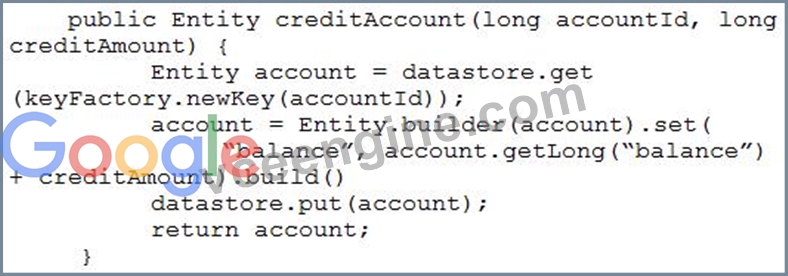
- A. Get the entity with an ancestor query.
- B. Get and put the entity in a transaction.
- C. Use a strongly consistent transactional database.
- D. Don't return the account entity from the function.
Answer: A
NEW QUESTION # 85
You recently deployed a Go application on Google Kubernetes Engine (GKE). The operations team has noticed that the application's CPU usage is high even when there is low production traffic. The operations team has asked you to optimize your application's CPU resource consumption. You want to determine which Go functions consume the largest amount of CPU. What should you do?
- A. Modify your Go application to capture profiling data. Analyze the CPU metrics of your application in flame graphs in Profiler.
- B. Deploy a Fluent Bit daemonset on the GKE cluster to log data in Cloud Logging. Analyze the logs to get insights into your application code's performance.
- C. Create a custom dashboard in Cloud Monitoring to evaluate the CPU performance metrics of your application.
- D. Connect to your GKE nodes using SSH. Run the top command on the shell to extract the CPU utilization of your application.
Answer: A
Explanation:
Explanation
https://cloud.google.com/profiler/docs/about-profiler
Cloud Profiler is a statistical, low-overhead profiler that continuously gathers CPU usage and memory-allocation information from your production applications. It attributes that information to the source code that generated it, helping you identify the parts of your application that are consuming the most resources, and otherwise illuminating your applications performance characteristics.
https://cloud.google.com/profiler/docs
NEW QUESTION # 86
You are developing a corporate tool on Compute Engine for the finance department, which needs to authenticate users and verify that they are in the finance department. All company employees use G Suite.
What should you do?
- A. Enable Cloud Identity-Aware Proxy on the HTTP(s) load balancer and restrict access to a Google Group containing users in the finance department. Verify the provided JSON Web Token within the application.
- B. Configure Cloud Armor Security Policies to restrict access to only corporate IP address ranges. Verify the provided JSON Web Token within the application.
- C. Enable Cloud Identity-Aware Proxy on the HTTP(s) load balancer and restrict access to a Google Group containing users in the finance department. Issue client-side certificates to everybody in the finance team and verify the certificates in the application.
- D. Configure Cloud Armor Security Policies to restrict access to only corporate IP address ranges. Issue client side certificates to everybody in the finance team and verify the certificates in the application.
Answer: B
NEW QUESTION # 87
You are planning to deploy hundreds of microservices in your Google Kubernetes Engine (GKE) cluster. How should you secure communication between the microservices on GKE using a managed service?
- A. Deploy open source Istio in your GKE cluster, and enable mTLS in your Service Mesh
- B. Use global HTTP(S) Load Balancing with managed SSL certificates to protect your services
- C. Install Anthos Service Mesh, and enable mTLS in your Service Mesh.
- D. Install cert-manager on GKE to automatically renew the SSL certificates.
Answer: C
Explanation:
Explanation
https://cloud.google.com/service-mesh/docs/overview#security_benefits
- Ensures encryption in transit. Using mTLS for authentication also ensures that all TCP communications are encrypted in transit.
NEW QUESTION # 88
You are using Cloud Build to build and test application source code stored in Cloud Source Repositories. The build process requires a build tool not available in the Cloud Build environment.
What should you do?
- A. Build a custom cloud builder image and reference the image in your build steps.
- B. Ask to have the binary added to the Cloud Build environment by filing a feature request against the Cloud Build public Issue Tracker.
- C. Download the binary from the internet during the build process.
- D. Include the binary in your Cloud Source Repositories repository and reference it in your build scripts.
Answer: A
NEW QUESTION # 89
You are working on a social media application. You plan to add a feature that allows users to upload images.
These images will be 2 MB - 1 GB in size. You want to minimize their infrastructure operations overhead for this feature. What should you do?
- A. Set up a web server on GCP to accept user images and create a file store to keep uploaded files. Change the application to retrieve images from the file store.
- B. Change the application to accept images directly and store them in the database that stores other user information.
- C. Create a separate bucket for each user in Cloud Storage. Assign a separate service account to allow write access on each bucket. Transfer service account credentials to the client application based on user information. The application uses this service account to upload images to Cloud Storage.
- D. Change the application to create signed URLs for Cloud Storage. Transfer these signed URLs to the client application to upload images to Cloud Storage.
Answer: D
Explanation:
Reference:
https://cloud.google.com/blog/products/storage-data-transfer/uploading-images-directly-to-cloud-storage-by-usin
NEW QUESTION # 90
You are developing an HTTP API hosted on a Compute Engine virtual machine instance that needs to be invoked by multiple clients within the same Virtual Private Cloud (VPC). You want clients to be able to get the IP address of the service.
What should you do?
- A. Reserve a static external IP address and assign it to an HTTP(S) load balancing service's forwarding rule.
Then, define an A record in Cloud DNS. Clients should use the name of the A record to connect to the service. - B. Ensure that clients use Compute Engine internal DNS by connecting to the instance name with the url https://[INSTANCE_NAME].[ZONE].c.[PROJECT_ID].internal/.
- C. Ensure that clients use Compute Engine internal DNS by connecting to the instance name with the url https://[API_NAME]/[API_VERSION]/.
- D. Reserve a static external IP address and assign it to an HTTP(S) load balancing service's forwarding rule.
Clients should use this IP address to connect to the service.
Answer: C
NEW QUESTION # 91
For this question, refer to the HipLocal case study.
HipLocal's application uses Cloud Client Libraries to interact with Google Cloud. HipLocal needs to configure authentication and authorization in the Cloud Client Libraries to implement least privileged access for the application. What should they do?
- A. Use the default compute service account to interact with Google Cloud.
- B. Create an API key. Use the API key to interact with Google Cloud.
- C. Create a service account for the application and for each Google Cloud API used by the application.
Export and deploy the private keys used by the application. Use the service account with one Google Cloud API to interact with Google Cloud. - D. Create a service account for the application. Export and deploy the private key for the application. Use the service account to interact with Google Cloud.
Answer: B
NEW QUESTION # 92
You want to migrate an on-premises container running in Knative to Google Cloud. You need to make sure that the migration doesn't affect your application's deployment strategy, and you want to use a fully managed service. Which Google Cloud service should you use to deploy your container?
- A. Compute Engine
- B. App Engine flexible environment
- C. Cloud Run
- D. Google Kubernetes Engine
Answer: C
Explanation:
Explanation
https://cloud.google.com/blog/products/serverless/knative-based-cloud-run-services-are-ga
NEW QUESTION # 93
You are load testing your server application. During the first 30 seconds, you observe that a previously inactive Cloud Storage bucket is now servicing 2000 write requests per second and 7500 read requests per second.
Your application is now receiving intermittent 5xx and 429 HTTP responses from the Cloud Storage JSON API as the demand escalates. You want to decrease the failed responses from the Cloud Storage API.
What should you do?
- A. Use the XML API instead of the JSON API for interfacing with Cloud Storage.
- B. Distribute the uploads across a large number of individual storage buckets.
- C. Limit the upload rate from your application clients so that the dormant bucket's peak request rate is reached more gradually.
- D. Pass the HTTP response codes back to clients that are invoking the uploads from your application.
Answer: B
Explanation:
Reference: https://cloud.google.com/storage/docs/request-rate
NEW QUESTION # 94
You have an analytics application that runs hundreds of queries on BigQuery every few minutes using BigQuery API. You want to find out how much time these queries take to execute. What should you do?
- A. Use Stackdriver Monitoring to plot query execution times.
- B. Use Stackdriver Monitoring to plot slot usage.
- C. Use Stackdriver Trace to plot API execution time.
- D. Use Stackdriver Trace to plot query execution time.
Answer: A
NEW QUESTION # 95
You have containerized a legacy application that stores its configuration on an NFS share. You need to deploy this application to Google Kubernetes Engine (GKE) and do not want the application serving traffic until after the configuration has been retrieved. What should you do?
- A. Use the COPY statement in the Dockerfile to load the configuration into the container image. Verify that the configuration is available, and start the service using an ENTRYPOINT script.
- B. Add a startup script to the GKE instance group to mount the NFS share at node startup. Copy the configuration files into the container, and start the service using an ENTRYPOINT script.
- C. Use the gsutil utility to copy files from within the Docker container at startup, and start the service using an ENTRYPOINT script.
- D. Create a PersistentVolumeClaim on the GKE cluster. Access the configuration files from the volume, and start the service using an ENTRYPOINT script.
Answer: B
Explanation:
Reference: https://cloud.google.com/compute/docs/instances/startup-scripts/linux
NEW QUESTION # 96
Case study
This is a case study. Case studies are not timed separately. You can use as much exam time as you would like to complete each case. However, there may be additional case studies and sections on this exam. You must manage your time to ensure that you are able to complete all questions included on this exam in the time provided.
To answer the questions included in a case study, you will need to reference information that is provided in the case study. Case studies might contain exhibits and other resources that provide more information about the scenario that is described in the case study. Each question is independent of the other questions in this case study.
At the end of this case study, a review screen will appear. This screen allows you to review your answers and to make changes before you move to the next section of the exam. After you begin a new section, you cannot return to this section.
To start the case study
To display the first question in this case study, click the Next button. Use the buttons in the left pane to explore the content of the case study before you answer the questions. Clicking these buttons displays information such as business requirements, existing environment, and problem statements. If the case study has an All Information tab, note that the information displayed is identical to the information displayed on the subsequent tabs. When you are ready to answer a question, click the Question button to return to the question.
Company Overview
HipLocal is a community application designed to facilitate communication between people in close proximity. It is used for event planning and organizing sporting events, and for businesses to connect with their local communities. HipLocal launched recently in a few neighborhoods in Dallas and is rapidly growing into a global phenomenon. Its unique style of hyper-local community communication and business outreach is in demand around the world.
Executive Statement
We are the number one local community app; it's time to take our local community services global. Our venture capital investors want to see rapid growth and the same great experience for new local and virtual communities that come online, whether their members are 10 or 10000 miles away from each other.
Solution Concept
HipLocal wants to expand their existing service, with updated functionality, in new regions to better serve their global customers. They want to hire and train a new team to support these regions in their time zones. They will need to ensure that the application scales smoothly and provides clear uptime data.
Existing Technical Environment
HipLocal's environment is a mix of on-premises hardware and infrastructure running in Google Cloud Platform.
The HipLocal team understands their application well, but has limited experience in global scale applications.
Their existing technical environment is as follows:
* Existing APIs run on Compute Engine virtual machine instances hosted in GCP.
* State is stored in a single instance MySQL database in GCP.
* Data is exported to an on-premises Teradata/Vertica data warehouse.
* Data analytics is performed in an on-premises Hadoop environment.
* The application has no logging.
* There are basic indicators of uptime; alerts are frequently fired when the APIs are unresponsive.
Business Requirements
HipLocal's investors want to expand their footprint and support the increase in demand they are seeing. Their requirements are:
* Expand availability of the application to new regions.
* Increase the number of concurrent users that can be supported.
* Ensure a consistent experience for users when they travel to different regions.
* Obtain user activity metrics to better understand how to monetize their product.
* Ensure compliance with regulations in the new regions (for example, GDPR).
* Reduce infrastructure management time and cost.
* Adopt the Google-recommended practices for cloud computing.
Technical Requirements
* The application and backend must provide usage metrics and monitoring.
* APIs require strong authentication and authorization.
* Logging must be increased, and data should be stored in a cloud analytics platform.
* Move to serverless architecture to facilitate elastic scaling.
* Provide authorized access to internal apps in a secure manner.
HipLocal's APIs are showing occasional failures, but they cannot find a pattern. They want to collect some metrics to help them troubleshoot.
What should they do?
- A. Use Stackdriver Trace to look for performance bottlenecks.
- B. Take frequent snapshots of all of the VMs.
- C. Install the Stackdriver Monitoring agent on the VMs.
- D. Install the Stackdriver Logging agent on the VMs.
Answer: C
NEW QUESTION # 97
You are planning to deploy your application in a Google Kubernetes Engine (GKE) cluster. Your application can scale horizontally, and each instance of your application needs to have a stable network identity and its own persistent disk.
Which GKE object should you use?
- A. StatefulSet
- B. ReplicaSet
- C. Deployment
- D. ReplicaController
Answer: A
Explanation:
Explanation/Reference: https://livebook.manning.com/book/kubernetes-in-action/chapter-10/46
NEW QUESTION # 98
You are developing a web application that will be accessible over both HTTP and HTTPS and will run on Compute Engine instances. On occasion, you will need to SSH from your remote laptop into one of the Compute Engine instances to conduct maintenance on the app. How should you configure the instances while following Google-recommended best practices?
- A. Set up a backend with Compute Engine web server instances with a private IP address behind an HTTP(S) load balancer. Set up a bastion host with a public IP address and open firewall ports. Connect to the web instances using the bastion host.
- B. Configure Cloud Identity-Aware Proxy API for SSH access. Then configure the Compute Engine servers with private IP addresses behind an HTTP(s) load balancer for the application web traffic.
- C. Configure the firewall rules to allow all ingress traffic to connect to the Compute Engine web servers, with each server having a unique external IP address.
- D. Set up a backend with Compute Engine web server instances with a private IP address behind a TCP proxy load balancer.
Answer: B
Explanation:
Reference: https://cloud.google.com/compute/docs/instances/connecting-advanced#cloud_iap
https://cloud.google.com/solutions/connecting-securely#storing_host_keys_by_enabling_guest_attributes
NEW QUESTION # 99
You have a container deployed on Google Kubernetes Engine. The container can sometimes be slow to launch, so you have implemented a liveness probe. You notice that the liveness probe occasionally fails on launch. What should you do?
- A. Increase the CPU limit for the container.
- B. Add a startup probe.
- C. Add a readiness probe.
- D. Increase the initial delay for the liveness probe.
Answer: D
Explanation:
Explanation
https://kubernetes.io/docs/tasks/configure-pod-container/configure-liveness-readiness-startup-probes/#configure-
NEW QUESTION # 100
You support an application that uses the Cloud Storage API. You review the logs and discover multiple HTTP
503 Service Unavailable error responses from the API. Your application logs the error and does not take any further action. You want to implement Google-recommended retry logic to improve success rates. Which approach should you take?
- A. Retry each failure at a set time interval up to a maximum number of times.
- B. Retry the failures in batch after a set number of failures is logged.
- C. Retry each failure at decreasing time intervals up to a maximum number of tries.
- D. Retry each failure at increasing time intervals up to a maximum number of tries.
Answer: D
Explanation:
Explanation
https://cloud.google.com/storage/docs/retry-strategy
NEW QUESTION # 101
Your company wants to expand their users outside the United States for their popular application. The company wants to ensure 99.999% availability of the database for their application and also wants to minimize the read latency for their users across the globe.
Which two actions should they take? (Choose two.)
- A. Create a minimum of two Cloud Spanner instances in separate regions with at least one node.
- B. Create a cluster with at least 1 Spanner node.
- C. Create a multi-regional Cloud Spanner instance with "nam3" configuration.
- D. Create a Cloud Dataflow pipeline to replicate data across different databases.
- E. Create a cluster with at least 3 Spanner nodes.
- F. Create a multi-regional Cloud Spanner instance with "nam-asia-eur1" configuration.
Answer: C,D
NEW QUESTION # 102
You are developing an application that will handle requests from end users. You need to secure a Cloud Function called by the application to allow authorized end users to authenticate to the function via the application while restricting access to unauthorized users. You will integrate Google Sign-In as part of the solution and want to follow Google-recommended best practices. What should you do?
- A. Deploy from your local machine using gcloud and grant users the roles/cloudfunctions.admin role
- B. Deploy from a source code repository and grant users the roles/cloudfunctions.viewer role.
- C. Deploy from your local machine using gcloud and grant users the roles/cloudfunctions.developer role
- D. Deploy from a source code repository and grant users the roles/cloudfunctions.invoker role
Answer: A
NEW QUESTION # 103
You have deployed an HTTP(s) Load Balancer with the gcloud commands shown below.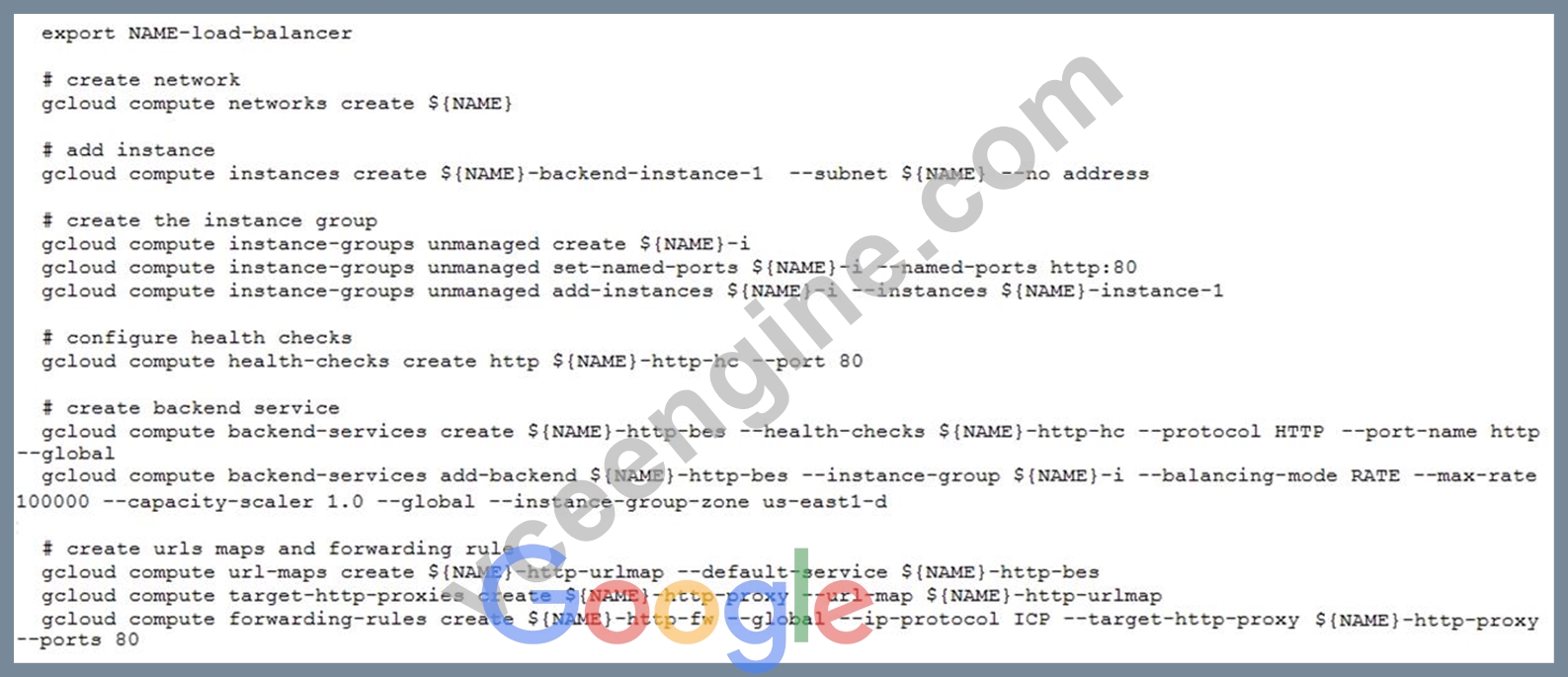
Health checks to port 80 on the Compute Engine virtual machine instance are failing and no traffic is sent to your instances. You want to resolve the problem.
Which commands should you run?
- A. gcloud compute instances add-access-config ${NAME}-backend-instance-1
- B. gcloud compute instances add-tags ${NAME}-backend-instance-1 --tags http-server
- C. gcloud compute firewall-rules create allow-lb --network load-balancer --allow tcp --source-ranges 130.211.0.0/22,35.191.0.0/16 --direction INGRESS
- D. gcloud compute firewall-rules create allow-lb --network load-balancer --allow tcp --destination-ranges 130.211.0.0/22,35.191.0.0/16 --direction EGRESS
Answer: C
Explanation:
Reference:
https://cloud.google.com/vpc/docs/special-configurations
NEW QUESTION # 104
You are developing an application that will allow users to read and post comments on news articles. You want to configure your application to store and display user-submitted comments using Firestore. How should you design the schema to support an unknown number of comments and articles?
- A. Add each comment to an array property on the article.
- B. Store each comment in a document, and add the comment's key to an array property on the user profile.
- C. Store each comment in a subcollection of the article.
- D. Store each comment in a document, and add the comment's key to an array property on the article.
Answer: B
NEW QUESTION # 105
Your company has created an application that uploads a report to a Cloud Storage bucket. When the report is uploaded to the bucket, you want to publish a message to a Cloud Pub/Sub topic. You want to implement a solution that will take a small amount to effort to implement. What should you do?
- A. Create an application deployed in a Google Kubernetes Engine cluster to receive the file; when it is received, publish a message to the Cloud Pub/Sub topic.
- B. Create an App Engine application to receive the file; when it is received, publish a message to the Cloud Pub/Sub topic.
- C. Create a Cloud Function that is triggered by the Cloud Storage bucket. In the Cloud Function, publish a message to the Cloud Pub/Sub topic.
- D. Configure the Cloud Storage bucket to trigger Cloud Pub/Sub notifications when objects are modified.
Answer: C
Explanation:
Explanation
https://cloud.google.com/storage/docs/pubsub-notifications
NEW QUESTION # 106
You plan to make a simple HTML application available on the internet. This site keeps information about FAQs for your application. The application is static and contains images, HTML, CSS, and Javascript. You want to make this application available on the internet with as few steps as possible.
What should you do?
- A. Containerize your application first. Deploy this container to Google Kubernetes Engine (GKE) and assign an external IP address to the GKE pod hosting the application.
- B. Upload your application to Cloud Storage.
- C. Upload your application to an App Engine environment.
- D. Create a Compute Engine instance with Apache web server installed. Configure Apache web server to host the application.
Answer: B
Explanation:
Reference:
https://cloud.google.com/storage/docs/hosting-static-website
NEW QUESTION # 107
......
Professional-Cloud-Developer Exam Info and Free Practice Test Professional Quiz Study Materials: https://www.vceengine.com/Professional-Cloud-Developer-vce-test-engine.html
Accurate Hot Selling Professional-Cloud-Developer Exam Dumps 2023 Newly Released: https://drive.google.com/open?id=18WggrGIf6KJ3gBAprfoj77lDoTnBHJdX
