

[2026] Pass Appian ACD301 Exam Updated 47 Questions
Get 2026 Updated Free Appian ACD301 Exam Questions and Answer
NEW QUESTION # 13
You are reviewing log files that can be accessed in Appian to monitor and troubleshoot platform-based issues.
For each type of log file, match the corresponding Information that it provides. Each description will either be used once, or not at all.
Note: To change your responses, you may deselect your response by clicking the blank space at the top of the selection list.
Answer:
Explanation:
Explanation:
* design_errors.csv # Errors in start forms, task forms, record lists, enabled environments
* devops_infrastructure.csv # Metrics such as the total time spent evaluating a plug-in function
* login-audit.csv # Inbound requests using HTTP basic authentication
Comprehensive and Detailed In-Depth Explanation:Appian provides various log files to monitor and troubleshoot platform issues, accessible through the Administration Console or exported as CSV files. These logs capture different aspects of system performance, security, and user interactions. The Appian Monitoring and Troubleshooting Guide details the purpose of each log file, enabling accurate matching.
* design_errors.csv # Errors in start forms, task forms, record lists, enabled environments:The design_errors.csv log file is specifically designed to track errors related to the design and runtime behavior of Appian objects such as start forms, task forms, and record lists. It alsoincludes information about issues in enabled environments, making it the appropriate match. This log helps developers identify and resolve UI or configuration errors, aligning with its purpose of capturing design-time and runtime issues.
* devops_infrastructure.csv # Metrics such as the total time spent evaluating a plug-in function:The devops_infrastructure.csv log file provides infrastructure and performance metrics for Appian Cloud instances. It includes data on system performance, such as the time spent evaluating plug-in functions, which is critical for optimizing custom integrations. This matches the description, as it focuses on operational metrics rather than errors or security events, consistent with Appian's infrastructure monitoring approach.
* login-audit.csv # Inbound requests using HTTP basic authentication:The login-audit.csv log file tracks user authentication and login activities, including details about inbound requests using HTTP basic authentication. This log is used to monitor security events, such as successful and failed login attempts, making it the best fit for this description. Appian's security logging emphasizes audit trails for authentication, aligning with this use case.
Unused Description:
* Number of enabled environments:This description is not matched to any log file. While it could theoretically relate to system configuration logs, none of the listed files (design_errors.csv, devops_infrastructure.csv, login-audit.csv) are specifically designed to report the number of enabled environments. This might be tracked in a separate administrative report or configuration log not listed here.
Matching Rationale:
* Each description is either used once or not at all, as specified. The matches are based on Appian's documented log file purposes: design_errors.csv for design-related errors, devops_infrastructure.csv for performance metrics, and login-audit.csv for authentication details.
* The unused description suggests the question allows for some descriptions to remain unmatched, reflecting real-world variability in log file content.
References:Appian Documentation - Monitoring and Troubleshooting Guide, Appian Administration Console - Log File Reference, Appian Lead Developer Training - Platform Diagnostics.
NEW QUESTION # 14
You are in a backlog refinement meeting with the development team and the product owner. You review a story for an integration involving a third-party system. A payload will be sent from the Appian system through the integration to the third-party system. The story is 21 points on a Fibonacci scale and requires development from your Appian team as well as technical resources from the third-party system. This item is crucial to your project's success. What are the two recommended steps to ensure this story can be developed effectively?
- A. Break down the item into smaller stories.
- B. Maintain a communication schedule with the third-party resources.
- C. Acquire testing steps from QA resources.
- D. Identify subject matter experts (SMEs) to perform user acceptance testing (UAT).
Answer: A,B
Explanation:
Comprehensive and Detailed In-Depth Explanation:
This question involves a complex integration story rated at 21 points on the Fibonacci scale, indicating significant complexity and effort. Appian Lead Developer best practices emphasize effective collaboration, risk mitigation, and manageable development scopes for such scenarios. The two most critical steps are:
Option C (Maintain a communication schedule with the third-party resources):
Integrations with third-party systems require close coordination, as Appian developers depend on external teams for endpoint specifications, payload formats, authentication details, and testing support. Establishing a regular communication schedule ensures alignment on requirements, timelines, and issue resolution. Appian's Integration Best Practices documentation highlights the importance of proactive communication with external stakeholders to prevent delays and misunderstandings, especially for critical project components.
Option D (Break down the item into smaller stories):
A 21-point story is considered large by Agile standards (Fibonacci scale typically flags anything above 13 as complex). Appian's Agile Development Guide recommends decomposing large stories into smaller, independently deliverable pieces to reduce risk, improve testability, and enable iterative progress. For example, the integration could be split into tasks like designing the payload structure, building the integration object, and testing the connection-each manageable within a sprint. This approach aligns with the principle of delivering value incrementally while maintaining quality.
Option A (Acquire testing steps from QA resources): While QA involvement is valuable, this step is more relevant during the testing phase rather than backlog refinement or development preparation. It's not a primary step for ensuring effective development of the story.
Option B (Identify SMEs for UAT): User acceptance testing occurs after development, during the validation phase. Identifying SMEs is important but not a key step in ensuring the story is developed effectively during the refinement and coding stages.
By choosing C and D, you address both the external dependency (third-party coordination) and internal complexity (story size), ensuring a smoother development process for this critical integration.
NEW QUESTION # 15
You need to connect Appian with LinkedIn to retrieve personal information about the users in your application. This information is considered private, and users should allow Appian to retrieve their information. Which authentication method would you recommend to fulfill this request?
- A. API Key Authentication
- B. Basic Authentication with user's login information
- C. Basic Authentication with dedicated account's login information
- D. OAuth 2.0: Authorization Code Grant
Answer: D
Explanation:
Comprehensive and Detailed In-Depth Explanation:As an Appian Lead Developer, integrating with an external system like LinkedIn to retrieve private user information requires a secure, user-consented authentication method that aligns with Appian's capabilities and industry standards. The requirement specifies that users must explicitly allow Appian to access their private data, which rules out methods that don't involve user authorization. Let's evaluate each option based on Appian's official documentation and LinkedIn's API requirements:
* A. API Key Authentication:API Key Authentication involves using a single static key to authenticate requests. While Appian supports this method via Connected Systems (e.g., HTTP Connected System with an API key header), it's unsuitable here. API keys authenticate the application, not the user, and don't provide a mechanism for individual user consent. LinkedIn's API for private data (e.g., profile information) requires per-user authorization, which API keys cannot facilitate. Appian documentation notes that API keys are best for server-to-server communication without user context, making this option inadequate for the requirement.
* B. Basic Authentication with user's login information:This method uses a username and password (typically base64-encoded) provided by each user. In Appian, Basic Authentication is supported in Connected Systems, but applying it here would require users to input their LinkedIn credentials directly into Appian. This is insecure, impractical, and against LinkedIn's security policies, as it exposes user passwords to the application. Appian Lead Developer best practices discourage storing or handling user credentials directly due to security risks (e.g., credential leakage) and maintenance challenges.
Moreover, LinkedIn's API doesn't support Basic Authentication for user-specific data access-it requires OAuth 2.0. This option is not viable.
* C. Basic Authentication with dedicated account's login information:This involves using a single, dedicated LinkedIn account's credentials to authenticate all requests. While technically feasible in Appian's Connected System (using Basic Authentication), it fails to meet the requirement that "users should allow Appian to retrieve their information." A dedicated account would access data on behalf of all users without their individual consent, violating privacy principles and LinkedIn's API terms.
LinkedIn restricts such approaches, requiring user-specific authorization for private data. Appian documentation advises against blanket credentials for user-specific integrations, making this option inappropriate.
* D. OAuth 2.0: Authorization Code Grant:This is the recommended choice. OAuth 2.0 Authorization Code Grant, supported natively in Appian's Connected System framework, is designed for scenarios where users must authorize an application (Appian) to access their private data on a third-party service (LinkedIn). In this flow, Appian redirects users to LinkedIn's authorization page, where they grant permission. Upon approval, LinkedIn returns an authorization code, which Appian exchanges for an access token via the Token Request Endpoint. This token enables Appian to retrieve private user data (e.
g., profile details) securely and per user. Appian's documentation explicitly recommends this method for integrations requiring user consent, such as LinkedIn, and provides tools like a!authorizationLink() to handle authorization failures gracefully. LinkedIn's API (e.g., v2 API) mandates OAuth 2.0 for personal data access, aligning perfectly with this approach.
Conclusion: OAuth 2.0: Authorization Code Grant (D) is the best method. It ensures user consent, complies with LinkedIn's API requirements, and leverages Appian's secure integration capabilities. In practice, you'd configure a Connected System in Appian with LinkedIn's Client ID, Client Secret, Authorization Endpoint (e.
g., https://www.linkedin.com/oauth/v2/authorization), and Token Request Endpoint (e.g., https://www.
linkedin.com/oauth/v2/accessToken), then use an Integration object to call LinkedIn APIs with the access token. This solution is scalable, secure, and aligns with Appian Lead Developer certification standards for third-party integrations.
References:
* Appian Documentation: "Setting Up a Connected System with the OAuth 2.0 Authorization Code Grant" (Connected Systems).
* Appian Lead Developer Certification: Integration Module (OAuth 2.0 Configuration and Best Practices).
* LinkedIn Developer Documentation: "OAuth 2.0 Authorization Code Flow" (API Authentication Requirements).
NEW QUESTION # 16
Your Agile Scrum project requires you to manage two teams, with three developers per team. Both teams are to work on the same application in parallel. How should the work be divided between the teams, avoiding issues caused by cross-dependency?
- A. Allocate stories to each team based on the cumulative years of experience of the team members.
- B. Have each team choose the stories they would like to work on based on personal preference.
- C. Group epics and stories by feature, and allocate work between each team by feature.
- D. Group epics and stories by technical difficulty, and allocate one team the more challenging stories.
Answer: C
Explanation:
Comprehensive and Detailed In-Depth Explanation:In an Agile Scrum environment with two teams working on the same application in parallel, effective work division is critical to avoid cross-dependency, which can lead to delays, conflicts, and inefficiencies. Appian's Agile Development Best Practices emphasize team autonomy and minimizing dependencies to ensure smooth progress.
* Option B (Group epics and stories by feature, and allocate work between each team by feature):
This is the recommended approach. By dividing the application's functionality into distinct features (e.
g., Team 1 handles customer management, Team 2 handles campaign tracking), each team can work independently on a specific domain. This reduces cross-dependency because teams are not reliant on each other's deliverables within a sprint. Appian's guidance on multi-team projects suggests feature- based partitioning as a best practice, allowing teams to own their backlog items, design, and testing without frequent coordination. For example, Team 1 can develop and test customer-related interfaces while Team 2 works on campaign processes, merging their work during integration phases.
* Option A (Group epics and stories by technical difficulty, and allocate one team the more challenging stories):This creates an imbalance, potentially overloading one team and underutilizing the other, which can lead to morale issues and uneven progress. It also doesn't address cross-dependency, as challenging stories might still require input from both teams (e.g., shared data models), increasing coordination needs.
* Option C (Allocate stories to each team based on the cumulative years of experience of the team members):Experience-based allocation ignores the project's functional structure and can result in mismatched skills for specific features. It also risks dependencies if experienced team members are needed across teams, complicating parallel work.
* Option D (Have each team choose the stories they would like to work on based on personal preference):This lacks structure and could lead to overlap, duplication, or neglect of critical features. It increases the risk of cross-dependency as teams might select interdependent stories without coordination, undermining parallel development.
Feature-based division aligns with Scrum principles of self-organization and minimizes dependencies, making it the most effective strategy for this scenario.
References:Appian Documentation - Agile Development with Appian, Scrum Guide - Multi-Team Coordination, Appian Lead Developer Training - Team Management Strategies.
NEW QUESTION # 17
You have created a Web API in Appian with the following URL to call it: https://exampleappiancloud.com/suite/webapi/user_management/users?username=john.smith. Which is the correct syntax for referring to the username parameter?
- A. httpRequest.queryParameters.users.username
- B. httpRequest.users.username
- C. httpRequest.queryParameters.username
- D. httpRequest.formData.username
Answer: C
Explanation:
Comprehensive and Detailed In-Depth Explanation:
In Appian, when creating a Web API, parameters passed in the URL (e.g., query parameters) are accessed within the Web API expression using the httpRequest object. The URL https://exampleappiancloud.com/suite/webapi/user_management/users?username=john.smith includes a query parameter username with the value john.smith. Appian's Web API documentation specifies how to handle such parameters in the expression rule associated with the Web API.
Option D (httpRequest.queryParameters.username):
This is the correct syntax. The httpRequest.queryParameters object contains all query parameters from the URL. Since username is a single query parameter, you access it directly as httpRequest.queryParameters.username. This returns the value john.smith as a text string, which can then be used in the Web API logic (e.g., to query a user record). Appian's expression language treats query parameters as key-value pairs under queryParameters, making this the standard approach.
Option A (httpRequest.queryParameters.users.username):
This is incorrect. The users part suggests a nested structure (e.g., users as a parameter containing a username subfield), which does not match the URL. The URL only defines username as a top-level query parameter, not a nested object.
Option B (httpRequest.users.username):
This is invalid. The httpRequest object does not have a direct users property. Query parameters are accessed via queryParameters, and there's no indication of a users object in the URL or Appian's Web API model.
Option C (httpRequest.formData.username):
This is incorrect. The httpRequest.formData object is used for parameters passed in the body of a POST or PUT request (e.g., form submissions), not for query parameters in a GET request URL. Since the username is part of the query string (?username=john.smith), formData does not apply.
The correct syntax leverages Appian's standard handling of query parameters, ensuring the Web API can process the username value effectively.
NEW QUESTION # 18
You are reviewing the Engine Performance Logs in Production for a single application that has been live for six months. This application experiences concurrent user activity and has a fairly sustained load during business hours. The client has reported performance issues with the application during business hours.
During your investigation, you notice a high Work Queue - Java Work Queue Size value in the logs. You also notice unattended process activities, including timer events and sending notification emails, are taking far longer to execute than normal.
The client increased the number of CPU cores prior to the application going live.
What is the next recommendation?
- A. Add more application servers.
- B. Optimize slow-performing user interfaces.
- C. Add more engine replicas.
- D. Add execution and analytics shards
Answer: C
Explanation:
As an Appian Lead Developer, analyzing Engine Performance Logs to address performance issues in a Production application requires understanding Appian's architecture and the specific metrics described. The scenario indicates a high "Work Queue - Java Work Queue Size," which reflects a backlog of tasks in the Java Work Queue (managed by Appian engines), and delays in unattended process activities (e.g., timer events, email notifications). These symptoms suggest the Appian engines are overloaded, despite the client increasing CPU cores. Let's evaluate each option:
* A. Add more engine replicas:This is the correct recommendation. In Appian, engine replicas (part of the Appian Engine cluster) handle process execution, including unattended tasks like timers and notifications. A high Java Work Queue Size indicates the engines are overwhelmed by concurrent activity during business hours, causing delays. Adding more engine replicas distributes the workload, reducing queue size and improving performance for both user-driven and unattended tasks. Appian's documentation recommends scaling engine replicas to handle sustained loads, especially in Production with high concurrency. SinceCPU cores were already increased (likely on application servers), the bottleneck is likely the engine capacity, not the servers.
* B. Optimize slow-performing user interfaces:While optimizing user interfaces (e.g., SAIL forms, reports) can improve user experience, the scenario highlights delays in unattended activities (timers, emails), not UI performance. The Java Work Queue Size issue points to engine-level processing, not UI rendering, so this doesn't address the root cause. Appian's performance tuning guidelines prioritize engine scaling for queue-related issues, making this a secondary concern.
* C. Add more application servers:Application servers handle web traffic (e.g., SAIL interfaces, API calls), not process execution or unattended tasks managed by engines. Increasing application servers would help with UI concurrency but wouldn't reduce the Java Work Queue Size or speed up timer
/email processing, as these are engine responsibilities. Since the client already increased CPU cores (likely on application servers), this is redundant and unrelated to the issue.
* D. Add execution and analytics shards:Execution shards (for process data) and analytics shards (for reporting) are part of Appian's data fabric for scalability, but they don't directly address engine workload or Java Work Queue Size. Shards optimize data storage and query performance, not real-time process execution. The logs indicate an engine bottleneck, not a data storage issue, so this isn't relevant.
Appian's documentation confirms shards are for long-term scaling, not immediate performance fixes.
Conclusion: Adding more engine replicas (A) is the next recommendation. It directly resolves the high Java Work Queue Size and delays in unattended tasks, aligning with Appian's architecture for handling concurrent loads in Production. This requires collaboration with system administrators to configure additional replicas in the Appian cluster.
References:
* Appian Documentation: "Engine Performance Monitoring" (Java Work Queue and Scaling Replicas).
* Appian Lead Developer Certification: Performance Optimization Module (Engine Scaling Strategies).
* Appian Best Practices: "Managing Production Performance" (Work Queue Analysis).
NEW QUESTION # 19
Your Appian project just went live with the following environment setup: DEV > TEST (SIT/UAT) > PROD.
Your client is considering adding a support team to manage production defects and minor enhancements, while the original development team focuses on Phase 2. Your client is asking you for a new environment strategy that will have the least impact on Phase 2 development work. Which optioninvolves the lowest additional server cost and the least code retrofit effort?
- A. Phase 2 development work stream: DEV > TEST (SIT) > STAGE (UAT) > PROD Production support work stream: DEV > TEST2 (SIT/UAT) > PROD
- B. Phase 2 development work stream: DEV > TEST (SIT) > STAGE (UAT) > PROD Production support work stream: DEV2 > STAGE (SIT/UAT) > PROD
- C. Phase 2 development work stream: DEV > TEST (SIT/UAT) > PROD Production support work stream: DEV2 > TEST (SIT/UAT) > PROD
- D. Phase 2 development work stream: DEV > TEST (SIT/UAT) > PROD Production support work stream: DEV > TEST2 (SIT/UAT) > PROD
Answer: D
Explanation:
Comprehensive and Detailed In-Depth Explanation:The goal is to design an environment strategy that minimizes additional server costs and code retrofit effort while allowing the support team to manage production defects and minor enhancements without disrupting the Phase 2 development team. The current setup (DEV > TEST (SIT/UAT) > PROD) uses a single development and testing pipeline, and the client wants to segregate support activities from Phase 2 development. Appian's Environment Management Best Practices emphasize scalability, cost efficiency, and minimal refactoring when adjusting environments.
* Option C (Phase 2 development work stream: DEV > TEST (SIT/UAT) > PROD; Production support work stream: DEV > TEST2 (SIT/UAT) > PROD):This option is the most cost-effective and requires the least code retrofit effort. It leverages the existing DEV environment for both teams but introduces a separate TEST2 environment for the support team's SIT/UAT activities. Since DEV is already shared, no new development server is needed, minimizing server costs. The existing code in DEV and TEST can be reused for TEST2 by exporting and importing packages, with minimal adjustments (e.g., updating environment-specific configurations). The Phase 2 team continues using the original TEST environment, avoiding disruption. Appian supports multiple test environments branching from a single DEV, and the PROD environment remains shared, aligning with the client's goal of low impact on Phase 2. The support team can handle defects and enhancements in TEST2 without interfering with development workflows.
* Option A (Phase 2 development work stream: DEV > TEST (SIT) > STAGE (UAT) > PROD; Production support work stream: DEV > TEST2 (SIT/UAT) > PROD):This introduces a STAGE environment for UAT in the Phase 2 stream, adding complexity and potentially requiring code updates to accommodate the new environment (e.g., adjusting deployment scripts). It also requires a new TEST2 server, increasing costs compared to Option C, where TEST2 reuses existing infrastructure.
* Option B (Phase 2 development work stream: DEV > TEST (SIT) > STAGE (UAT) > PROD; Production support work stream: DEV2 > STAGE (SIT/UAT) > PROD):This option adds both a DEV2 server for the support team and a STAGE environment, significantly increasing server costs. It also requires refactoring code to support two development environments (DEV and DEV2), including duplicating or synchronizing objects, which is more effort than reusing a single DEV.
* Option D (Phase 2 development work stream: DEV > TEST (SIT/UAT) > PROD; Production support work stream: DEV2 > TEST (SIT/UAT) > PROD):This introduces a DEV2 server for the support team, adding server costs. Sharing the TEST environment between teams could lead to conflicts (e.g., overwriting test data), potentially disrupting Phase 2 development. Code retrofit effort is higher due to managing two DEV environments and ensuring TEST compatibility.
Cost and Retrofit Analysis:
* Server Cost:Option C avoids new DEV or STAGE servers, using only an additional TEST2, which can often be provisioned on existing hardware or cloud resources with minimal cost. Options A, B, and D require additional servers (TEST2, DEV2, or STAGE), increasing expenses.
* Code Retrofit:Option C minimizes changes by reusing DEV and PROD, with TEST2 as a simple extension. Options A and B require updates for STAGE, and B and D involve managing multiple DEV environments, necessitating more significant refactoring.
Appian's recommendation for environment strategies in such scenarios is to maximize reuse of existing infrastructure and avoid unnecessary environment proliferation, making Option C the optimal choice.
References:Appian Documentation - Environment Management and Deployment, Appian Lead Developer Training - Environment Strategy and Cost Optimization.
NEW QUESTION # 20
You are on a protect with an application that has been deployed to Production and is live with users. The client wishes to increase the number of active users.
You need to conduct load testing to ensure Production can handle the increased usage Review the specs for four environments in the following image.
Which environment should you use for load testing7
- A. acmedev
- B. acmeuat
- C. acmetest
- D. acme
Answer: B
Explanation:
The image provides the specifications for four environments in the Appian Cloud:
* acmedev.appiancloud.com (acmedev): Non-production, Disk: 30 GB, Memory: 16 GB, vCPUs: 2
* acmetest.appiancloud.com (acmetest): Non-production, Disk: 75 GB, Memory: 32 GB, vCPUs: 4
* acmeuat.appiancloud.com (acmeuat): Non-production, Disk: 75 GB, Memory: 64 GB, vCPUs: 8
* acme.appiancloud.com (acme): Production, Disk: 75 GB, Memory: 32 GB, vCPUs: 4 Load testing assesses an application's performance under increased user load to ensure scalability and stability. Appian's Performance Testing Guidelines emphasize using an environment that mirrors Production as closely as possible to obtain accurate results, while avoiding direct impact on live systems.
* Option A (acmeuat):This is the best choice. The UAT (User Acceptance Testing) environment (acmeuat) has the highest resources (64 GB memory, 8 vCPUs) among the non-production environments, closely aligning with Production's capabilities (32 GB memory, 4 vCPUs) but with greater capacity to handle simulated loads. UAT environments are designed to validate the application with real-world usage scenarios, making them ideal for load testing. The higher resources also allow testing beyond current Production limits to predict future scalability, meeting the client's goal of increasing active users without risking live data.
* Option B (acmedev):The development environment (acmedev) has the lowest resources (16 GB memory, 2 vCPUs), which is insufficient for load testing. It's optimized for development, not performance simulation, and results would not reflect Production behavior accurately.
* Option C (acme):The Production environment (acme) is live with users, and load testing here would disrupt service, violate Appian's Production Safety Guidelines, and risk data integrity. It should never be used for testing.
* Option D (acmetest):The test environment (acmetest) has moderate resources (32 GB memory, 4 vCPUs), matching Production's memory and vCPUs. However, it's typically used for SIT (System Integration Testing) and has less capacity than acmeuat. While viable, it's less ideal than acmeuat for simulating higher user loads due to its resource constraints.
Appian recommends using a UAT environment for load testing when it closely mirrors Production and can handle simulated traffic, making acmeuat the optimal choice given its superior resources and non-production status.
References:Appian Documentation - Performance Testing Guidelines, Appian Cloud Environment Management, Appian Lead Developer Training - Load Testing Strategies.
NEW QUESTION # 21
You need to export data using an out-of-the-box Appian smart service. Which two formats are available (or data generation?
- A. CSV
- B. XML
- C. Excel
- D. JSDN
Answer: A,C
Explanation:
The two formats that are available for data generation using an out-of-the-box Appian smart service are:
* A. CSV. This is a comma-separated values format that can be used to export data in a tabular form, such as records, reports, or grids. CSV files can be easily opened and manipulated by spreadsheet applications such as Excel or Google Sheets.
* C. Excel. This is a format that can be used to export data in a spreadsheet form, with multiple worksheets, formatting, formulas, charts, and other features. Excel files can be opened by Excel or other compatible applications.
The other options are incorrect for the following reasons:
* B. XML. This is a format that can be used to export data in a hierarchical form, using tags and attributes to define the structure and content of the data. XML files can be opened by text editors or XML parsers, but they are not supported by the out-of-the-box Appian smart service for data generation.
* D. JSON. This is a format that can be used to export data in a structured form, using objects and arrays to represent the data. JSON files can be opened by text editors or JSON parsers, but they are not supported by the out-of-the-box Appian smart service for data generation. Verified References: Appian Documentation, section "Write to Data Store Entity" and "Write to Multiple Data Store Entities".
NEW QUESTION # 22
Your application contains a process model that is scheduled to run daily at a certain time, which kicks off a user input task to a specified user on the 1st time zone for morning data collection. The time zone is set to the (default) pm!timezone. In this situation, what does the pm!timezone reflect?
- A. The time zone of the user who is completing the input task.
- B. The time zone of the user who most recently published the process model.
- C. The time zone of the server where Appian is installed.
- D. The default time zone for the environment as specified in the Administration Console.
Answer: D
Explanation:
Comprehensive and Detailed In-Depth Explanation:In Appian, the pm!timezone variable is a process variable automatically available in process models, reflecting the time zone context for scheduled or time- based operations. Understanding its behavior is critical for scheduling tasks accurately, especially in scenarios like this where a process runs daily and assigns a user input task.
* Option C (The default time zone for the environment as specified in the Administration Console):
This is the correct answer. Per Appian's Process Model documentation, when a process model uses pm!
timezone and no custom time zone is explicitly set, it defaults to the environment's time zone configured in the Administration Console (under System > Time Zone settings). For scheduled processes, such as one running "daily at a certain time," Appian uses this default time zone to determine when the process triggers. In this case, the task assignment occurs based on the schedule, and pm!
timezone reflects the environment's setting, not the user's location.
* Option A (The time zone of the server where Appian is installed):This is incorrect. While the server' s time zone might influence underlying system operations, Appian abstracts this through the Administration Console's time zone setting. The pm!timezone variable aligns with the configured environment time zone, not the raw server setting.
* Option B (The time zone of the user who most recently published the process model):This is irrelevant. Publishing a process model does not tie pm!timezone to the publisher's time zone. Appian's scheduling is system-driven, not user-driven in this context.
* Option D (The time zone of the user who is completing the input task):This is also incorrect. While Appian can adjust task display times in the user interface to the assigned user's time zone (based on their profile settings), the pm!timezone in the process model reflects the environment's default time zone for scheduling purposes, not the assignee's.
For example, if the Administration Console is set to EST (Eastern Standard Time), the process will trigger daily at the specified time in EST, regardless of the assigned user's location. The "1st time zone" phrasing in the question appears to be a typo or miscommunication, but it doesn't change the fact that pm!timezone defaults to the environment setting.
References:Appian Documentation - Process Variables (pm!timezone), Appian Lead Developer Training - Process Scheduling and Time Zone Management, Administration Console Guide - System Settings.
NEW QUESTION # 23
What are two advantages of having High Availability (HA) for Appian Cloud applications?
- A. An Appian Cloud HA instance is composed of multiple active nodes running in different availability zones in different regions.
- B. A typical Appian Cloud HA instance is composed of two active nodes.
- C. In the event of a system failure, your Appian instance will be restored and available to your users in less than 15 minutes, having lost no more than the last 1 minute worth of data.
- D. In the event of a system failure, your Appian instance will be restored and available to your users in less than 15 minutes, having lost no more than the last 1 minute worth of data. This is an advantage of having HA, as it guarantees a high level of service availability and reliability for your Appian instance. If one of the nodes fails or becomes unavailable, the other node will take over and continue to serve requests without any noticeable downtime or data loss for your users.
- E. Data and transactions are continuously replicated across the active nodes to achieve redundancy and avoid single points of failure.
Answer: C,E
Explanation:
The other options are incorrect for the following reasons:
A : An Appian Cloud HA instance is composed of multiple active nodes running in different availability zones in different regions. This is not an advantage of having HA, but rather a description of how HA works in Appian Cloud. An Appian Cloud HA instance consists of two active nodes running in different availability zones within the same region, not different regions.
C : A typical Appian Cloud HA instance is composed of two active nodes. This is not an advantage of having HA, but rather a description of how HA works in Appian Cloud. A typical Appian Cloud HA instance consists of two active nodes running in different availability zones within the same region, but this does not necessarily provide any benefit over having one active node. Verified Reference: Appian Documentation, section "High Availability".
Explanation:
Comprehensive and Detailed In-Depth Explanation:
High Availability (HA) in Appian Cloud is designed to ensure that applications remain operational and data integrity is maintained even in the face of hardware failures, network issues, or other disruptions. Appian's Cloud Architecture and HA documentation outline the benefits, focusing on redundancy, minimal downtime, and data protection. The question asks for two advantages, and the options must align with these core principles.
Option B (Data and transactions are continuously replicated across the active nodes to achieve redundancy and avoid single points of failure):
This is a key advantage of HA. Appian Cloud HA instances use multiple active nodes to replicate data and transactions in real-time across the cluster. This redundancy ensures that if one node fails, others can take over without data loss, eliminating single points of failure. This is a fundamental feature of Appian's HA setup, leveraging distributed architecture to enhance reliability, as detailed in the Appian Cloud High Availability Guide.
Option D (In the event of a system failure, your Appian instance will be restored and available to your users in less than 15 minutes, having lost no more than the last 1 minute worth of data):
This is another significant advantage. Appian Cloud HA is engineered to provide rapid recovery and minimal data loss. The Service Level Agreement (SLA) and HA documentation specify that in the case of a failure, the system failover is designed to complete within a short timeframe (typically under 15 minutes), with data loss limited to the last minute due to synchronous replication. This ensures business continuity and meets stringent uptime and data integrity requirements.
Option A (An Appian Cloud HA instance is composed of multiple active nodes running in different availability zones in different regions):
This is a description of the HA architecture rather than an advantage. While running nodes across different availability zones and regions enhances fault tolerance, the benefit is the resulting redundancy and availability, which are captured in Options B and D. This option is more about implementation than a direct user or operational advantage.
Option C (A typical Appian Cloud HA instance is composed of two active nodes):
This is a factual statement about the architecture but not an advantage. The number of nodes (typically two or more, depending on configuration) is a design detail, not a benefit. The advantage lies in what this setup enables (e.g., redundancy and quick recovery), as covered by B and D.
The two advantages-continuous replication for redundancy (B) and fast recovery with minimal data loss (D)-reflect the primary value propositions of Appian Cloud HA, ensuring both operational resilience and data integrity for users.
Reference:
The two advantages of having High Availability (HA) for Appian Cloud applications are:
B : Data and transactions are continuously replicated across the active nodes to achieve redundancy and avoid single points of failure. This is an advantage of having HA, as it ensures that there is always a backup copy of data and transactions in case one of the nodes fails or becomes unavailable. This also improves data integrity and consistency across the nodes, as any changes made to one node are automatically propagated to the other node.
NEW QUESTION # 24
You are designing a process that is anticipated to be executed multiple times a day. This process retrieves data from an external system and then calls various utility processes as needed. The main process will not use the results of the utility processes, and there are no user forms anywhere.
Which design choice should be used to start the utility processes and minimize the load on the execution engines?
- A. Use Process Messaging to start the utility process.
- B. Start the utility processes via a subprocess synchronously.
- C. Start the utility processes via a subprocess asynchronously.
- D. Use the Start Process Smart Service to start the utility processes.
Answer: C
Explanation:
Comprehensive and Detailed In-Depth Explanation:As an Appian Lead Developer, designing a process that executes frequently (multiple times a day) and calls utility processes without using their results requires optimizing performance and minimizing load on Appian's execution engines. The absence of user forms indicates a backend process, so user experience isn't a concern-only engine efficiency matters. Let's evaluate each option:
* A. Use the Start Process Smart Service to start the utility processes:The Start Process Smart Service launches a new process instance independently, creating a separate process in the Work Queue. While functional, it increases engine load because each utility process runs as a distinct instance, consuming engine resources and potentially clogging the Java Work Queue, especially with frequent executions.
Appian's performance guidelines discourage unnecessary separate process instances for utility tasks, favoring integrated subprocesses, making this less optimal.
* B. Start the utility processes via a subprocess synchronously:Synchronous subprocesses (e.g., a!
startProcess with isAsync: false) execute within the main process flow, blocking until completion. For utility processes not used by the main process, this creates unnecessary delays, increasing execution time and engine load. With frequent daily executions, synchronous subprocesses could strain engines, especially if utility processes are slow or numerous. Appian's documentation recommends asynchronous execution for non-dependent, non-blocking tasks, ruling this out.
* C. Use Process Messaging to start the utility process:Process Messaging (e.g., sendMessage() in Appian) is used for inter-process communication, not for starting processes. It's designed to pass data between running processes, not initiate new ones. Attempting to use it for starting utility processes would require additional setup (e.g., a listening process) and isn't a standard or efficient method.
Appian's messaging features are for coordination, not process initiation, making this inappropriate.
* D. Start the utility processes via a subprocess asynchronously:This is the best choice. Asynchronous subprocesses (e.g., a!startProcess with isAsync: true) execute independently of the main process, offloading work to the engine without blocking or delaying the parent process. Since the main process doesn't use the utility process results and there are no user forms, asynchronous execution minimizes engine load by distributing tasks across time, reducing Work Queue pressure during frequent executions. Appian's performance best practices recommend asynchronous subprocesses for non- dependent, utility tasks to optimize engine utilization, making this ideal for minimizing load.
Conclusion: Starting the utility processes via a subprocess asynchronously (D) minimizes engine load by allowing independent execution without blocking the main process, aligning with Appian's performance optimization strategies for frequent, backend processes.
References:
* Appian Documentation: "Process Model Performance" (Synchronous vs. Asynchronous Subprocesses).
* Appian Lead Developer Certification: Process Design Module (Optimizing Engine Load).
* Appian Best Practices: "Designing Efficient Utility Processes" (Asynchronous Execution).
NEW QUESTION # 25
You are on a protect with an application that has been deployed to Production and is live with users. The client wishes to increase the number of active users.
You need to conduct load testing to ensure Production can handle the increased usage Review the specs for four environments in the following image.
Which environment should you use for load testing7
- A. acmedev
- B. acmeuat
- C. acmetest
- D. acme
Answer: B
Explanation:
The image provides the specifications for four environments in the Appian Cloud:
acmedev.appiancloud.com (acmedev): Non-production, Disk: 30 GB, Memory: 16 GB, vCPUs: 2 acmetest.appiancloud.com (acmetest): Non-production, Disk: 75 GB, Memory: 32 GB, vCPUs: 4 acmeuat.appiancloud.com (acmeuat): Non-production, Disk: 75 GB, Memory: 64 GB, vCPUs: 8 acme.appiancloud.com (acme): Production, Disk: 75 GB, Memory: 32 GB, vCPUs: 4 Load testing assesses an application's performance under increased user load to ensure scalability and stability. Appian's Performance Testing Guidelines emphasize using an environment that mirrors Production as closely as possible to obtain accurate results, while avoiding direct impact on live systems.
Option A (acmeuat):
This is the best choice. The UAT (User Acceptance Testing) environment (acmeuat) has the highest resources (64 GB memory, 8 vCPUs) among the non-production environments, closely aligning with Production's capabilities (32 GB memory, 4 vCPUs) but with greater capacity to handle simulated loads. UAT environments are designed to validate the application with real-world usage scenarios, making them ideal for load testing. The higher resources also allow testing beyond current Production limits to predict future scalability, meeting the client's goal of increasing active users without risking live data.
Option B (acmedev):
The development environment (acmedev) has the lowest resources (16 GB memory, 2 vCPUs), which is insufficient for load testing. It's optimized for development, not performance simulation, and results would not reflect Production behavior accurately.
Option C (acme):
The Production environment (acme) is live with users, and load testing here would disrupt service, violate Appian's Production Safety Guidelines, and risk data integrity. It should never be used for testing.
Option D (acmetest):
The test environment (acmetest) has moderate resources (32 GB memory, 4 vCPUs), matching Production's memory and vCPUs. However, it's typically used for SIT (System Integration Testing) and has less capacity than acmeuat. While viable, it's less ideal than acmeuat for simulating higher user loads due to its resource constraints.
Appian recommends using a UAT environment for load testing when it closely mirrors Production and can handle simulated traffic, making acmeuat the optimal choice given its superior resources and non-production status.
NEW QUESTION # 26
Your client's customer management application is finally released to Production. After a few weeks of small enhancements and patches, the client is ready to build their next application. The new application will leverage customer information from the first application to allow the client to launch targeted campaigns for select customers in order to increase sales. As part of the first application, your team had built a section to display key customer information such as their name, address, phone number, how long they have been a customer, etc. A similar section will be needed on the campaign record you are building. One of your developers shows you the new object they are working on for the new application and asks you to review it as they are running into a few issues. What feedback should you give?
- A. Point the developer to the relevant areas in the documentation or Appian Community where they can find more information on the issues they are running into.
- B. Provide guidance to the developer on how to address the issues so that they can proceed with their work.
- C. Ask the developer to convert the original customer section into a shared object so it can be used by the new application.
- D. Create a duplicate version of that section designed for the campaign record.
Answer: C
Explanation:
Comprehensive and Detailed In-Depth Explanation:
The scenario involves reusing a customer information section from an existing application in a new application for campaign management, with the developer encountering issues. Appian's best practices emphasize reusability, efficiency, and maintainability, especially when leveraging existing components across applications.
Option B (Ask the developer to convert the original customer section into a shared object so it can be used by the new application):
This is the recommended approach. Converting the original section into a shared object (e.g., a reusable interface component) allows it to be accessed across applications without duplication. Appian's Design Guide highlights the use of shared components to promote consistency, reduce redundancy, and simplify maintenance. Since the new application requires similar customer data (name, address, etc.), reusing the existing section-after ensuring it is modular and adaptable-addresses the developer's issues while aligning with the client's goal of leveraging prior work. The developer can then adjust the shared object (e.g., via parameters) to fit the campaign context, resolving their issues collaboratively.
Option A (Provide guidance to the developer on how to address the issues so that they can proceed with their work):
While providing guidance is valuable, it doesn't address the root opportunity to reuse existing code. This option focuses on fixing the new object in isolation, potentially leading to duplicated effort if the original section could be reused instead.
Option C (Point the developer to the relevant areas in the documentation or Appian Community where they can find more information on the issues they are running into):
This is a passive approach and delays resolution. As a Lead Developer, offering direct support or a strategic solution (like reusing components) is more effective than redirecting the developer to external resources without context.
Option D (Create a duplicate version of that section designed for the campaign record):
Duplication violates Appian's principle of DRY (Don't Repeat Yourself) and increases maintenance overhead. Any future updates to customer data display logic would need to be applied to multiple objects, risking inconsistencies.
Given the need to leverage existing customer information and the developer's issues, converting the section to a shared object is the most efficient and scalable solution.
NEW QUESTION # 27
An Appian application contains an integration used to send a JSON, called at the end of a form submission, returning the created code of the user request as the response. To be able to efficiently follow their case, the user needs to be informed of that code at the end of the process. The JSON contains case fields (such as text, dates, and numeric fields) to a customer's API. What should be your two primary considerations when building this integration?
- A. A process must be built to retrieve the API response afterwards so that the user experience is not impacted.
- B. The size limit of the body needs to be carefully followed to avoid an error.
- C. The request must be a multi-part POST.
- D. A dictionary that matches the expected request body must be manually constructed.
Answer: B,D
Explanation:
Comprehensive and Detailed In-Depth Explanation:As an Appian Lead Developer, building an integration to send JSON to a customer's API and return a code to the user involves balancing usability, performance, and reliability. The integration is triggered at form submission, and the user must see the response (case code) efficiently. The JSON includes standard fields (text, dates, numbers), and the focus is on primary considerations for the integration itself. Let's evaluate each option based on Appian's official documentation and best practices:
* A. A process must be built to retrieve the API response afterwards so that the user experience is not impacted:This suggests making the integration asynchronous by calling it in a process model (e.g., via a Start Process smart service) and retrieving the response later, avoiding delays in the UI. While this improves user experience for slow APIs (e.g., by showing a "Processing" message), it contradicts the requirement that the user is "informed of that code at the end of the process." Asynchronous processing would delay the code display, requiring additional steps (e.g., a follow-up task), which isn't efficient for this use case. Appian's default integration pattern (synchronous call in an Integration object) is suitable unless latency is a known issue, making this a secondary-not primary-consideration.
* B. The request must be a multi-part POST:A multi-part POST (e.g., multipart/form-data) is used for sending mixed content, like files and text, in a single request. Here, the payload is a JSON containing case fields (text, dates, numbers)-no files are mentioned. Appian's HTTP Connected System and Integration objects default to application/json for JSON payloads via a standard POST, which aligns with REST API norms. Forcing a multi-part POST adds unnecessary complexity and is incompatible with most APIs expecting JSON. Appian documentation confirms this isn't required for JSON-only data, ruling it out as a primary consideration.
* C. The size limit of the body needs to be carefully followed to avoid an error:This is a primary consideration. Appian's Integration object has a payload size limit (approximately 10 MB, though exact limits depend on the environment and API), and exceeding it causes errors (e.g., 413 Payload Too Large). The JSON includes multiple case fields, and while "hundreds of thousands" isn't specified, large datasets could approach this limit. Additionally, the customer's API may impose its own size restrictions (common in REST APIs). Appian Lead Developer training emphasizes validating payload size during design-e.g., testing with maximum expected data-to prevent runtime failures. This ensures reliability and is critical for production success.
* D. A dictionary that matches the expected request body must be manually constructed:This is also a primary consideration. The integration sends a JSON payload to the customer's API, which expects a specific structure (e.g., { "field1": "text", "field2": "date" }). In Appian, the Integration object requires a dictionary (key-value pairs) to construct the JSON body, manually built to match the API's schema.
Mismatches (e.g., wrong field names, types) cause errors (e.g., 400 Bad Request) or silent failures.
Appian's documentation stresses defining the request body accurately-e.g., mapping form data to a CDT or dictionary-ensuring the API accepts the payload and returns the case code correctly. This is foundational to the integration's functionality.
Conclusion: The two primary considerations are C (size limit of the body) and D (constructing a matching dictionary). These ensure the integration works reliably (C) and meets the API's expectations (D), directly enabling the user to receive the case code at submission end. Size limits prevent technical failures, while the dictionary ensures data integrity-both are critical for a synchronous JSON POST in Appian. Option A could be relevant for performance but isn't primary given the requirement, and B is irrelevant to the scenario.
References:
* Appian Documentation: "Integration Object" (Request Body Configuration and Size Limits).
* Appian Lead Developer Certification: Integration Module (Building REST API Integrations).
* Appian Best Practices: "Designing Reliable Integrations" (Payload Validation and Error Handling).
NEW QUESTION # 28
Users must be able to navigate throughout the application while maintaining complete visibility in the application structure and easily navigate to previous locations. Which Appian Interface Pattern would you recommend?
- A. Use Billboards as Cards pattern on the homepage to prominently display application choices.
- B. Implement a Drilldown Report pattern to show detailed information about report data.
- C. Implement an Activity History pattern to track an organization's activity measures.
- D. Include a Breadcrumbs pattern on applicable interfaces to show the organizational hierarchy.
Answer: D
Explanation:
Comprehensive and Detailed In-Depth Explanation:The requirement emphasizes navigation with complete visibility of the application structure and the ability to return to previous locations easily. TheBreadcrumbs patternis specifically designed to meet this need. According to Appian's design best practices, the Breadcrumbs pattern provides a visual trail of the user's navigation path, showing the hierarchy of pages or sections within the application. This allows users to understand their current location relative to the overall structure and quickly navigate back to previous levels by clicking on the breadcrumb links.
* Option A (Billboards as Cards):This pattern is useful for presenting high-level options or choices on a homepage in a visually appealing way. However, it does not address navigation visibility or the ability to return to previous locations, making it irrelevant to the requirement.
* Option B (Activity History):This pattern tracks and displays a log of activities or actions within the application, typically for auditing or monitoring purposes. It does not enhance navigation or provide visibility into the application structure.
* Option C (Drilldown Report):This pattern allows users to explore detailed data within reports by drilling into specific records. While it supports navigation within data, it is not designed for general application navigation or maintaining structural visibility.
* Option D (Breadcrumbs):This is the correct choice as it directly aligns with the requirement. Per Appian's Interface Patterns documentation, Breadcrumbs improve usability by showing ahierarchical path (e.g., Home > Section > Subsection) and enabling backtracking, fulfilling both visibility and navigation needs.
References:Appian Design Guide - Interface Patterns (Breadcrumbs section), Appian Lead Developer Training - User Experience Design Principles.
NEW QUESTION # 29
You are just starting with a new team that has been working together on an application for months. They ask you to review some of their views that have been degrading in performance. The views are highly complex with hundreds of lines of SQL. What is the first step in troubleshooting the degradation?
- A. Browse through the tables, note any tables that contain a large volume of null values, and work with your team to plan for table restructure.
- B. Go through the entire database structure to obtain an overview, ensure you understand the business needs, and then normalize the tables to optimize performance.
- C. Run an explain statement on the views, identify critical areas of improvement that can be remediated without business knowledge.
- D. Go through all of the tables one by one to identify which of the grouped by, ordered by, or joined keys are currently indexed.
Answer: C
Explanation:
Comprehensive and Detailed In-Depth Explanation:Troubleshooting performance degradation in complex SQL views within an Appian application requires a systematic approach. The views, described as having hundreds of lines of SQL, suggest potential issues with query execution, indexing, or join efficiency. As a new team member, the first step should focus on quickly identifying the root cause without overhauling the system prematurely. Appian's Performance Troubleshooting Guide and database optimization best practices provide the framework for this process.
* Option B (Run an explain statement on the views, identify critical areas of improvement that can be remediated without business knowledge):This is the recommended first step. Running an EXPLAIN statement (or equivalent, such as EXPLAIN PLAN in some databases) analyzes the query execution plan, revealing details like full table scans, missing indices, or inefficient joins. This technical analysis can identify immediate optimization opportunities (e.g., adding indices or rewriting subqueries) without requiring business input, allowing you to address low-hanging fruit quickly. Appian encourages using database tools to diagnose performance issues before involving stakeholders, making this a practical starting point as you familiarize yourself with the application.
* Option A (Go through the entire database structure to obtain an overview, ensure you understand the business needs, and then normalize the tables to optimize performance):This is too broad and time-consuming as a first step. Understanding business needs and normalizing tables are valuable but require collaboration with the team and stakeholders, delaying action. It's better suited for a later phase after initial technical analysis.
* Option C (Go through all of the tables one by one to identify which of the grouped by, ordered by, or joined keys are currently indexed):Manually checking indices is useful but inefficient without first knowing which queries are problematic. The EXPLAIN statement provides targeted insights into index usage, making it a more direct initial step than a manual table-by-table review.
* Option D (Browse through the tables, note any tables that contain a large volume of null values, and work with your team to plan for table restructure):Identifying null values and planning restructures is a long-term optimization strategy, not a first step. It requires team input and may not address the immediate performance degradation, which is better tackled with query-level diagnostics.
Starting with an EXPLAIN statement allows you to gather data-driven insights, align with Appian's performance troubleshooting methodology, and proceed with informed optimizations.
References:Appian Documentation - Performance Troubleshooting Guide, Appian Lead Developer Training
- Database Optimization, MySQL/PostgreSQL Documentation - EXPLAIN Statement.
NEW QUESTION # 30
For each scenario outlined, match the best tool to use to meet expectations. Each tool will be used once Note: To change your responses, you may deselected your response by clicking the blank space at the top of the selection list.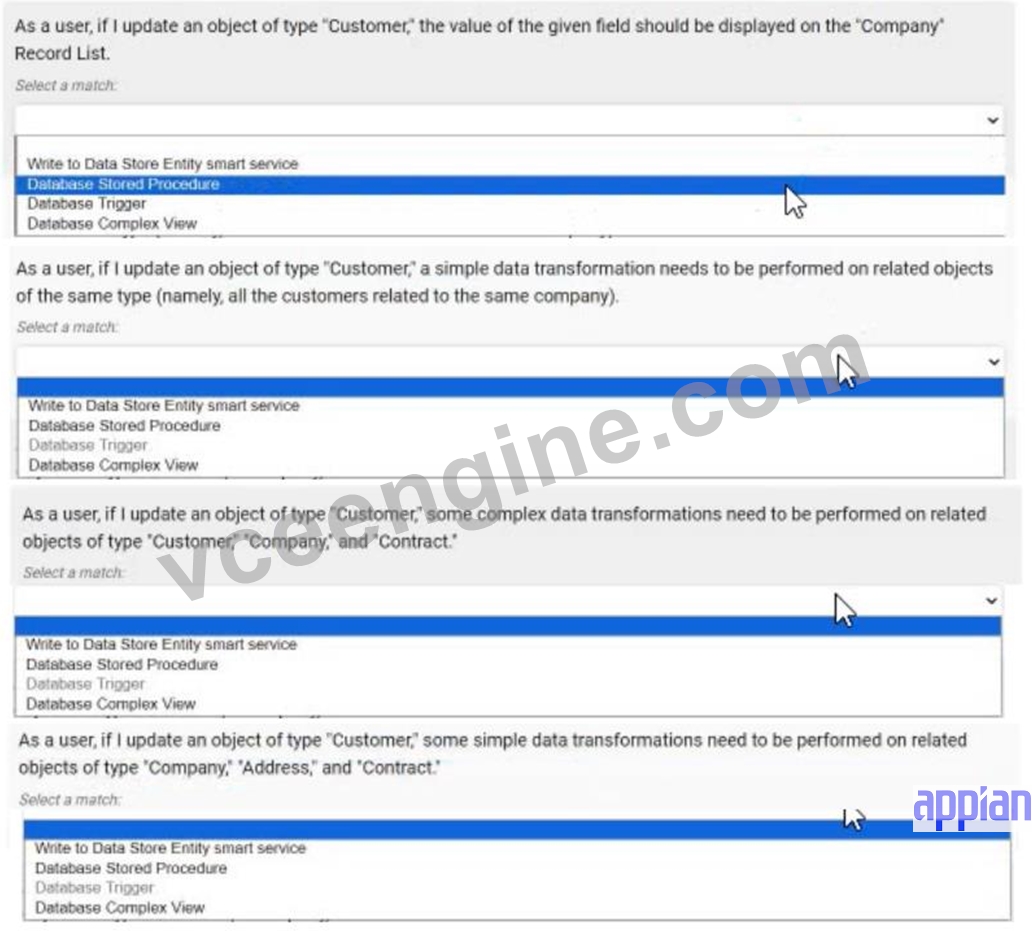
Answer:
Explanation:
NEW QUESTION # 31
You are selling up a new cloud environment. The customer already has a system of record for Its employees and doesn't want to re-create them in Appian. so you are going to Implement LDAP authentication.
What are the next steps to configure LDAP authentication?
To answer, move the appropriate steps from the Option list to the Answer List area, and arrange them in the correct order. You may or may not use all the steps.
Answer:
Explanation:
NEW QUESTION # 32
Your Agile Scrum project requires you to manage two teams, with three developers per team. Both teams are to work on the same application in parallel. How should the work be divided between the teams, avoiding issues caused by cross-dependency?
- A. Allocate stories to each team based on the cumulative years of experience of the team members.
- B. Have each team choose the stories they would like to work on based on personal preference.
- C. Group epics and stories by feature, and allocate work between each team by feature.
- D. Group epics and stories by technical difficulty, and allocate one team the more challenging stories.
Answer: C
Explanation:
Comprehensive and Detailed In-Depth Explanation:
In an Agile Scrum environment with two teams working on the same application in parallel, effective work division is critical to avoid cross-dependency, which can lead to delays, conflicts, and inefficiencies. Appian's Agile Development Best Practices emphasize team autonomy and minimizing dependencies to ensure smooth progress.
Option B (Group epics and stories by feature, and allocate work between each team by feature):
This is the recommended approach. By dividing the application's functionality into distinct features (e.g., Team 1 handles customer management, Team 2 handles campaign tracking), each team can work independently on a specific domain. This reduces cross-dependency because teams are not reliant on each other's deliverables within a sprint. Appian's guidance on multi-team projects suggests feature-based partitioning as a best practice, allowing teams to own their backlog items, design, and testing without frequent coordination. For example, Team 1 can develop and test customer-related interfaces while Team 2 works on campaign processes, merging their work during integration phases.
Option A (Group epics and stories by technical difficulty, and allocate one team the more challenging stories):
This creates an imbalance, potentially overloading one team and underutilizing the other, which can lead to morale issues and uneven progress. It also doesn't address cross-dependency, as challenging stories might still require input from both teams (e.g., shared data models), increasing coordination needs.
Option C (Allocate stories to each team based on the cumulative years of experience of the team members):
Experience-based allocation ignores the project's functional structure and can result in mismatched skills for specific features. It also risks dependencies if experienced team members are needed across teams, complicating parallel work.
Option D (Have each team choose the stories they would like to work on based on personal preference):
This lacks structure and could lead to overlap, duplication, or neglect of critical features. It increases the risk of cross-dependency as teams might select interdependent stories without coordination, undermining parallel development.
Feature-based division aligns with Scrum principles of self-organization and minimizes dependencies, making it the most effective strategy for this scenario.
NEW QUESTION # 33
As part of your implementation workflow, users need to retrieve data stored in a third-party Oracle database on an interface. You need to design a way to query this information.
How should you set up this connection and query the data?
- A. Configure an expression-backed record type, calling an API to retrieve the data from the third-party database. Then, use a!queryRecordType to retrieve the data.
- B. Configure a timed utility process that queries data from the third-party database daily, and stores it in the Appian business database. Then use a!queryEntity using the Appian data source to retrieve the data.
- C. Configure a Query Database node within the process model. Then, type in the connection information, as well as a SQL query to execute and return the data in process variables.
- D. In the Administration Console, configure the third-party database as a "New Data Source." Then, use a!queryEntity to retrieve the data.
Answer: D
Explanation:
Comprehensive and Detailed In-Depth Explanation:
As an Appian Lead Developer, designing a solution to query data from a third-party Oracle database for display on an interface requires secure, efficient, and maintainable integration. The scenario focuses on real-time retrieval for users, so the design must leverage Appian's data connectivity features. Let's evaluate each option:
A . Configure a Query Database node within the process model. Then, type in the connection information, as well as a SQL query to execute and return the data in process variables:
The Query Database node (part of the Smart Services) allows direct SQL execution against a database, but it requires manual connection details (e.g., JDBC URL, credentials), which isn't scalable or secure for Production. Appian's documentation discourages using Query Database for ongoing integrations due to maintenance overhead, security risks (e.g., hardcoding credentials), and lack of governance. This is better for one-off tasks, not real-time interface queries, making it unsuitable.
B . Configure a timed utility process that queries data from the third-party database daily, and stores it in the Appian business database. Then use a!queryEntity using the Appian data source to retrieve the data:
This approach syncs data daily into Appian's business database (e.g., via a timer event and Query Database node), then queries it with a!queryEntity. While it works for stale data, it introduces latency (up to 24 hours) for users, which doesn't meet real-time needs on an interface. Appian's best practices recommend direct data source connections for up-to-date data, not periodic caching, unless latency is acceptable-making this inefficient here.
C . Configure an expression-backed record type, calling an API to retrieve the data from the third-party database. Then, use a!queryRecordType to retrieve the data:
Expression-backed record types use expressions (e.g., a!httpQuery()) to fetch data, but they're designed for external APIs, not direct database queries. The scenario specifies an Oracle database, not an API, so this requires building a custom REST service on the Oracle side, adding complexity and latency. Appian's documentation favors Data Sources for database queries over API calls when direct access is available, making this less optimal and over-engineered.
D . In the Administration Console, configure the third-party database as a "New Data Source." Then, use a!queryEntity to retrieve the data:
This is the best choice. In the Appian Administration Console, you can configure a JDBC Data Source for the Oracle database, providing connection details (e.g., URL, driver, credentials). This creates a secure, managed connection for querying via a!queryEntity, which is Appian's standard function for Data Store Entities. Users can then retrieve data on interfaces using expression-backed records or queries, ensuring real-time access with minimal latency. Appian's documentation recommends Data Sources for database integrations, offering scalability, security, and governance-perfect for this requirement.
Conclusion: Configuring the third-party database as a New Data Source and using a!queryEntity (D) is the recommended approach. It provides direct, real-time access to Oracle data for interface display, leveraging Appian's native data connectivity features and aligning with Lead Developer best practices for third-party database integration.
Reference:
Appian Documentation: "Configuring Data Sources" (JDBC Connections and a!queryEntity).
Appian Lead Developer Certification: Data Integration Module (Database Query Design).
Appian Best Practices: "Retrieving External Data in Interfaces" (Data Source vs. API Approaches).
NEW QUESTION # 34
You need to generate a PDF document with specific formatting. Which approach would you recommend?
- A. Create an embedded interface with the necessary content and ask the user to use the browser "Print" functionality to save it as a PDF.
- B. Use the PDF from XSL-FO Transformation smart service to generate the content with the specific format.
- C. There is no way to fulfill the requirement using Appian. Suggest sending the content as a plain email instead.
- D. Use the Word Doc from Template smart service in a process model to add the specific format.
Answer: B
Explanation:
Comprehensive and Detailed In-Depth Explanation:
As an Appian Lead Developer, generating a PDF with specific formatting is a common requirement, and Appian provides several tools to achieve this. The question emphasizes "specific formatting," which implies precise control over layout, styling, and content structure. Let's evaluate each option based on Appian's official documentation and capabilities:
A . Create an embedded interface with the necessary content and ask the user to use the browser "Print" functionality to save it as a PDF:
This approach involves designing an interface (e.g., using SAIL components) and relying on the browser's native print-to-PDF feature. While this is feasible for simple content, it lacks precision for "specific formatting." Browser rendering varies across devices and browsers, and print styles (e.g., CSS) are limited in Appian's control. Appian Lead Developer best practices discourage relying on client-side functionality for critical document generation due to inconsistency and lack of automation. This is not a recommended solution for a production-grade requirement.
B . Use the PDF from XSL-FO Transformation smart service to generate the content with the specific format:
This is the correct choice. The "PDF from XSL-FO Transformation" smart service (available in Appian's process modeling toolkit) allows developers to generate PDFs programmatically with precise formatting using XSL-FO (Extensible Stylesheet Language Formatting Objects). XSL-FO provides fine-grained control over layout, fonts, margins, and styling-ideal for "specific formatting" requirements. In a process model, you can pass XML data and an XSL-FO stylesheet to this smart service, producing a downloadable PDF. Appian's documentation highlights this as the preferred method for complex PDF generation, making it a robust, scalable, and Appian-native solution.
C . Use the Word Doc from Template smart service in a process model to add the specific format:
This option uses the "Word Doc from Template" smart service to generate a Microsoft Word document from a template (e.g., a .docx file with placeholders). While it supports formatting defined in the template and can be converted to PDF post-generation (e.g., via a manual step or external tool), it's not a direct PDF solution. Appian doesn't natively convert Word to PDF within the platform, requiring additional steps outside the process model. For "specific formatting" in a PDF, this is less efficient and less precise than the XSL-FO approach, as Word templates are better suited for editable documents rather than final PDFs.
D . There is no way to fulfill the requirement using Appian. Suggest sending the content as a plain email instead:
This is incorrect. Appian provides multiple tools for document generation, including PDFs, as evidenced by options B and C. Suggesting a plain email fails to meet the requirement of generating a formatted PDF and contradicts Appian's capabilities. Appian Lead Developer training emphasizes leveraging platform features to meet business needs, ruling out this option entirely.
Conclusion: The PDF from XSL-FO Transformation smart service (B) is the recommended approach. It provides direct PDF generation with specific formatting control within Appian's process model, aligning with best practices for document automation and precision. This method is scalable, repeatable, and fully supported by Appian's architecture.
Reference:
Appian Documentation: "PDF from XSL-FO Transformation Smart Service" (Process Modeling > Smart Services).
Appian Lead Developer Certification: Document Generation Module (PDF Generation Techniques).
Appian Best Practices: "Generating Documents in Appian" (XSL-FO vs. Template-Based Approaches).
NEW QUESTION # 35
You are required to configure a connection so that Jira can inform Appian when specific tickets change (using a webhook). Which three required steps will allow you to connect both systems?
- A. Configure the connection in Jira specifying the URL and credentials.
- B. Create an integration object from Appian to Jira to periodically check the ticket status.
- C. Create a new API Key and associate a service account.
- D. Give the service account system administrator privileges.
- E. Create a Web API object and set up the correct security.
Answer: A,C,E
Explanation:
Comprehensive and Detailed In-Depth Explanation:
Configuring a webhook connection from Jira to Appian requires setting up a mechanism for Jira to push ticket change notifications to Appian in real-time. This involves creating an endpoint in Appian to receive the webhook and configuring Jira to send the data. Appian's Integration Best Practices and Web API documentation provide the framework for this process.
Option A (Create a Web API object and set up the correct security):
This is a required step. In Appian, a Web API object serves as the endpoint to receive incoming webhook requests from Jira. You must define the API structure (e.g., HTTP method, input parameters) and configure security (e.g., basic authentication, API key, or OAuth) to validate incoming requests. Appian recommends using a service account with appropriate permissions to ensure secure access, aligning with the need for a controlled webhook receiver.
Option B (Configure the connection in Jira specifying the URL and credentials):
This is essential. In Jira, you need to set up a webhook by providing the Appian Web API's URL (e.g., https://<appian-site>/suite/webapi/<web-api-name>) and the credentials or authentication method (e.g., API key or basic auth) that match the security setup in Appian. This ensures Jira can successfully send ticket change events to Appian.
Option C (Create a new API Key and associate a service account):
This is necessary for secure authentication. Appian recommends using an API key tied to a service account for webhook integrations. The service account should have permissions to process the incoming data (e.g., write to a process or data store) but not excessive privileges. This step complements the Web API security setup and Jira configuration.
Option D (Give the service account system administrator privileges):
This is unnecessary and insecure. System administrator privileges grant broad access, which is overkill for a webhook integration. Appian's security best practices advocate for least-privilege principles, limiting the service account to the specific objects or actions needed (e.g., executing the Web API).
Option E (Create an integration object from Appian to Jira to periodically check the ticket status):
This is incorrect for a webhook scenario. Webhooks are push-based, where Jira notifies Appian of changes. Creating an integration object for periodic polling (pull-based) is a different approach and not required for the stated requirement of Jira informing Appian via webhook.
These three steps (A, B, C) establish a secure, functional webhook connection without introducing unnecessary complexity or security risks.
Reference:
The three required steps that will allow you to connect both systems are:
A . Create a Web API object and set up the correct security. This will allow you to define an endpoint in Appian that can receive requests from Jira via webhook. You will also need to configure the security settings for the Web API object, such as authentication method, allowed origins, and access control.
B . Configure the connection in Jira specifying the URL and credentials. This will allow you to set up a webhook in Jira that can send requests to Appian when specific tickets change. You will need to specify the URL of the Web API object in Appian, as well as any credentials required for authentication.
C . Create a new API Key and associate a service account. This will allow you to generate a unique token that can be used for authentication between Jira and Appian. You will also need to create a service account in Appian that has permissions to access or update data related to Jira tickets.
The other options are incorrect for the following reasons:
D . Give the service account system administrator privileges. This is not required and could pose a security risk, as giving system administrator privileges to a service account could allow it to perform actions that are not related to Jira tickets, such as modifying system settings or accessing sensitive data.
E . Create an integration object from Appian to Jira to periodically check the ticket status. This is not required and could cause unnecessary overhead, as creating an integration object from Appian to Jira would involve polling Jira for ticket status changes, which could consume more resources than using webhook notifications. Verified Reference: Appian Documentation, section "Web API" and "API Keys".
NEW QUESTION # 36
You need to connect Appian with LinkedIn to retrieve personal information about the users in your application. This information is considered private, and users should allow Appian to retrieve their information. Which authentication method would you recommend to fulfill this request?
- A. API Key Authentication
- B. Basic Authentication with user's login information
- C. Basic Authentication with dedicated account's login information
- D. OAuth 2.0: Authorization Code Grant
Answer: D
NEW QUESTION # 37
You have created a Web API in Appian with the following URL to call it: https://exampleappiancloud.com
/suite/webapi/user_management/users?username=john.smith. Which is the correct syntax for referring to the username parameter?
- A. httpRequest.queryParameters.users.username
- B. httpRequest.users.username
- C. httpRequest.queryParameters.username
- D. httpRequest.formData.username
Answer: C
Explanation:
Comprehensive and Detailed In-Depth Explanation:In Appian, when creating a Web API, parameters passed in the URL (e.g., query parameters) are accessed within the Web API expression using the httpRequest object. The URL https://exampleappiancloud.com/suite/webapi/user_management/users?username=john.
smith includes a query parameter username with the value john.smith. Appian's Web API documentation specifies how to handle such parameters in the expression rule associated with the Web API.
* Option D (httpRequest.queryParameters.username):This is the correct syntax. The httpRequest.
queryParameters object contains all query parameters from the URL. Since username is a single query parameter, you access it directly as httpRequest.queryParameters.username. This returns the value john.
smith as a text string, which can then be used in the Web API logic (e.g., to query a user record).
Appian's expression language treats query parameters as key-value pairs under queryParameters, making this the standard approach.
* Option A (httpRequest.queryParameters.users.username):This is incorrect. The users part suggests a nested structure (e.g., users as a parameter containing a username subfield), which does not match the URL. The URL only defines username as a top-level query parameter, not a nested object.
* Option B (httpRequest.users.username):This is invalid. The httpRequest object does not have a direct users property. Query parameters are accessed via queryParameters, and there's no indication of a users object in the URL or Appian's Web API model.
* Option C (httpRequest.formData.username):This is incorrect. The httpRequest.formData object is used for parameters passed in the body of a POST or PUT request (e.g., form submissions), not for query parameters in a GET request URL. Since the username is part of the query string (?
username=john.smith), formData does not apply.
The correct syntax leverages Appian's standard handling of query parameters, ensuring the Web API can process the username value effectively.
References:Appian Documentation - Web API Development, Appian Expression Language Reference -
httpRequest Object.
NEW QUESTION # 38
......
Appian ACD301 Exam Syllabus Topics:
| Topic | Details |
|---|---|
| Topic 1 |
|
| Topic 2 |
|
| Topic 3 |
|
| Topic 4 |
|
Verified ACD301 exam dumps Q&As with Correct 47 Questions and Answers: https://www.vceengine.com/ACD301-vce-test-engine.html
ACD301 Dumps PDF and Test Engine Exam Questions: https://drive.google.com/open?id=1dY8meBkjMGPdpfQgrv0fwHYbyo7wXCY2
