

2026 The Most Effective L4M1 with 52 Questions Answers
Try Free and Start Using Realistic Verified L4M1 Dumps Instantly.
CIPS L4M1 Exam Syllabus Topics:
| Topic | Details |
|---|---|
| Topic 1 |
|
| Topic 2 |
|
| Topic 3 |
|
NEW QUESTION # 19
In the supplier selection part of the Procurement Cycle, what criteria can a Procurement Manager use to ensure they award to the best supplier? (25 points)
Answer:
Explanation:
See the solution in Explanation part below
Explanation:
How to approach this question:
- This is quite an open question and there are many different things you could mention. One way to approach it would be to use Carter's 10 Cs- discuss a couple of these. OR just give a couple of criteria in different paragraphs. Some ideas include: Supplier financial status, Reputation / Reference, Quality, Availability, CSR Policies / Ethics / Environmental considerations, Accreditations, Added Value. This list is not exhaustive.
- If you're going for Carter's 10 Cs you could name a couple of these: competency, consistency, capability, control, cost, cash, clean, communication, culture, commitment
- I don't think either approach is better or worse. Choose the criteria you know the most about and write about those.
- The question doesn't tell you how many criteria to name, so you have to make a judgement call here. I would aim for 5-6. But if you can only remember 4 that's fine. The main thing they're looking for is that you explain for each one 1) what it is 2) how procurement can check 3) why procurement would look at that criteria 4) an example. If you do too many you risk not going into enough detail on each. It's a balance. 5 is always a good number to aim for if the question doesn't state.
Example Essay
In the procurement cycle, the supplier selection phase is a critical juncture that demands consideration. Procurement Managers shoulder the responsibility of identifying and awarding contracts to suppliers who not only meet immediate needs, but contribute to the long-term success of the organization. This essay explores various criteria a Procurement Manager can employ to ensure the selection of the best supplier: financial stability, reputation, quality, availability, CSR policies, and added value.
Financial stability is a foundational criterion in supplier selection. Assessing a supplier's financial status involves a multifaceted evaluation, with liquidity and gearing ratio taking center stage. The acid test, comparing short-term assets to liabilities, offers insights into a supplier's ability to settle debts promptly, with a ratio exceeding 1 indicating financial health. Meanwhile, the gearing ratio, reflecting the proportion of capital funded by loans, aids in gauging financial risk, with a ratio below 50% considered low-risk. Relying on published Profit and Loss statements and income statements, along with financial credit checks from platforms like Dun and Bradstreet, empowers Procurement Managers to make informed decisions. This financial scrutiny is imperative to avoid entering contracts with suppliers facing imminent financial struggles, safeguarding against potential disruptions to the supply chain.
Reputation and references are another pivotal criterion. Seeking references from previous contracts allows Procurement Managers to gauge a supplier's track record in successfully delivering on similar commitments. Independent reviews and informal market inquiries supplement this information, providing a holistic understanding of a supplier's performance. However, caution is advised in overreliance on past performance, as variables like personnel changes or contract scale differences may impact outcomes. Recognizing that past shortcomings may have been addressed internally further emphasizes the need for a balanced approach to reference evaluation.
Thirdly, Quality. Beyond the product itself, considerations extend to the supplier's technological capabilities, manufacturing processes, and relevant accreditations such as ISO 9001. Physical visits to supplier sites may be warranted, especially for products like raw materials where samples can be requested. Adhering to recognized safety standards and assessing factors like fire retardancy ensures that the quality of manufactured goods aligns with established benchmarks.
Next, Availability is another important criteria to consider. Procurement Managers must evaluate a supplier's capacity and capability to meet specific requirements. Inquiries about existing contracts and flexibility in response to demand fluctuations provide insights into a supplier's commitment and responsiveness. Assessing the supplier's workload and the significance of the buyer in their client portfolio helps determine the level of attention and service the buyer can expect. A buyer may wish to avoid working for a supplier who is already stretched very thinly with other contracts.
Corporate Social Responsibility (CSR) policies and ethical considerations have gained prominence in supplier selection. Beyond legal compliance, Procurement Managers may scrutinize a supplier's history for convictions or negative press related to corruption, bribery, or fraud. The presence of a Modern Slavery Policy and Environmental Policy, along with relevant accreditations like ISO14001 or Fair Trade certification, attests to a supplier's commitment to ethical and sustainable practices. Procurement would likely seek to appoint a supplier who's CSR vision aligns with their own company's.
Lastly, added value is an important criteria to consider. This is particularly so for Public Sector Organizations governed by the Social Value Act. In addition to meeting contractual requirements, suppliers may offer knowledge sharing, training, improved processes, or contribute to social value by employing local community members or providing apprenticeships. This criterion aligns procurement decisions with broader organizational goals, enhancing the overall impact of supplier relationships and benefitting the local community.
In conclusion, a careful combination of financial scrutiny, reputation assessment, quality evaluation, availability considerations, CSR policies, and added value analysis forms the bedrock of effective supplier selection in the procurement cycle. Procurement Managers, armed with a holistic understanding of these criteria, should seek not only to fulfil immediate needs, but also consider the long-term impact of supplier appointments.
Tutor Notes
- A 'good' scoring answer (50-70%) will explain the criteria well and give examples. If you're looking for a distinction level answer (70% +) you could also mention advantages, disadvantages and risks associated with each of the criteri a. For example, when looking at references and reputation it's important to know that a supplier would only ever provide a good reference to you, they would never tell you of a contract that failed. Another example is that financial data may be skewed- a supplier may have a low score if they are just starting up or have recently remortgaged a property. It's therefore important to get a commentary as well as the figures / scores.
- You could also mention that criteria could be weighted e.g. more importance given to quality than financial status and also consider how easy or difficult it would be to get the information e.g. a supplier may say they have lots of availability to deliver the service you require, but they may just be saying this to win business. How do you know for sure?
- Social Value Act isn't in this syllabus. If you work in Public Sector procurement it's something you'll be very familiar with. If you don't or you're outside of the UK do not worry about this. I've just included it to show how you can bring in your own knowledge to questions like this. You could think of particular criteria that's important to your industry and write about that. The Social Value Act: What is it, and why is it important? (samtaler.co.uk)
- Study guide p.77
NEW QUESTION # 20
What is meant by the term 'centralised procurement'? (10 points) Explain 2 forms of Hybrid Procurement Structures (15 points).
Answer:
Explanation:
See the solution inExplanation partbelow.
Explanation:
- This is essentially two mini essays, so you can do them completely separately if you like.
1) Definition of centralised procurement - when an organisation has a designated procurement function which makes purchases on behalf of other teams. When departments need to make a purchase, they would do this by approaching the procurement department who would purchase the item they need. This is in contrast to devolved procurement where departments can make purchases themselves.
2)Explanation:of 2 forms of hybrid structures- there's a couple in the study guide you can pick from - consortium, shared services, lead buyer and outsourced. In the old syllabus they used to discuss SCAN - Strategically Controlled Action Network and CLAN = Centre Led Action Network. This has been removed from the new syllabus, but I don't think it would be wrong to use SCAN and CLAN in this essay if you wanted to. However they are more complicated than the others and if you can talk about other models instead I'd definitely go for that.
Example Essay:
Centralized procurement refers to a procurement strategy where an organization consolidates its purchasing activities into a single, central department or unit. Instead of allowing individual departments or divisions within the organization to independently manage their procurement processes, centralized procurement involves the concentration of these activities under a unified structure.
Key features of centralized procurement include:
1) Single Procurement Authority: In a centralized procurement system, there is a designated procurement authority or department responsible for handling all purchasing decisions. This central entity has the authority to negotiate contracts, select suppliers, and make procurement-related decisions on behalf of the entire organization.
2) Streamlined Processes: Centralized procurement aims to standardize and streamline procurement processes across the organization. This can include the establishment of uniform procurement policies, procedures, and documentation to ensure consistency and efficiency.
3) Economies of Scale: By consolidating purchasing power, centralized procurement allows organizations to leverage economies of scale. Bulk purchases, standardized contracts, and negotiations with suppliers on a larger scale can lead to cost savings and more favourable terms.
4) Improved Coordination and Communication: Centralized procurement enhances coordination and communication within the organization. With a centralized structure, there is better visibility into overall procurement activities, allowing for improved collaboration, information sharing, and strategic planning.
Moreover, this centralized control helps manage risks, ensure transparency, and monitor adherence to ethical and legal standards.
5) Consolidated Supplier Relationships: Centralized procurement enables the organization to consolidate its relationships with suppliers. This can lead to stronger partnerships, better negotiation positions, and improved collaboration with a select group of suppliers that meet the organization's needs.
6) Strategic Decision-Making: Centralized procurement allows organizations to make strategic decisions at a higher level. This includes aligning procurement strategies with overall organizational goals, optimizing the supply chain, and contributing to broader business objectives.
An example of centralised procurement would be in a hotel chain with several hotels across the UK. In a centralised procurement function there would be one team responsible for ordering everything for all of the hotels, rather than allowing the individual hotels to buy things themselves. Premier Inn is an example of a company that uses this structure- it allows them to buy stock in bulk and ensures that all hotels have the same equipment so customers expectations are always met.
Centralized procurement is often contrasted with decentralized procurement, where individual departments or business units manage their procurement independently (i.e. each hotel would buy their own supplies). The choice between centralized and decentralized procurement depends on various factors, including the size and structure of the organization, the nature of its operations, and the specific goals it aims to achieve through its procurement processes.
Consortium Procurement Model:
The consortium procurement model is characterized by the collaboration of multiple organizations forming a joint group (the consortium) to engage in collective buying activities. Typically composed of entities from the same industry or sector, these organizations unite their resources, expertise, and purchasing power to pursue shared procurement objectives. The consortium leverages this collective strength to negotiate contracts, conduct bulk purchases, and benefit from economies of scale, resulting in cost savings and increased operational efficiency. The UK University sector is an example of Consortium activities- many universities come together to 'group buy' items as this brings about many benefits.
The main benefit of this form of hybrid procurement model is the increased negotiating power and leverage derived from combining the purchasing volumes of participating entities. This often results in more favourable terms, competitive prices (through bulk purchases), and improved conditions with suppliers. Additionally, consortium buying allows organizations to share resources, knowledge, and expertise, fostering a collaborative environment that enhances overall procurement capabilities. By working together, consortium members can collectively address challenges, negotiate strategically, and navigate the procurement landscape more effectively.
However, consortium buying is not without its challenges. A potential disadvantage lies in the complexity of managing a collaborative procurement structure, involving coordinationamong diverse entities. Achieving consensus on procurement strategies, vendor selection, and contract terms may require considerable effort and compromise. Additionally, individual organizational needs and preferences within the consortium may differ, posing challenges in aligning priorities. It is essential to strike a balance between centralized decision-making and accommodating the specific requirements of each consortium member. Furthermore, the success of consortium buying relies heavily on effective communication and trust among participants. Any breakdown in communication or lack of trust could hinder the collaborative process, impacting the overall efficiency and success of the consortium's procurement endeavours.
Overall, while consortium buying offers notable advantages, its effectiveness is contingent on careful management of collaborative dynamics and effective communication strategies.
Shared Services Procurement Model:
In the shared services procurement model, various departments or business units within a single organization converge under a centralized procurement function. Rather than individual units managing their procurement independently, a dedicated shared services centre is established to provide procurement-related services across the organization. This model facilitates streamlined processes, ensures consistency through standardized procedures, and capitalizes on economies of scale.
One key benefit is the potential for cost savings through economies of scale. By centralizing procurement, the organization can negotiate bulk purchases and standardized contracts, leading to better terms and prices. This consolidation of purchasing power enables the organization to optimize its resources and achieve overall cost efficiency. Additionally, centralized procurement allows for streamlined processes, standardized procedures, and better control over procurement activities. It promotes consistency, reduces redundancy, and ensures adherence to organizational policies and compliance requirements.
However, there are also potential disadvantages to centralized procurement. One notable challenge is the potential for reduced flexibility in meeting the unique needs of individual departments or business units within the organization. Centralization may lead to standardized approaches that might not be well-suited for all units, potentially impacting their specific requirements. Furthermore, the centralization of decision-making can result in increased bureaucracy and longer decision-making processes, potentially slowing down procurement activities. Additionally, there may be resistance from decentralized units that are accustomed to managing their procurement independently. Striking a balance between centralized control and accommodating the diverse needs of various units is crucial for the success of centralized procurement.
In conclusion, both the consortium and shared services procurement models represent strategies to enhance efficiency, realize cost savings, and optimize procurement processes. While the consortium model involves collaboration with external entities, the shared services model centralizes procurement functions within a single organization. The choice between these models depends on the unique goals, structure, and requirements of the organizations involved, each offering distinct advantages in the pursuit of effective procurement management.
Tutor Notes:
- This is from LO 3.3 p.161 onwards. There's quite a bit of information on these hybrid models so there's many ways it can come up as a question. There are different types of consortium, which I didn't go into in the above essay because it wasn't asked for as part ofthe question, but I'd familiarise yourself with this. Also with the pros and cons of each model, and think about when an organisation may choose this type of model.
NEW QUESTION # 21
Explain how a focus on each of the 'five rights of procurement' can be used to meet Fast Fashion's objectives.
Fast Fashion is a national retailer of a variety of lower-priced clothing items, which are sold to men, women and children. It currently has 50 stores across different parts of the country and these are primarily based in the centres of towns and cities.
Fast Fashion buys its finished products, that are packaged ready for sale, from a range of global clothing manufacturers and then these are shipped directly from these suppliers to the stores. Fast Fashion then label and price the products in the stockrooms of each store, before putting them into the shops' retail areas for sale to their customers.
As its stores are located in high-cost city and town centres, it has limited space for storage and rely on its suppliers to deliver on time and in the required quantities. Although Fast Fashion can compete with similarly priced physical high-street retailers, it is facing increased competition from global online sellers, who often buy the same product from the same suppliers, but can charge less due to the lower costs in their overall supply chain. In addition, some of its global suppliers have threatened to increase their prices, stating that their labour costs are rising in the developing economies in which they operate.
In order to meet Fast Fashion's objectives of effectively and efficiently managing the spend with its supply base, you have been recruited as an experienced procurement and supply manager.
Answer:
Explanation:
See the solution in Explanation part below
Explanation:
The 'five rights of procurement' are: right quality, right quantity, right place, right time, and right price. Focusing on each of these can help Fast Fashion meet its objective of managing spend effectively and efficiently with its suppliers.
1. Right Quality
Fast Fashion must ensure that the clothing it purchases meets the quality expectations of its customers. As a retailer of lower-priced fashion, the quality must be fit for purpose, durable enough for use, and consistent across batches.
By working closely with global suppliers and setting clear specifications, Fast Fashion can reduce issues such as defective goods or returns, which would increase costs. For example, poor-quality garments could damage brand reputation and lead to lost sales.
Therefore, achieving the right quality helps to:
Reduce waste and returns
Maintain customer satisfaction
Avoid unnecessary costs
2. Right Quantity
Due to limited storage space in city-centre stores, ordering the correct quantity is critical. Overstocking would lead to storage problems, while understocking could result in lost sales.
Fast Fashion should use demand forecasting and sales data to order appropriate quantities and possibly adopt just-in-time (JIT) delivery approaches.
For example, frequent smaller deliveries from suppliers would help balance stock levels and reduce holding costs.
This ensures:
Efficient use of limited space
Reduced inventory holding costs
Availability of products for customers
3. Right Place
Products must be delivered directly to the correct store locations, as Fast Fashion's model relies on suppliers shipping directly to stores rather than central warehouses.
Ensuring delivery to the right place reduces handling costs and delays. If goods are sent to the wrong location, it would create additional transport costs and operational inefficiencies.
For example, accurate logistics coordination and clear delivery instructions can ensure goods arrive at the correct store first time.
This helps:
Improve operational efficiency
Reduce unnecessary transport costs
Ensure products reach customers quickly
4. Right Time
Timing is especially important in the fast fashion industry, where trends change quickly and stores have limited storage.
Fast Fashion depends heavily on suppliers delivering on time, as delays can lead to stockouts and missed sales opportunities. Late deliveries may also result in outdated stock that is no longer in demand.
For example, implementing supplier performance monitoring and agreements (such as SLAs) can help ensure timely deliveries.
This enables:
Continuous product availability
Reduced risk of lost sales
Better response to changing fashion trends
5. Right Price
Fast Fashion faces strong competition from online retailers with lower operating costs, as well as increasing supplier prices due to rising labour costs.
To achieve the right price, procurement must focus on:
Negotiating with suppliers
Building long-term relationships
Exploring alternative or lower-cost suppliers
Considering total cost of ownership (not just purchase price)
For example, consolidating orders or forming strategic partnerships may help secure better pricing.
This supports:
Cost control and profitability
Competitive pricing in the market
Efficient spend management
Conclusion
By focusing on the five rights of procurement, Fast Fashion can improve efficiency across its supply chain. This will allow the company to control costs, improve supplier performance, and remain competitive against online retailers, while meeting customer expectations.
NEW QUESTION # 22
What is meant by a structured procurement process? (10 marks) Why is this important? (15 marks).
Answer:
Explanation:
See the solution inExplanation partbelow.
Explanation:
- Definition of 'structured procurement process' - when an organisation provides a sequence of actions / steps to take to get the outcome (the procurement of an item). This involves an organisation providing guidelines and instructions of how things should be done. Basically following a step-by-step process.
- Why this is important - Ensures all tasks that need to be done are done, maintains consistency, prevents conflict and suboptimal behaviour, improves efficiency, better managerial control, compliance (with laws and standards), assists with continuous improvement, may result in time/ cost savings, reduces risks such as fraudulent spending.
Example essay:
The first part of the question is worth 10 points, so you could include a few of the following points. It would also be good to include examples:
- Structured procurement involves creating rules on how procurement should be done
- This is in contrast to reactive / maverick spending
- May come about due to company policy, external regulations or through trying to achieve Competitive Advantage
- Examples include an organisation having set procedures for ordering items of different spend- e.g.
Procurement Assistants can purchase items up to £500. Items between £500-£1000 require a manager's approval and anything over £1000 requires a written Business Case in order to procure
- Structures Procurement Processes will usually also include the use of a designated e-procurement tool. E.g.
an organisation may insist that all tenders use a certain online system and that invoices are sent via X system within 30 days.
The second part of the question is worth slightly more points, so spend more time on this. You could put each of the reasons why it is important in a separate paragraph. Also use examples where you can;
- Ensures all tasks that need to be done are done- having structured processes means having a step-by-step guide to how to procure. This means activities are well co-ordinated and there are no gaps, no duplications of effort and no conflicting efforts. It may involve assigning different people in the team different roles e.g.
someone makes the requisition and someone else approves it. It also means that nothing is forgotten.
- Maintains consistency- having standardised processes means each procurement exercise follows the same process. This may include using a standard template for a requisition or ITT. Where there is consistency, this results in time being saved and less mistakes being made as everyone (including supply partners) is familiar with the processes.
- Prevents conflict and suboptimal behaviour- in organisations that use structured procurement processes everyone does the same. This means there is no conflict (e.g. one person doing things one way and another person does it differently and arguing which way is best). It also means no one can do procurement 'wrong' - there are written guides and procedures to follow. This is particularly helpful for new starters.
- Efficiency - time and money can be saved where there are standard procedures as people don't have to plan each procurement activity individually. Structured Procurement Processes may also involve completing bulk orders and co-ordinating activity within the organisation which means less orders are placed over the year and efficiency savings can be made. For example, a factory may create an order of cleaning products once a quarter, compared to ordering products just as and when they are required. This will save time of the procurement department overall throughout the year and allows them to focus on other more value-adding tasks.
- Better managerial control - Managers have more oversight when using structured procurement. There are clear rules as to when managers need to be involved and provide sign-off. This visibility makes it easier for managers to make decisions and allows for early intervention where someone needs assistance. It will reduce maverick spending and fraudulent spending. For example, it is much harder to provide kick-backs to suppliers when there are clear processes and audit trails and managers have visibility over all processes.
- Compliance (with laws and standards) - particularly in the Public Sector there are rules and regulations regarding procurement practices. Using standardised processes allows organisations to demonstrate compliance with appropriate legislation. It also protects them from 'challenge'. This is when a bidder who is unsuccessful challenges the decision to award a contract to someone else. Using a structured procurement process allows the organisation to demonstrate that they procured the item correctly and the challenge is unfounded.
Tutor Notes
- This topic isn't as well explained in the new study guide as it used to be. It's all pretty obvious stuff but the language is slightly different. The guide now talks about 'compliance with processes' and the benefits this brings. Which is exactly the same as why do you follow a structured process. This is on p. 114.
- If you're feeling clever, you could mention the difference between Public and Private Sector- e.g. a private organisation may use standardised processes for efficiency and cost savings, whereas a public sector organisation may use it more for compliance purposes.
NEW QUESTION # 23
Explain the main differences between the Public Sector and the Private Sector (25 marks)
Answer:
Explanation:
See the solution in Explanation part below.
Explanation:
Bottom of Form
Top of Form
- This is an open question. You could really talk about anything. Here's some ideas of content:
Example Essay
The public and private sectors, while both essential to a nation's economy, operate under different paradigms, primarily due to their distinct drivers, stakeholders, regulations, procurement aims, and supplier relationships.
Drivers
The most fundamental difference lies in their drivers. Private sector organizations are primarily profit-driven; their existence hinges on their ability to generate profits. This profit influences their strategies, operations, and overall objectives. Conversely, public sector organizations are not driven by profit. Funded by taxpayer money, their primary objective is to deliver services effectively and efficiently to the public. Their success is measured not in financial terms, but in how well they meet the service levels required by the citizens who finance them through taxes.
Stakeholders
The range and influence of stakeholders in the two sectors also differ markedly. In the public sector, the stakeholder base is much broader, encompassing every member of society who interacts with or benefits from public services like healthcare, policing, and road maintenance. However, these stakeholders typically have less power to influence policy or practices. In contrast, stakeholders in the private sector, such as shareholders and customers, often have a more significant influence on company policies and practices. The private sector's narrower stakeholder base allows for more direct impact and influence from these groups.
Regulations
Regulations in the public sector are generally more stringent than in the private sector. Public sector entities, governed by regulations like PCR 2015, must demonstrate sound procurement practices and are accountable to society at large. This contrasts with the private sector, where companies have more latitude in choosing suppliers and are not obliged to justify their decisions publicly. The private sector faces fewer regulatory constraints, allowing for more flexibility in business decisions.
Procurement Aims
Procurement in the public sector is guided by the principles of efficiency, economy, and effectiveness, often summarized as the '3 Es'. The focus is on achieving value for money, considering both quality and price. In contrast, private sector procurement is more diverse in its aims, reflecting the organization's specific goals, which could range from profit maximization to innovation or sustainability. The private sector's procurement decisions are more closely aligned with the organization's unique values and objectives.
Supplier Relationships
Finally, the nature of supplier relationships differs significantly between the two sectors. The public sector is mandated to maintain a certain distance from its suppliers, ensuring equal treatment and open competition, as dictated by regulations like the PCR. This contrasts with the private sector, where companies are free to develop closer, more strategic relationships with preferred suppliers. The private sector can engage in practices like partnerships and Early Supplier Involvement, which are typically not permissible in the public sector due to the need for impartiality and fairness.
In summary, while both sectors aim to deliver services or products effectively, the public sector's focus on service delivery for the public good, stringent regulations, broad stakeholder base, and specific procurement principles, sets it apart from the private sector's profit-driven, flexible, and more narrowly focused approach.
Tutor Notes
- At Level 4 the questions are usually explain or describe, so don't worry too much about doing an in depth
'compare and contrast' style of answer. They don't expect that level of detail here. Simply saying Public Sector does X and Private Sector does Y is all you need.
- I have mentioned PCR 2015 - if you're taking this exam in 2025 you may need to update this reference with the new regulations.
- LO 4.3 p.220 / p. 226
NEW QUESTION # 24
Bob is a procurement manager at ABC Ltd. He has been asked to ensure all future purchases achieve
'value for money' for the organisation. What is meant by 'value for money'? (5 points). Describe 4 techniques that Bob could use to achieve this (20 points)
Answer:
Explanation:
See the solution inExplanation partbelow.
Explanation:
1) A definition of Value for Money: ensuring a purchase is cost effective. This may be that the purchase achieves the 5 Rights of Procurement or that the purchase achieves the 4Es: Economy, Efficiency, Effectiveness and Equity. - this is only worth 5 points, so don't spend too long on this
2) 4 techniques Bob can use to achieve VFM: this is the bulk of your essay. Each of the 4 will be worth 5 points, so remember to give a thoroughExplanation:and example. Pick 4 from the list below: complete a value analysis to eliminate non-essential features, minimise variety/ consolidate demand, avoid over specification, pro-active sourcing, whole life costing methodologies, eliminate / reduce inventory, use electronic systems, international sourcing, sustainability / environmental policies, currency/ exchange rate considerations, negotiating good payment terms, packaging, warrantees.
Example Essay:
"Value for money" (VFM) is a concept that refers to obtaining the best possible return on investment or benefits relative to the cost incurred. It involves assessing whether the goods, services, or activities provided offer an optimal balance between their cost and the quality, benefits, or outcomes they deliver.
Value for money is not solely about choosing the cheapest option; instead, it considers the overall efficiency, effectiveness, and long-term value derived from an expenditure. For Bob, the Procurement Manager at ABC Ltd there are four key ways that he can achieve this for all future purchases.
Value Engineering
This is looking at the components of a product and evaluating the value of each component individually.
You can then eliminate any components that do not add value to the end product. To do this Bob would choose a product to review and determine whether any parts of this can be omitted (thus saving the company money) or could be replaced by components that are of a higher quality at the same price (thus providing added value to the customer). For example, Bob could complete a Value Engineering exercise on the new mobile phone prototype ABC plan to release next year. His findings may discover a way to provide a higher quality camera at no additional cost or that some components don't add value and can be eliminated.
Consolidate demand
Bob can achieve value for money by consolidating demand at ABC ltd. This would mean rather than each individual person/ department ordering what they want when they need it, Bob creates a centralised process for ordering items in bulk for the departments to share. For example, if each department require stationary to be ordered, Bob can consolidate this demand and create one big order each quarter. This will likely result in cost savings for ABC as suppliers often offer discounts for large orders. Moreover, consolidating demand will allow for saving in time (one person does the task once, rather than lots of people doing the same task and duplicating work).
International sourcing
Bob may find there is value for money in changing suppliers and looking at international sourcing.
Often other countries outside of the UK can offer the same products at a lower cost. An example of this is manufactured goods from China. By looking at international supply chains, Bob may be able to make cost-savings for ABC. He should be sure that when using this technique there is no compromise on quality.
Whole Life Costing methodology
This is a technique Bob can use for procuring capital expenditure items for ABC. This involves looking at the costs of the item throughout its lifecycle and not just the initial purchase price. For example, if Bob needs to buy a new delivery truck he should consider not only the price of the truck, but also the costs of insurance for the truck, how expensive it is to buy replacement parts such as tyres and the cost of disposing of the truck once it reaches the end of its life. By considering these factors Bob will ensure that he buys the truck that represents the best value for money long term.
In conclusion Bob should ensure he uses these four techniques for all items he and his team procures in the future. This will ensure ABC Ltd are always achieving value for money, and thus remain competitive in the marketplace.
Tutor Notes
- This case study is really short, and the ones you'll receive in the exam are often longer and give you more guidance on what they're expecting you to write. With case study questions, you have to make your entire answer about Bob. So don't bring in examples from your own experience, rather, focus on giving examples for Bob.
- A good rule of thumb for case study questions is make sure you reference the case study once per paragraph.
- Value for Money is a really broad topic and you can pretty much argue anything that procurement does is helping to achieve value for money. There's a large table of stuff that's considered VFM on p.38 but that table isn't exhaustive. So feel free to come up with your own ideas for this type of essay.
Some additional tidbits of information on VFM:
- The 'academic' definition of Value for Money is 'the optimum combination of whole life cost and the quality necessary to meet the customer's requirement'
- Value for Money is an important strategic objective for most organisations but particularly in the public sector. This is because the public sector is financed by public money (taxes), so they must demonstrate that the organisation is using this money wisely. This might be an interesting fact to put into an essay on VFM.
- Value can often be hard to quantify, particularly in the service industry. E.g. in customer service it can be difficult to quantify the value of having knowledgeable and polite employees delivering the service.
NEW QUESTION # 25
What is a Public Sector organisation and what are the main objectives of organisations in the Public Sector? (25 points)
Answer:
Explanation:
See the solution in Explanation part below
Explanation:
How to approach this question
- For the first part of the question you should look to give a definition of the public sector, think about it's characteristics and give so examples e.g. local government, hospitals, libraries.
- For the second part try to explain 4-5 objectives. Try to remain as broad as you can - think about objectives that all public sector organisations have in common rather than anything very specific to one organisation, what the question is looking for is the higher level, more broad aims.
Example Essay
A public sector organization, is a branch of government responsible for providing a wide range of services and functions to citizens and communities. It is funded by taxpayers' money and operates under governmental authority at various levels, including federal, state, and local governments. Public sector organizations can encompass government departments, agencies, authorities, and public enterprises. The main objectives of these organizations are multifaceted, aimed at serving the public interest and ensuring the efficient functioning of society. Examples include hospitals, schools and libraries. In this essay, we will explore the primary objectives of public sector organizations: improving services, achieving value for money, supporting communities and social value, and promoting equality, diversity, and inclusion (EDI).
Improving Services:
One of the central objectives of public sector organizations is to enhance the quality and accessibility of services provided to the public. These services can range from healthcare and education to transportation and public safety. The focus is on improving the well-being of citizens by ensuring that essential services are accessible, efficient, and responsive to evolving societal needs. For example, public healthcare systems aim to deliver high-quality medical services to all citizens, striving to reduce health disparities and provide equitable care.
Value for Money:
Public sector organizations are entrusted with the responsible and efficient use of public funds. Achieving value for money is a critical objective, ensuring that taxpayer money is spent wisely and that resources are allocated efficiently. Government agencies are tasked with optimizing budgets, reducing waste, and delivering services in a cost-effective manner. For instance, public infrastructure projects must be designed and executed to maximize benefits while minimizing costs and delays.
Supporting Communities and Social Value:
Public sector organizations play a pivotal role in supporting communities and generating social value. This objective involves initiatives and policies aimed at fostering community well-being, economic development, and social cohesion. It includes activities such as urban planning, affordable housing initiatives, and community development programs. By focusing on supporting communities, public sector organizations contribute to the overall betterment of society, creating opportunities and improving the quality of life for residents. In the UK it is a legal requirement for all large public sector contracts to consider Social Value, in line with the Social Value Act 2012.
Equality, Diversity, and Inclusion (EDI):
Promoting equality, diversity, and inclusion is another fundamental objective of public sector organizations. These organizations are tasked with ensuring that all citizens are treated fairly and have equal access to opportunities and services. This objective encompasses anti-discrimination policies, diversity hiring practices, and programs that address societal inequalities. Public sector entities strive to create environments where individuals of diverse backgrounds can thrive and participate fully in public life, regardless of race, gender, age, disability, or other characteristics.
In conclusion, public sector organizations serve as key agents in addressing societal needs and promoting the common good. Their objectives encompass improving services, achieving value for money, supporting communities and social value, and promoting equality, diversity, and inclusion (EDI). By pursuing these objectives, public sector organizations contribute to the welfare and development of society, ensuring that public resources are utilized efficiently and equitably. They play a vital role in shaping the overall well-being and progress of their respective communities and nations.
Tutor Notes
- The study guide talks about the main objective of the public sector as being 'to improve services'. This is true, but in reality, the public sector may be the only people providing that service. They may be providing a service that the private sector can't or won't because it's simply not profitable. An example is the Forestry Commission which looks at protecting forests and conducting research on forests. No private sector organisation is going to do that because there's simply no money in it.
- With a lot of public sector organisations there are competing private sector organisations, just look at medical care and the rise of private health insurance. Same with transport. This essay doesn't ask you to talk about this, and it is outside of the scope of the study guide but it's an interesting observation: traditionally the aim of the public sector was to serve the public, nowadays it's actually competing with private sector organisations to do this!
- Social Value Act for anyone who's not familiar: Social Value Act: information and resources - GOV.UK (www.gov.uk)
NEW QUESTION # 26
What is meant by Stakeholder Mapping? Describe a tool that can be used by a Procurement Professional to map the stakeholders at their organisation (25 points)
Answer:
Explanation:
See the solution inExplanation partbelow.
Explanation:
How to approach this question:
- Define stakeholder mapping - completing an analysis of the stakeholders of an organisation and dividing them into categories depending on certain characteristics. This is often represented visually on a graph or matrix.
- Describe a Stakeholder mapping tool - the most common tool is Mendelow's Stakeholder Matrix so I would recommend using this one. It is explained in detail in the study guide. However, the question is open so you could choose to describe another tool such as Edgar's Stakeholder Position Analysis if you so wished. You wouldn't be wrong choosing this, but honestly, I'd just go for Mendelow. You can't go wrong with Mendelow.
Because the Matrix has 4 sections you can imagine you'd get 5 points for the definition of stakeholder mapping, and 5 points for each of the quadrants of the matrix.
Essay Plan:
Introduction - The reason why stakeholder mapping is important is because interests and expectations of stakeholder groups will be different and possibly conflicting. Mapping this allows an organisation to see the variety and decide on an appropriate management style for each stakeholder group.
Paragraph 1 - Mendelow's Power / Interest Matrix maps stakeholders based on their influencing power and the strength of their motivation to use that power. It uses a 2x2 grid and defines power as high or low and interest and high or low. It then provides four strategies for managing the stakeholders based on which quadrant of the grid the stakeholder falls into. These 4 categories are:
Paragraph 2 - Keep satisfied - high power but low interest. If the stakeholder becomes dissatisfied or concerned their interest may peak. Examples include regulatory bodies, shareholders, senior management. The best approach is to keep them up to date so they are informed of what is going on, but do not burden them with information they do not need.
Paragraph 3 - Manage Closely - AKA Key players - includes major customers, key suppliers, partners, senior management. These stakeholders need to know everything that is going on and approve of what is going on.
The recommended strategy is early involvement and participation, and integrating their goals with yours. This group requires regular communication and meetings. You should take their opinions on board.
Paragraph 4- Monitor - minimum effort required - this is the low priority group as they have low power and low interest. Includes small volume suppliers and other organisational functions with no direct interest in your activities. This group does not need to receive regular communication.
Paragraph 5 - Keep informed - high interest, but low power. If they're not kept in the loop and understand the need for decisions, they may lobby together to protect their interest if they feel threatened. Employee groups, suppliers and community groups may be in this category. This group should receive regular communication.
Conclusion - Mendelow created the matrix in 1991 and it is still used today. It is a popular management tool due to its simplicity. It's important to notes that stakeholders can move through the matrix- it isn't stagnant.
For example, at the beginning of a project a manager in another department may be classed as 'low priority' because they are seen to have no interest and no power in the project. However, as the project progresses the manager may become interested. They will then transfer into the keep informed category. Therefore, the matrix should be redone regularly throughout the lifetime of a project to capture any movements. The matrix should also be redone for each individual project - it cannot be assumed that a stakeholder who had interest in one project would be interested in another.
Tutor Notes
- The above essay plan is basically the entire essay, I got carried away. The only thing you'd need to add into that is an example of a stakeholder for each of the sections! (e.g. the CEO is high power, but low interest stakeholder for the procurement department. He/ She doesn't care about the day to day operations but should be kept informed of any big news). For your examples you could use your own place of work.
- At level 4 you don't have to analyse the model, you just have to be able to memorise it and repeat it.
Mendelow comes up again at Level 5 and 6 in a bit more detail. If you want to score super bonus points you could mention in your conclusion that the main disadvantage of Mendelow's Matrix is that it doesn't take into consideration the stakeholder's position on the project - whether they're for it or against it. Therefore, it doesn't provide the full picture or provide much help on how to manage stakeholders. E.g. two stakeholders might both be in 'manage closely' section, but one is for the project and the other against - they'd need to be handled very differently!
- Study guide p. 65
NEW QUESTION # 27
Explain the impact that having a Corporate Governance Framework can have on the policies and processes of the procurement department (25 points)
Answer:
Explanation:
See the solution inExplanation partbelow.
Explanation:
A basic response would include:
- What a Corporate Governance Framework is - the system of rules, practices and processes which directs and controls a company. Corporate Governance refers to the way in which companies are governed and to what purpose.
- Impact this has on policies and processes - means the procurement department follows regulatory mechanisms (e.g. financial regulations, Codes of Practices), has a checks and balances system (such as auditing), uses e-procurement technologies, vets staff and suppliers, has a clear segregation of duties etc.
This is a very open question and there are so many correct answers. In fact, it's quite hard to give a wrong answer to this question - as long as your response explains a policy or process that a procurement department can have that ensures they're following Corporate Governance - that's right!
A good response may mention:
- Corporate governance is in essence a 'toolkit' that allows an organisation to effectively manage itself, ensuring that it's policies and procedures are compliant with legislation and are ethical. It also ensures that the company meets its objectives.
- The impact Corporate Governance has on the procurement department will be in mandating the ways in which goods and services are procured and in the general ways of working of the procurement department.
- In your response you should mention 5 (ish) different ways Corporate Governance would impact on how procurement do their job. Examples include:
- Ethical Conduct - corporate governance ensures that the company is operating in a legal and ethical way.
This influences the processes Procurement will do and the type of suppliers they will engage with. This may also be in their approach to relationships and negotiations- seeking out collaborative relationships with suppliers rather than looking to exploit them. For example, an organisation that does not have a Corporate Governance structure may look to take advantage of suppliers and achieve the lowest cost possible at the expense of the supply chain and local community. An organisation that has strong Corporate Governance would work with suppliers, developing the relationships and thinking long-term about the impact on the local community. The organisation may therefore prioritisestandards such as Fair Trade over price, and this would be reflected in the way tenders are evaluated by the procurement department.
- Use of Checks and Balance system- Corporate Governance ensures strong financial controls are implemented throughout the organisation. For the procurement department this may result in purchases being made to strict budgets (rather than just spending whatever they want), and business cases being written up and approved before the organisation spends a large amount of money on a single item. Another impact may be in the use of audits. For example, peer reviewing tenders and contract awards to ensue all members of the Procurement Team are following internal processes correctly.
- Anti-fraud prevention mechanisms. An important area of Corporate Governance is ensuring the organisation is free from fraud and corruption. This impacts on Procurement's policies and processes as it will mean scrutinising tenders and who is being awarded contracts. It may result in high levels of Due Diligence being completed on suppliers before entering into contracts and providing a whistle-blowing service for staff to report issues.
- Security measures- this will be to protect the organisation from risk. It may include the procurement department vetting new staff by completing background checks. It may also involve the segregation of procurement duties so that no individual has too much power. E.g. one person raises the requisition and another person approves the purchase. Security may also be in ways of working such as password protecting documentation and limiting access to confidential information.
- Use of a Purchasing Policy Manual - this provides operational guidance on procurement policies and procedures to all staff members. It may detail things like who has permission to order what, who the Delegated Purchasing Authority (DPA) is and the roles and responsibilities of the team.
An excellent response may also include
- Reasons why Corporate Governance Frameworks impact on procurement policies and practices. This could include reasons of accountability, reputation and risk management, procurement's links with other departments.
- You could also look at what processes would look like with Corporate Governance compared to without it (with CG = rule driven, autocratic but organisation is protected from risk. Without CG = laissez-faire, everyone does whatever they like, very risky)
- You could also provide further examples, either real life or hypothetical. Investopedia has some great information and examples you could use: Corporate Governance Definition: How It Works (investopedia.com)
NEW QUESTION # 28
Describe the four main ways that a Public Sector organisation can procure goods or services (25 points)
Answer:
Explanation:
See the solution in Explanation part below.
Explanation:
How to approach this question
- This question is testing to see if you know the 4 procurement procedures allowed in the Public Sector which are: open, restricted, competitive dialogue, competitive dialogue with negotiation. The Public Sector is limited in how it can procure due to the Public Contract Regulations, so things like Early Supplier Involvement isn't an option.
- The question doesn't specifically say it has to be these four, but these are the ones in the book. Because of the vagueness you could say something like running a competition and awarding via a Framework instead.
Talking about Public Private Partnerships could also be appropriate but that is outside of the scope of this module (and Level! It comes up in Level 5). These answers would be accepted.
- Also note that it doesn't say the UK in the question, so if you answered this about your own country, that would be fine.
Example Essay
Each country's government has its own regulations relating to how goods, services and works can be procured. The UK's procurement rules is currently dictated by the Public Procurement Regulations 2015 which is based off EU Procurement Directives. This piece of legislation will likely be superseded in Autumn
2023 due to the UK leaving the EU. Until this point, the PCR allows UK public sector organisations to procure in the following ways: open, restricted, competitive dialogue, competitive dialogue with negotiation Open Procedure: This is the most straightforward and transparent method. A local government issues an open tender for office supplies. Any company that provides these supplies can submit a bid. The government then evaluates all bids based on price, quality, and delivery terms to select the supplier. Any interested supplier can submit a tender. The process is open from the outset, and all submissions are evaluated against pre-defined criteria. This procedure is used when you wish to attract a large number of bidders for the opportunity and is often posted online on a platform such as Find A Tender.com so that suppliers can find the opportunity. If it is a large contract it is a requirement for details to be published on OJEU. The disadvantage of using this approach is that you may receive many bids which can be time-consuming.
Restricted Procedure: In this method, the public sector organization invites suppliers to express their interest.
After a preliminary selection process, only those who meet the criteria are invited to submit tenders. This is used when the opportunity is more technical, for example a healthcare authority needs specialized medical equipment. The authority would requests expressions of interest from suppliers. After reviewing these, it invites a shortlist of qualified suppliers to submit detailed bids for further evaluation. The benefit of this approach is that unsuitable suppliers are weeded out early, this saving time.
Competitive Dialogue: This is used for complex contracts where the organization cannot define the technical means or legal or financial make-up of a project in advance. A dialogue with selected bidders is conducted to develop one or more suitable solutions, which are then put out to tender. For example, a local council is planning a new public transport system but is unsure of the best solution. It enters into a dialogue with several firms specializing in transport systems to explore various options before requesting final bids based on the developed solutions. Suppliers can be eliminated through the dialogue process based on pre-determined criteria.
Competitive Dialogue with Negotiation: Similar to competitive dialogue, but with an added phase of negotiation. It's used for particularly complex projects where the needs cannot be met without adaptation of readily available solutions. For example: a government department requires a complex IT system that integrates various existing systems. It engages in a competitive dialogue to develop potential solutions and then negotiates with bidders to refine these solutions before finalizing the contract. This procedure allows for negotiations with the winning bidder to readjust requirements if needed.
The approach taken by a public sector organisation will depend on a number of factors, but in particular the complexity of the project and whether there is a pre-determined scope. Other factors to consider include; the time-sensitiveness of the project and how quickly the procurement exercise needs to be completed, the amount of suppliers in the marketplace, and whether suppliers need to be consulted on to create the specification.
Tutor Notes
- These four procedures are outlined on p.212. Post PCR 2015, these procedures may change, or be renamed, depending on what the UK government decide to do. So if you're taking this exam in November 2024 or later, note that the study guide is now out of date and you should conduct a bit of your own research.
- You could also mention that the value of spend is a factor when public sector organisations are deciding on a procurement route. For really low value stuff, like they need a new sofa for the office, most organisation's requirements are to get three quotes and compare them. That isn't in the study guide, it's just real life (I've worked in this sector so know thisstuff). Each organisation will have it's own thresholds for what procurement route needs to be taken, so I wouldn't comment on that but generally if it's under £10k there's quite a bit of flexibility. Where you reach 'threshold' then things become very serious and there's much more scrutiny.
- Thresholds are not part of the syllabus so don't worry about learning this. But if you're interested have a read here: New public procurement thresholds from 1 January 2024 - BM Insights - Blake Morgan
NEW QUESTION # 29
Explain each of the following FIVE electronic systems and how
they can contribute to an effective procurement process. (25
marks)
(i) e-requisitioning
(ii) e-catalogues
(iii) e.ordering
(iv) e-sourcing
(v) e-payment
Answer:
Explanation:
See the solution in Explanation part below.
Explanation:
Electronic procurement systems leverage technology to improve efficiency, transparency, and control in procurement processes. Each system has distinct functionalities that contribute to effective procurement.
Below is an explanation of each system and its contribution:
(i) E-Requisitioning
* Explanation:E-requisitioning is the electronic process of submitting purchase requests within an organization, replacing traditional paper-based requisition forms. Users can raise requisitions online, detailing the goods or services needed.
* Contribution to Procurement Effectiveness:E-requisitioning accelerates the request process, reduces errors, and ensures standardization of data. It enables automatic routing for approvals, enforcing procurement policies and budget controls. This reduces processing time and improves transparency, allowing better tracking and auditability of requests.
* Example:An employee submits an electronic requisition which is automatically routed to managers for approval, ensuring compliance and faster processing.
(ii) E-Catalogues
* Explanation:E-catalogues are digital product listings maintained by suppliers or procurement departments. They provide a searchable and standardized database of goods and services available for purchase, often with pricing and technical details.
* Contribution to Procurement Effectiveness:E-catalogues simplify ordering by giving users easy access to approved products, reducing the need for manual sourcing. They help control spending by limiting choices to pre-approved items and negotiated prices, supporting compliance and reducing maverick spending. The electronic format improves accuracy in ordering and reduces processing time.
* Example:Procurement users select products directly from a supplier's e-catalogue integrated into the procurement system, ensuring correct specifications and pricing.
(iii) E-Ordering
* Explanation:E-ordering refers to the electronic placement of purchase orders via procurement software or online platforms. It replaces manual order creation and transmission methods.
* Contribution to Procurement Effectiveness:E-ordering increases speed and accuracy of orders, reduces administrative costs, and provides real-time order status tracking. It minimizes errors caused by manual entry, improves communication with suppliers, and supports automatic matching of orders with invoices for smoother payment processes.
* Example:Once a requisition is approved, the system generates an electronic purchase order sent directly to the supplier, reducing lead times.
(iv) E-Sourcing
* Explanation:E-sourcing is the electronic process of identifying, evaluating, and selecting suppliers using online tools such as auctions, tendering portals, and supplier databases.
* Contribution to Procurement Effectiveness:E-sourcing enhances transparency, widens supplier competition, and accelerates the tendering process. It reduces paperwork and streamlines supplier evaluation through standardized online submissions. Electronic auctions can drive competitive pricing and better contract terms. It also enables better documentation and audit trails.
* Example:An organization uses an e-sourcing platform to conduct a reverse auction, encouraging suppliers to offer their best prices in real time.
(v) E-Payment
* Explanation:E-payment systems facilitate electronic transfer of funds to suppliers, including methods such as electronic funds transfer (EFT), automated clearing house (ACH) payments, or procurement card payments.
* Contribution to Procurement Effectiveness:E-payment increases the efficiency and security of supplier payments, reduces errors, and speeds up transaction processing. It strengthens supplier relationships through timely payments and reduces administrative overhead and costs associated with manual cheque processing. Automated payments also support better cash flow management and financial control.
* Example:Invoices matched and approved in the procurement system are paid automatically through an integrated e-payment platform, ensuring prompt settlement.
Conclusion:
The integration of these five electronic procurement systems - e-requisitioning, e-catalogues, e-ordering, e- sourcing, and e-payment - delivers significant improvements in procurement efficiency, control, and transparency. Together, they streamline processes, reduce costs, enhance compliance, and improve supplier collaboration, making the procurement function more strategic and value-driven.
NEW QUESTION # 30
Discuss 3 areas of regulation relating to competition that a procurement professional should be aware of (25 points)
Answer:
Explanation:
See the solution in Explanation part below.
Explanation:
How to approach this question
- This question is very vague. Sometimes CIPS do this. It allows for you to be a bit more free in your response, but can also be quite stressful because you don't 100% know what they're after.
- For this question we're looking at competitions, so full tenders where lots of suppliers are invited to bid for an opportunity. This means the type of things we could be discussing include; IP, cartels, merger controls and monopolies.
Example Essay
Procurement professionals operate within a legal framework that regulates competition, aiming to ensure fair business practices and prevent anti-competitive behaviour. Three critical areas of regulation related to competition that procurement professionals should be aware of include intellectual property, cartels, and merger controls.
Intellectual Property (IP):
Intellectual property encompasses creations of the mind, such as inventions, designs, and brand names, protected by law. In the context of procurement, understanding intellectual property is essential when dealing with suppliers' products, technologies, or services that may involve intellectual property rights.
Procurement professionals must be aware of the intellectual property rights associated with the goods or services they are procuring. This includes respecting patents, trademarks, copyrights, and trade secrets owned by suppliers. Due diligence is crucial to ensure that the products or services being procured do not infringe on the intellectual property rights of others, requiring verification of legal ownership and legitimacy. An example of something procurement should look out for include ensuring goods are authentic and not counterfeit.
Cartels:
Cartels involve agreements between competitors to control prices, manipulate markets, or restrict competition.
For procurement professionals, it is imperative to be vigilant and avoid engaging in or unintentionally supporting cartel activities. Procurement professionals should refrain from participating in anti-competitive behaviour, such as bid-rigging or price-fixing, which are common cartel activities. This involves not colluding with suppliers or competitors to manipulate procurement processes. Maintaining open and fair competition is essential, ensuring that procurement processes remain transparent, competitive, and free from attempts to distort market dynamics, thereby preventing the formation of cartels and promoting a level playing field.
One notable example involved the construction industry in the UK. In 2019, the Competition and Markets Authority (CMA) fined three major suppliers to the construction industry for participating in a cartel. The companies, which supplied concrete drainage products, were found to have coordinated their behaviour to share markets, fix prices, and rig bids.The investigation revealed that these companies had breached competition law by engaging in anti-competitive practices that limited competition and negatively impacted customers. The fines imposed were part of the CMA's efforts to deter and penalize such cartel behaviour, emphasizing the importance of fair competition in procurement. The Directors of the companies have also been banned from undertaking the role of Director of any company for 12 years.
Merger Controls:
Merger controls are regulations overseeing the consolidation of companies, mergers, and acquisitions to prevent monopolistic practices and protect fair competition. Procurement professionals need to be aware of these regulations, especially when dealing with suppliers undergoing mergers or acquisitions.
Staying informed about mergers and acquisitions within the supplier base is crucial. If a key supplier undergoes such changes, it may impact the stability of the supply chain or alter market dynamics.
Procurement professionals need to be aware of potential changes in supplier relationships, pricing structures, or product/service availability resulting from mergers. Engaging in proactive risk management and contingency planning is necessary to mitigate any negative impacts on procurement operations.
Mergers are actively watched in the UK by the Competition and Markets Authority, and where rules are broken, the CMA can intervene and even prevent mergers from happening. A notable example of this was the attempted merger between JD Sports and Footasylum - the companies were fined millions of pounds for exchanging information and attempting to collude and distort the marketplace.
In conclusion, procurement professionals play a crucial role in navigating these regulatory landscapes effectively. Understanding intellectual property, avoiding cartel activities, and staying informed about merger controls contribute to fostering fair and transparent competition within the marketplace.
Tutor Notes
- The construction example of a cartel can be found here Supply of precast concrete drainage products: civil investigation - GOV.UK (www.gov.uk) but feel free to use your own!
- The JD/ Footasylum one is here: JD Sports and Footasylum fined £4.7m for competition breach - BBC News. Basically, the CMA got involved because the two firms were sharing private information and having secret meetings, with the intention that they could combine. The CMA thought it was super dodgy and that it would distort the trainer / footwear market in the UK so they fined the companies and told them to stop it.
- The study guide is a bit light on this topic, so I would do a bit of extra research and have an example in your back pocket for if you need it. P. 142 If you want an example of IP issues- Shein is a great company to look at- 'They took my world': fashion giant Shein accused of art theft | Art and design | The Guardian
NEW QUESTION # 31
Describe 3 stages of the sourcing cycle that occur in the post-contract award stage (25 marks)
Answer:
Explanation:
See the solution inExplanation partbelow.
Explanation:
How to approach the question
Your answer should provide details on 3 of the following:
- Contract Award and Implementation
- Warehouse Logistics
- Contract performance and Improvement
- Supplier Relationship Management
- Asset Management
Because the question is only asking for 3 stages, you're going to have to go much more into detail for each stage, giving lots of information about why each stage is important and examples. You could consider thinking of an example procurement you have done recently and explaining the stages for that. Or you could take a hypothetical procurement too. Either will get you the same marks. Pick the three that you can write the most about.
Essay Plan
Introduction - explain that sourcing of goods and the role of Procurement doesn't end once a contract is signed. There is ongoing management and processes which must be carried out to ensure success.
Paragraph 1 - Contract Performance and Improvement
This is about ensuring contract obligations are fulfilled. Contract administration includes P2P procedures, database management, budgeting / costs monitoring, reporting and dispute resolution
Procurement's role may be in managing contract performance through the use of SLAs and / or KPIs. This can be done via reporting, using a Supplier Scorecard and meeting regularly to discuss.
It's important KPIs are measured and that there are consequences for failing to meet them. An example of consequences could be using a Performance Improvement Plan.
Contract Management also includes updating the contract where required - e.g. issuing variations to contract and updating the change control log
Another important aspect of this is ensuring the costs remain within scope of the budget
Contract performance can be compared if you have several suppliers delivering the same goods- could use a Factor Rating Method.
Performance could be measured against several criteria such as on time deliveries, response time of supplier, number of complaints.
Paragraph 2 - Supplier Relationship Management
There is a difference between managing the contract and managing the supplier relationship. It's possible to have excellent contract performance and a terrible relationship. However, the two are generally linked- where there is a good relationship, the contract often performs well.
The supplier management approach depends on where the relationship falls on the relationship spectrum (e.g.
transactional or collaborative)
This involves; maintaining regular contact with the supplier, motivating the supplier, working collaboratively with them (e.g. on performance issues or resolving any disputes)
Incentivising the supplier leads to collaboration and mutual support
To assess or rank suppliers you could use a vendor rating method or supplier evaluation forms
Supplier relationship management may involve investing in the supplier- e.g. through training or technology sharing Paragraph 3 - Asset Management
Includes creating a post contract 'lessons-learned'
Assessments should be carried out to determine if business requirements have changed, whether the agreement is still required and fit for purpose, what can be learnt from the process and how improvements can be incorporated next time.
This is the final stage of the Procurement Cycle and takes us back to the start of cycle, which begins again when the item needs to be reprocured
Whole life costing should be considered at this stage: this is the total cost of ownership over the life of an asset. The concept is also known as life-cycle cost (LCC) or lifetime cost, and is commonly referred to as
"cradle to grave" or "womb to tomb" costs.
Generally used on large purchases such as machinery and vehicles. Full Asset Management may not necessary for direct cost items such as raw materials incorporated into final goods.
Considerations may include; costs of running the asset, how long it will perform, insurance, maintenance, opportunity costs, disposing of the asset.
Also consider environmental and social impacts of the procurement.
Conclusion - it is important that procurement are involved at every stage of the cycle, not just in the pre-award stages. Procurement can add value at every stage.
Tutor Notes
- Depending on the examples you choose to use, you could talk about how the type of item procured could impact on the different stages. For example, high risk purchases may require more contract management than low risk purchases, and capital expenditure items such as new machinery may require more attention to the Asset Management stage.
- You could also think about how procurement adds value at each of the stages.
- Study guide p. 79
NEW QUESTION # 32
Explain, with examples, the three different ways one can categorise procurement spend: direct vs indirect, capital expenditure vs operational expenditure and stock vs non-stock items. (25 points)
Answer:
Explanation:
See the solution inExplanation partbelow.
Explanation:
The knowledge to remember:
A table with text on it Description automatically generated

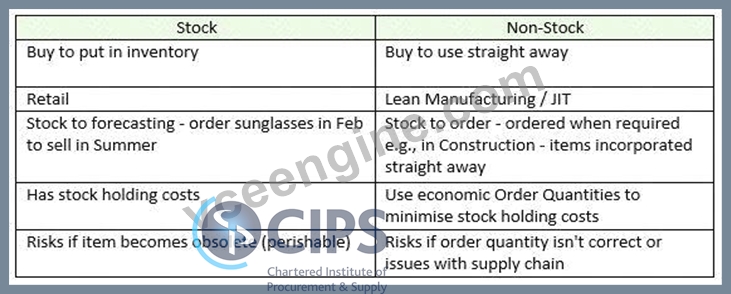
Essay Plan :
Remember to include examples for each of the six categories of spend. This is specifically asked for in the question so it's important to include as many examples as you can. To do this you could take an example organisation such as a cake manufacturer and explain which of their purchases would fall into each category and why.
Introduction - explain why procurement categorises spend
- Direct - these are items that are incorporated into the final goods (the cakes) so would include raw materials such as flour, eggs, sugar etc
- Indirect - these are items that the company needs, but don't go into the end product. For example, cleaning products and MRO supplies for the machines
- Capital Expenditure- these are large one-off purchases, such as buying a new piece of equipment such as a giant oven to cook the cakes.
- Operational Expenditure - these are purchases that are required to ensure the business can function day-to-day. They may include PPE for the workers in the factory and cleaning equipment
- Stock items - these are items procured in advance and held in inventory until they are needed. In a cake manufacturing factory this could be PPE for staff such as hairnets and gloves. The organisation will buy these in bulk and keep them in a stock cupboard, using these as and when they are required
- Non- stock items - items that are not stored and used right away. An example would be eggs- these will need to be put directly into the cakes as they would go off if bought in advance.
Conclusion - the categories are not mutually exclusive - an item can be direct and operational, or indirect and stock. Different companies may use different systems to classify items of spend.
Example Introduction and Conclusion
Introduction
Procurement categorizes spend to efficiently manage resources and make strategic decisions. Three primary ways of categorizing procurement spend include distinguishing between direct and indirect spend, classifying expenditures as capital or operational, and categorizing items as stock or non-stock. These distinctions aid organizations in optimizing their procurement strategies for better resource allocation.
Conclusion:
In conclusion, categorizing procurement spend into direct vs. indirect, capital vs. operational, and stock vs.
non-stock items is essential for strategic resource management. While these categories provide a structured framework, they are not mutually exclusive, as an item can fall into multiple categories. For example, an item may be both direct and operational or indirect and stock. The flexibility of these categories allows organizations to tailor their procurement strategies based on their specific needs, ensuring efficient resource allocation and effective supply chain management. Different companies may adopt varying categorization approaches depending on their industry, size, and operational requirements.
Tutor notes:
- Because you've got 6 categories of spend to talk about you're only going to need 3-4 sentences for each.
Providing you've said the category, explained what it is and given one example, you'll absolutely fly through this type of question
- You could also mention that it is useful to use categories of spend as this helps with budgeting. Different categories may also have different processes to follow for procuring the item (this could form part of your introduction or conclusion).
- This subject is LO 1.3.2 it's quite spread out in the text book but the main info is on p.49
- Note- different companies/ industries classify items of spend differently. Particularly packaging and salaries.
Some say they're direct costs and some say they're indirect costs. Honestly, it's a hotly debated subject and I don't think there is a right or wrong. I'd just avoid those two examples if you can and stick to ones that aren't as contentious like eggs and PPE.
NEW QUESTION # 33
What is a Code of Ethics? What should an Ethical Policy Contain? What measures can an organisation take if there is a breach of their Ethical Policy? (25 points)
Answer:
Explanation:
See the solution in Explanation part below
Explanation:
- Firstly give a short definition of Code of Ethics: a document that sets out moral principles or values about what is right and wrong.
- What an Ethical Policy should contain: Condition of workers, Environment, H+S, Discrimination, Gift / Bribery Policy, Whistleblowing, Confidentiality, Fair Dealings, Declaration of Conflict of Interests. You won't have time to go into depth on all of these, so pick a few where you want to give an example.
- Measures to take if there is a breach: depending on what the breach is and who breached it this could include: education/ training, sanctions, blacklisting, reporting to authorities, publicise the issue, use a performance improvement plan, issue warnings, dismissal.
Example Essay:
A code of ethics is a formal document or set of principles that outlines the values, ethical standards, and expected conduct for individuals within an organization. It serves as a guide for employees and stakeholders, shaping their behaviour and decision-making to align with the organization's ethical framework. It may take the form of a Mission Statement, Core Values, Specific Guidelines or established reporting mechanisms. The purpose of the Code is to establish standards, promote integrity, mitigate risks and build trust- with both internal and external stakeholders.
A Code of Ethics may contain the following:
- Condition of workers - stating what the company will provide to the employees to make sure the environment is safe. This could include the physical environment but also hours worked, opportunities for breaks etc. Depending on the sector it could detail shift patterns, expectations regarding overtime and compensation.
- Environment - this section would discuss compliance with legislation regarding pollution, disposal of waste materials etc. Depending on the company's goals- they may have higher commitments to the environment than those imposed by the government. Additional commitments may include NetZero targets or the use of renewable sources of energy.
- H+S- Health and Safety. Ensuring that the working environment is free of hazards and that workers have the training and equipment they need to complete the work safely. E.g. PPE
- Discrimination- a promise not to discriminate based on any characteristic. Aligns with the Equalities Act. Policy should include how the company would handle situations, for example if an employee reports an issue of discrimination or harassment. This may involve the use of a whistleblowing hotline or details on how to contact HR.
- Gift / Bribery Policy - this area of the code of conduct would explain whether the company allows staff members to receive gifts (e.g. from suppliers) and the processes to complete if they do (e.g. return the item, complete an internal document, donate the gift to charity). Different companies and industries will have different rules surrounding this, the Public Sector is much more likely to reject gifts from suppliers for example.
- Declaration of conflict of interests- this explains what staff should do if there is a conflict. For example if they are running a tender and their father owns one of the suppliers who is bidding for the work. The conflict of interest policy will explain what the person should do, how to report it and have mechanisms in place to ensure that nothing untoward could come of the situation. This may be having another member of staff mark the tender to ensure unbiasedness.
Measures to take in case of a breach
A response to a breach will depend on who breached the policy - whether this is an employee or a supplier. It will also depend on the severity of the breach.
Remedies for a supplier breach could include: education / training if the breach is minor. Supplier development if the relationship with the supplier is very important (for example if there are no other suppliers the buyer could turn to) and the breach is minor. If the breach is major such as fraud or misappropriation of funds, a buyer could look to issue sanctions, claim damages and dismiss the supplier. There could be options to claim liquidated damages if this is included in the contract. For very serious offenses the buyer may blacklist the supplier- never use them ever again and could also report the issue to the police if the breech is also criminal (e.g. modern slavery or fraud).
Remedies for an employee breach could include: for minor breaches training may be required, particularly if it was a junior member of the team and it was an innocent mistake like forgetting to fill out a form when they received a Gift. The employee could be carefully monitored and put on an Improvement Plan. If internal issues are found, such as several staff are breaching the Code of Ethics, senior management could look to review policies to make sure issues are being flagged and responded to in the best way. Employees who fail to follow the Ethical Policy, either through routinely failing to adhere to it or through a major breach could be dismissed from the organisation. There would need to be strong evidence of this.
In conclusion it is important for all organisations regardless of size of industry to have an Ethics Policy. Sharing the code of ethics with staff is a fundamental step in embedding ethical principles into the organizational culture. Regular communication and training reinforce these principles, fostering a shared commitment to ethical behaviour across all levels of the organization.
Tutor Notes
- In an essay like this it's always a good example to use examples. They can be hypothetical - you don't have to know any company's Ethics policy off by heart. E.g. If a supplier breached a buyer's Ethical Policy by employing Child Labour in their factories, an appropriate measure for the buyer to take would be to cancel the contract and find another supplier. This is because not only is Child Labour illegal, the buyer will not want to be associated with this supplier as it will have negative repercussions on their image. The best response would therefore be to distance themselves from the supplier.
- Code of Ethics and an Ethics Policy are the same thing. Just different language. The terms can be used interchangeably
- Study guide p. 128
NEW QUESTION # 34
Analyse FIVE different sources of added value in procurement
and supply.
(25 marks)
Answer:
Explanation:
See the solution in Explanation part below
Explanation:
In procurement and supply, adding value means going beyond simple cost savings to enhance the overall contribution of procurement to the organization's objectives. Added value can be generated in multiple ways, impacting cost, quality, efficiency, innovation, and sustainability. Below are five key sources of added value in procurement and supply, analysed in detail:
1. Cost Reduction and Cost Avoidance
Definition: Cost reduction involves lowering the actual purchase price of goods or services, while cost avoidance refers to actions that prevent costs from increasing in the future.
Through effective supplier negotiations, competitive tendering, bulk purchasing, and long-term contracts, procurement can achieve significant cost savings. Cost avoidance can come from proactive management of risks, improving contract terms, or optimizing specifications to prevent future price hikes.
Impact: This directly improves the organization's profitability by reducing expenditure without compromising quality or service levels.
Example: Renegotiating supplier contracts to achieve better rates or standardizing materials to reduce complexity and cost.
2. Improved Quality and Performance
Definition: Enhancing the quality of goods and services procured to meet or exceed organizational needs.
Procurement contributes added value by specifying and sourcing higher quality materials or services that reduce defects, returns, and downtime. Better quality improves customer satisfaction and product reliability.
Impact: Higher quality inputs lead to better outputs, reducing internal failures and enhancing brand reputation.
Example: Working with suppliers to implement quality assurance processes or selecting suppliers with robust certification and testing capabilities.
3. Innovation and Supplier Collaboration
Definition: Encouraging suppliers to contribute innovative ideas, technologies, or processes that benefit the organization.
Procurement can create value by fostering collaborative relationships with suppliers to drive product innovation, process improvements, and new market opportunities. Early supplier involvement can reduce development times and costs.
Impact: Innovation enhances competitive advantage, supports new product development, and can open up new revenue streams.
Example: Joint development projects with suppliers or using supplier expertise to redesign components for cost efficiency and performance improvement.
4. Risk Management and Supply Continuity
Definition: Identifying and mitigating risks in the supply chain to ensure uninterrupted supply.
Procurement adds value by assessing supplier reliability, geopolitical risks, financial stability, and logistical challenges to minimize disruptions. Contingency planning and diversified sourcing reduce vulnerability.
Impact: Reliable supply chains prevent costly production stoppages and reputational damage, contributing to operational resilience.
Example: Developing dual sourcing strategies or monitoring supplier performance and compliance continuously.
5. Sustainability and Corporate Social Responsibility (CSR)
Definition: Integrating environmental and social considerations into procurement decisions.
Procurement adds value by selecting suppliers who comply with sustainability standards, ethical labor practices, and environmental regulations. This aligns with organizational CSR goals and reduces negative impacts.
Impact: Enhances brand image, meets regulatory requirements, and can reduce waste and resource consumption.
Example: Choosing suppliers with certified green practices or implementing circular economy principles in supply chains.
Conclusion:
Added value in procurement and supply extends beyond price savings to include quality enhancement, innovation, risk mitigation, and sustainability. By strategically managing supplier relationships and aligning procurement activities with organizational goals, procurement professionals can deliver significant and measurable benefits that improve competitive advantage and organizational performance.
NEW QUESTION # 35
Explain what is meant by the term Inventory Management System? Describe MRP and ERP systems explaining when they are used and the advantages and disadvantages of using them (25 points)
Answer:
Explanation:
See the solution in Explanation part below.
Explanation:
How to approach this question:
- Definition of Inventory Management System - a system, usually a piece of digital software, that helps an organisation manage their inventory. It oversees the process of ordering stock, receiving it, storing it and converting it into finished goods. Used predominantly in manufacturing organisations. MRP and ERP are types of IMS.
- MRP - Material Requirements Planning- this is a planning, scheduling, and inventory control system used to manage manufacturing processes. Most MRP systems are software-based. The aim is to automate and improve the efficiency of ordering and processing raw materials.
- ERP - Enterprise Resource Planning - this system uses MRP but also includes other operations such as finance, so allows for budgeting and forecasting, and customer relations. ERP gives an organisation a more holistic overview compared to MRP which just focuses on manufacturing.
- When they are used - predominantly in the manufacturing industry for the ordering of goods. Not used for services. Used when there is a lot of maths involved in figuring out how much of something to order and when e.g. a chocolate manufacturer who needs to produce 50,000 chocolate bars a day. MRP / ERP helps the organisation know what to order, how much and when. It helps achieve the 5 Rights of Procurement.
- Advantages - the advantages of MRP and ERP are very similar and in most cases the same: more accurate than manual processes, quicker response times, automated process frees up people to complete more added value tasks, flexibility, has real time information to inform on decision making, improved responsiveness to customers, improved supply chain management, reduction in costs.
- Disadvantages - expensive, complicated, can break down or be hacked (as they're digital systems), only as good as the information put into them. training required to use.
Example Essay:
IMS
An Inventory Management System (IMS) is a software application or set of tools designed to oversee and optimize the management of a company's inventory. The primary goal of an inventory management system is to maintain an accurate record of stock levels, streamline the procurement process, and ensure efficient order fulfilment. This system plays a crucial role in supporting businesses by helping them avoid stockouts, reduce excess inventory, and enhance overall supply chain efficiency.
Inventory Management Systems have the following functions: demand management (which assists with forecasting, and helps the avoidance of overstocking), helps to control stock levels (by stating minimum and maximum levels), replenishment of stock in line with policies, allows automatic reordering when stock levels get low, tracks stock movements (e.g. around a warehouse), allows communication with suppliers and end users, and helps increase safety by ensuring stock isn't damaged or deteriorating.
MRP
MRP stands for Material Requirements Planning, and it is a computer-based inventory management and production planning system used by businesses to optimize the management of materials, components, and finished products in the manufacturing process. MRP is a key component of Enterprise Resource Planning (ERP) systems, focusing specifically on the planning and control of materials and production resources.
MRP systems uses 3 main modules: 1. Master Production Schedule- information on customer orders, forecast orders, customer requirements and stock orders 2. Bill of Materials - the recipe / breakdown of components of the finished product and 3. Inventory Status File - tells you the current stock levels.
How MRP works- For example, a customer wants to order a new sofa. 1. input the customer order into MRP
2. Check finished stock and if there's a sofa, give the customer that sofa. If there isn't a sofa in stock, the MRP system will look at the Bill of Materials- looking at individual materials needed to make the sofa and will order these, factoring in lead times 3. confirm to customer what the lead time is on getting their new sofa, based on delivery time of materials and time to make it.
MRP is a simple system - it doesn't take into account other business processes and can go wrong due to inaccurate or outdated information.
Advantages of the MRP process include the assurance that materials and components will be available when needed, minimised inventory levels, reduced customer lead times, optimised inventory management, and improved overall customer satisfaction.
Disadvantages to the MRP process include a heavy reliance on input data accuracy (garbage in, garbage out), the high cost to implement, and a lack of flexibility when it comes to the production schedule.
ERP
This is business management software which is used to collect, store, manage, and interpret data from many business activities. It uses MRP but also includes other operations such as finance, HR and customer services.
Therefore it's more powerful than MRP. Where MRP can tell you how much of something to order and what the lead times are, ERP can also consider how many staff are available each day (by looking at holidays and sickness) and factor this into the manufacturing process. It can also produce accurate financial data, manage customer and supplier relationships.
ERP facilitates information flow between all business functions and manages connections to outside stakeholders. SAP and Oracle are examples of ERP systems. There is also ERP II - this extends the system to include links with suppliers and supply chain stakeholders One of the primary advantages of implementing an ERP system is the integration of information across various departments. By providing a unified view of an organization's operations, an ERP system ensures that different functions work with synchronized and consistent data, fostering improved decision-making and collaboration.
Operational efficiency is another significant benefit of ERP systems. Through the automation of routine tasks and streamlined processes, organizations can achieve greater efficiency, reduce manual errors, and enhance overall productivity.
However, one of the primary disadvantages is the high initial implementation costs. Organizations must invest in software licenses, training programs, and customization to align the ERP system with their specific needs.
The complexity of ERP systems and potential customization challenges can pose difficulties, requiring expertise and resources for successful implementation.
Resistance to change among employees is a common hurdle when introducing ERP systems. Employees may be hesitant to adopt new processes and technologies, leading to a slower transition period and potential inefficiencies during the learning curve. Organizations also become dependent on ERP vendors for updates, support, and maintenance, and switching vendors can be disruptive and costly.
In conclusion, while MRP and ERP systems offer numerous advantages in terms of operational efficiency, data integration, and strategic planning, organizations must carefully weigh these benefits against the associated challenges. A well-planned and effectively implemented system can contribute significantly to an organization's success, but the decision to adopt such a system should be approached with a thorough understanding of both its advantages and potential drawbacks.
Tutor Notes
- This is a really hard topic if you don't have a manufacturing background. The way I think about it is this- imagine you're Cadbury's and you're coming up to Easter. How much sugar do you need to buy and when do you need to buy it in order to make all your Easter Eggs? Hard question right? Well MRP / ERP is the clever software that figures that all out for you. It will tell you how much sugar needs to be bought on what day, in order for the delivery time to be right for manufacturing. It will consider storage costs and how quickly Easter Eggs get made in the factory. It's honestly so clever. Feel free to use that example in your essay. Examples like that show the examiner you understand the topic.
- Although they're fabulous systems, using MRP and ERP systems doesn't guarantee success- at the end of the day they're just software- the key to success is in the accuracy of the data that's inputted into the systems and how the systems are used. That would make a strong conclusion.
- This is a good simple video that explains the topic: What is Materials Requirement Planning (MRP)?
(youtube.com) I also like watching How Its Made - a documentary series about factory life. You can find it on BBC Iplayer. If you don't have a manufacturing background it helps give context to some of these dry subjects like MRP and Just-in-Time manufacturing.
- LO 3.4 p. 175
NEW QUESTION # 36
Explain what is meant by Corporate Governance and why having Corporate Governance structures is important. Discuss 2 obstacles which may impede an organisation achieving high levels of Corporate Governance. (25 points)
Answer:
Explanation:
See the solution in Explanation part below.
Explanation:
- Firstly start with a definition of Corporate Governance - this means the rules, policies, processes and organisational structures that ensure an organisation adheres to accepted ethical standards, good practices, the law and regulations. It's the systems put in place which directs and controls organisations to do 'the right thing'.
- Then move on to discuss why having this is important - I'd maybe think of 3-4 examples here such as:
protects the interest of shareholders, reduces risk, moral obligations, legal obligations
- The last part of your essay should talk about the 2 obstacles - describe two from the following list: lack of executive support, poor stakeholder co-operation, lack of clarity and / or resources, having poor IT systems, lack of co-ordination of procurement responsibilities. Because you're only talking about 2 here, you'll need to go into detail about them. So pick 2 you know well. Don't be tempted to talk about more than 2. You won't get extra marks.
Example Essay:
Corporate governance refers to the system of rules, practices, processes, and structures by which a company is directed and controlled. It encompasses the relationships among a company's management, its board of directors, shareholders, and other stakeholders. The primary objective of corporate governance is to ensure that the company operates in an ethical, transparent, and accountable manner, safeguarding the interests of shareholders and promoting long-term value creation. Corporate governance can be defined internally (by shareholders/ managers) or externally (by governments and international standard-setting bodies such as ISO) and is important for all organisations Corporate governance is needed because you can't assume everyone will act ethically- rules and procedures need to be written down and the organisation needs to have recourse for dealing with behaviour that falls outside of what is accepted. Procurement's role in Corporate Governance includes control over finance and expenditure, ensuring the supply chain is 'clean' (i.e. not involved in unethical business practices such as child labour) and risk management.
Why having a corporate governance structure is important:
1) The procurement department has a 'stewardship' role - it controls large sums of organisation's funds.
There are many opportunities to commit fraud, make unethical or biased decisions so it's important that there are corporate governance structures in place to prevent this. It protects the organisation from individuals with bad intent, scandal, and legal repercussions.
2) Strong Corporate Governance is required to successfully manage a supply chain. It's important to ensure good relationships- suppliers need to see you as a 'good customer'. If your organisation is seen to be unethical or underhand, suppliers may not want to work with you.
3) Financial impact - where corporate governance isn't implemented, there may be financial costs for the organisation. For example, in the Public Sector if a supplier successfully challenges a tender award, the buyer may have to award the value of the tender - so there's financial impact on a company if corporate governance isn't followed.
Obstacle 1 - lack of senior management support
Unless there is buy-in from the senior leadership team it will not be possible for departments such as Procurement to implement sound Corporate Governance procedures. Corporate Governance needs to be directed from the top of an organisation to ensure all departments and staff give importance to this. If Senior Leadership are seen not to care about implementing or following Corporate Governance, other staff won't care either. They need to lead by example to ensure the whole organisation 'buys into' the processes.
Obstacle 2 - Poor IT infrastructure.
For Corporate Governance to be effective, an effective IT system must be implemented. For example, to avoid fraud it's not just necessary to have a written anti-fraud policy, there must be ways of checking that fraud isn't being committed. The way to do this is to have an effective IT system which can flag anomaly payments and procurement activities outside of what is considered 'normal'. Therefore, having a poor IT infrastructure is a barrier to effective Corporate Governance.
In conclusion, corporate governance is essential for building trust among stakeholders and contributing to the overall success and sustainability of a company. Effective governance structures and practices instil confidence in investors, enhance the company's reputation, and foster a culture of responsibility and accountability throughout the organization. Good corporate governance is a cornerstone of sound business management and contributes to the long-term prosperity of the company.
Tutor Notes
- Corporate Governance became a big thing in the 70s and 80s following high profile scandals and the collapse of several companies. Investors were concerned about what companies were doing which led to increased control on the powers of directors and greater transparency of corporate actions.
- Examples of Corporate Governance. Enron is a good real life example you could use: Impact of Bad Corporate Governance - Corporate Fraud and Corruption: A Holistic Approach to Preventing Financial Crises (ebrary.net)
- This is a really good real-life example of Public Sector procurement gone wrong: Flawed nuclear tender sees
£100m payout to firms - BBC News
- Adding in some real life examples will take your essay from a Merit result (50-70%) to a Distinction (70% +)
- Another way this topic can come up as a question is describing the elements of corporate governance, or asking what a procurement manager should do when corporate governance is broken/ not followed.
- LO 3.1 p.117
NEW QUESTION # 37
What is the purpose of a CSR policy? What elements should it contain and how can a buyer evaluate a potential suppliers CSR policy? (25 points)
Answer:
Explanation:
See the solution inExplanation partbelow.
Explanation:
How to approach this question
- There are three questions within this question. The purpose could be your introduction, and then take two big sections in the main body of your essay for the elements and how to evaluate it.
Example Essay
A Corporate Social Responsibility (CSR) policy serves as a formal commitment by a company to conduct its business in a socially responsible and sustainable manner. The purpose of a CSR policy is to outline the organization's dedication to ethical practices, environmental stewardship, and social contributions. It reflects a company's commitment to going beyond mere profit generation and actively engaging in initiatives that benefit society and the environment.
Elements of a CSR Policy:
1. Ethical Business Practices:
Clearly articulated principles on fair business dealings, anti-corruption measures, and adherence to ethical standards in all operations.
2. Environmental Sustainability:
Commitments to minimize environmental impact through sustainable practices, energy efficiency, waste reduction, and responsible sourcing of materials.
3. Social Responsibility:
Efforts to contribute positively to the community, which may include support for education, healthcare, poverty alleviation, or other social initiatives.
4. Labor Practices:
Fair and ethical treatment of employees, including non-discrimination, fair wages, safe working conditions, and respect for workers' rights.
5. Supply Chain Responsibility:
A commitment to ensuring that suppliers and partners adhere to similar ethical and CSR standards, promoting responsible practices throughout the entire supply chain.
6. Transparency and Accountability:
Open disclosure of CSR initiatives, performance, and impacts, demonstrating a commitment to transparency and being accountable for CSR goals.
7. Stakeholder Engagement:
A pledge to engage with and consider the interests of various stakeholders, including employees, customers, communities, and shareholders, in decision-making processes.
Evaluating a Supplier's CSR Policy:
Assessing a potential supplier's CSR policy involves a comprehensive examination of key factors to ensure alignment with ethical and responsible business practices:
1. Policy Content:
Review the content of the CSR policy to ensure it covers a broad spectrum of social, environmental, and ethical aspects. A comprehensive policy reflects a commitment to holistic CSR practices.
2. Alignment with Industry Standards:
Check if the CSR policy aligns with industry-specific standards and best practices. Adherence to recognized standards, such as the Global Reporting Initiative (GRI) or ISO 26000, indicates a commitment to global CSR norms.
3. Performance Metrics:
Evaluate whether the supplier includes measurable performance metrics in their CSR policy. Clear objectives and key performance indicators (KPIs) demonstrate a commitment to continual improvement and accountability.
4. Stakeholder Engagement:
Assess how the supplier engages with stakeholders. A robust CSR policy should involve stakeholders in decision-making processes and demonstrate an understanding of their concerns.
5. Supply Chain Responsibility:
Check if the supplier extends CSR principles to its supply chain. This involves ensuring that suppliers and partners adhere to ethical, environmental, and social standards, contributing to a responsible and sustainable supply chain.
6. Transparency and Reporting:
Look for transparency in reporting. A supplier that openly communicates about its CSR initiatives, achievements, and challenges indicates a commitment to accountability and transparency.
7. Continuous Improvement:
Evaluate if the supplier emphasizes a commitment to continuous improvement in its CSR policy. This indicates a dynamic approach to addressing emerging challenges and staying ahead of evolving CSR expectations.
By thoroughly examining these aspects, a buyer can gain insights into a potential supplier's commitment to corporate social responsibility and make informed decisions that align with their own CSR objectives and values.
Tutor Notes
- Students often ask if they can use bullet points in their essays. Many tutors say no, but the answer is actually more nuanced than that. I've purposefully written the above in bullet points to show you how it can be done effectively. Bullet points are fine, providing you're using full sentences and it makes sense as a stylistic choice. It's not a good option if you're just going to list things without context. Then it can be hard to follow.
I've personally used bullet points in essays and done really well. There's no rule against it. You've just got to make sure you're doing it 'right'.
- CSR policies are only briefly mentioned in LO 2.4 but it does come up as quite a big topic in other parts of the syllabus so is worth knowing. You could mention some examples of big companies and what their stance on CSR is. A good one to look at is The Body Shop.
- The study guide references Carroll's Pyramid - this would be great to include in your essay Carroll's CSR Pyramid explained: Theory, Examples and Criticism (toolshero.com) p.112
NEW QUESTION # 38
......
Download Free Latest Exam L4M1 Certified Sample Questions: https://www.vceengine.com/L4M1-vce-test-engine.html
L4M1 Actual Questions - Instant Download 52 Questions: https://drive.google.com/open?id=1aU11YalmQpe1RHxa23Cgg-tlOGbKWqEo
