

[Dec-2021] 5V0-21.20 Exam Dumps Pass with Updated 2021 VMware HCI Master Specialist
Free 5V0-21.20 Exam Dumps to Pass Exam Easily
Difficulty in Writing 5V0-21.20: VMware HCI Master Specialist Exam
5V0-21.20: VMware HCI Master Specialist is a privileged achievement one could be graced with. But adverse to general notion certifying with VMware is not that challenging if the candidates have proper preparation material to pass the 5V0-21.20: VMware HCI Master Specialist exam with good grades. Certification questions consist of the foremost phenomenal and noteworthy queries answers and description that consists of the complete course content. Certification questions have a brilliant 5V0-21.20 exam dumps with most recent and important questions and answers in PDF files. VCEEngine is sure about the exactness and legitimacy of 5V0-21.20: VMware HCI Master Specialist exam dumps and in this manner. Candidates can easily pass the 5V0-21.20: VMware HCI Master Specialist exam with genuine 5V0-21.20 dumps and get VMware certification. These dumps are viewed as the best source to understand the 5V0-21.20: VMware HCI Master Specialist well by simply pursuing examples questions and answers. If a candidate completes practice the exam with certification-test 5V0-21.20 dumps pdf along with self-assessment to get the proper idea on VMware accreditation and to ace the certification exam.
NEW QUESTION 39
What are two factors to consider prior to placing a vSAN node into Maintenance Mode with full data migration? (Choose two.)
- A. Sufficient vSAN free storage capacity must exist.
- B. Number of fault domains required to satisfy storage policies.
- C. VMs registered to the host must be powered off.
- D. vSAN must be disabled from command line on the host.
- E. vSAN node must be removed from the cluster.
Answer: A,D
NEW QUESTION 40
An administrator arrives at work and begins their morning checks on a four node, all-flash vSAN Cluster.
They notice the vSAN datastore reached 99% capacity due to a single node failure.
How can the administrator provide temporary relief?
- A. change FTT=1 with RAID-5 (Erasure coding) to FTT=0 No data redundancy
- B. change FTT=1 with RAID-5 (Erasure coding) to FTT=1 with RAID-1 (Mirroring)
- C. change FTT=1 with RAID-1 (Mirroring) to FTT=0 No data redundancy
- D. change FTT=1 with RAID-1 (Mirroring) to FTT=1 with RAID-5 (Erasure coding)
Answer: D
NEW QUESTION 41
Where would an administrator enable deduplication and compression in a vSAN environment?
- A. at the object level using storage policies
- B. at the disk group level
- C. at the host level using ESXCLI commands
- D. at the cluster level under vSAN services
Answer: A
NEW QUESTION 42
Reference the exhibit.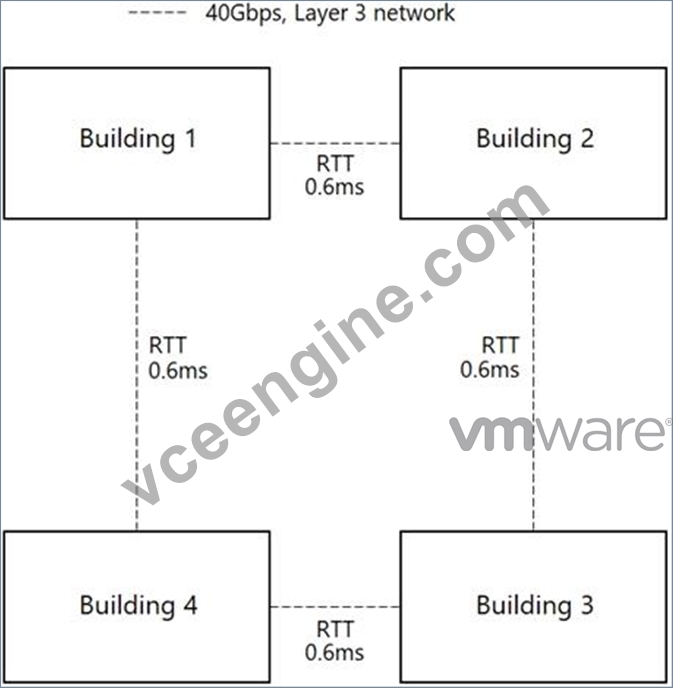
A university campus has a site topology illustrated in the exhibit. Adjacent connected buildings are connected with a single 40gb layer 3 network with a RTT of 0.6ms as depicted by each line. An architect wants to configure a fault domain in each building.
What would the architect need change in order to implement a fully supported vSAN Cluster?
- A. Decrease the existing RTT between the existing links by 0.1ms or more.
- B. Enable IPv6 networks across all buildings for vSAN connectivity.
- C. Add an additional link to the existing adjacent links to make it redundant.
- D. Enable a single Layer 2 network across all buildings for vSAN connectivity.
Answer: C
NEW QUESTION 43
An architect is designing network high availability for a new vSAN Cluster.
Which is a supported configuration for this design?
- A. Configure multicast to use two separate network interfaces for vSAN traffic.
- B. Create an additional TCP/IP stack within the cluster and specify vSAN type.
- C. Use LACP on the distributed switch with a route based on IP hash algorithm.
- D. Create multiple VMkernel adapters on the same subnet for vSAN.
Answer: A
NEW QUESTION 44
Which should be verified before enabling de duplication and compression?
- A. All hosts are in maintenance mode.
- B. Ensure disk groups are balanced.
- C. Autoclaim mode is enabled.
- D. Adequate space is available.
Answer: D
NEW QUESTION 45
Which two statements are true about enabling deduplication and compression on an All-Flash vSAN cluster with data? (Choose two.)
- A. Move one host at a time to maintenance mode and enable deduplication and compression.
- B. On-disk format version 3.0 or later is required to support deduplication and compression.
- C. This can be enabled through storage policies and does not require any data migration.
- D. This requires data evacuation and disk format upgrade of all the disk groups.
- E. Deduplication and Compression cannot be enabled on an existing vSAN datastore with data.
Answer: B,D
Explanation:
Explanation/Reference: https://docs.vmware.com/en/VMware-vSphere/6.7/com.vmware.vsphere.virtualsan.doc/GUID- BD30E413-F870-4C25-9507-123F59D0A4B8.html
NEW QUESTION 46
Which two must be considered when creating a vSAN solution that will utilize VMware vSphere Replication?
(Choose two.)
- A. Additional read I/O will be generated by vSphere Replication.
- B. AES-NI must be enabled prior to using snapshots for replication,
- C. vSAN Encryption cannot be used with vSphere Replication.
- D. Deduplication and compression must be disabled for PIT snapshots,
- E. Point-in-time snapshots count towards component limit.
Answer: C,D
NEW QUESTION 47
Which two are requirements for Kubernetes cluster virtual machines when leveraging vSphere Cloud Native Storage (CNS)? (Choose two.)
- A. Set the Disk Mode to Independent
- B. virtual machine hardware version 15 or higher
- C. set the disk.EnableUUID advanced setting to
- D. minimum of 4 vCPUs per node
- E. configure UEFI firmware
Answer: B,C
NEW QUESTION 48
An architect has been asked to design a vSAN Stretched Cluster. The architect will configure Microsoft Active Directory to replicate between a server on Site A (preferred) and a server on Site B (non-preferred). The architect must minimize the amount of raw storage capacity used.
Which storage policy needs to be applied to the Active Directory server on site A?
- A. None - stretched cluster
- B. Dual site mirronng
- C. None - keep data on Preferred
- D. None - standard cluster
Answer: C
NEW QUESTION 49
A company has reserved the last Saturday of the month to conduct server maintenance. An administrator is allowed to perform maintenance from 5 AM to 12 PM. During the upcoming maintenance window, the administrator will upgrade the controller driver, controller firmware, and vSphere version.
Environment details:
* vCenter is already at the latest version
* 5 node vSAN cluster
* The VMs are using a mix of RAID-0, RAID-1, and RAID-5 policies
* Each node is storing 20 TBs worth of VMs
Which maintenance mode option will allow an administrator to successfully perform the required upgrades, while ensuring all VMs remain online?
- A. Full data migration
- B. Ensure Accessibility
- C. Admission Control Enabled
- D. No Data Migration
Answer: D
NEW QUESTION 50
A failed storage controller has two vSAN disk groups attached. The components contained on the dnves in those disk groups are marked Degraded. vSAN reports that some objects do not comply with their assigned storage policy.
How is the compliance issue resolved?
- A. Rebuilding of the degraded components starts immediately.
- B. Storage policies must be reapplied to all affected objects.
- C. Initiate a proactive rebalance to force component repairs.
- D. Degraded components are repaired after CLOM Repair Delay Timer expires.
Answer: A
NEW QUESTION 51
The Cloud Native Storage control plane in vSphere allows an administrator to provision storage directly from which cloud technology?
- A. AWS EC2 instances
- B. Kubernetes Clusters
- C. Docker nodes
- D. vRealize Automation
Answer: B
NEW QUESTION 52
A vSAN disk group contains one cache drive and four capacity drives. A drive that belongs to this disk group has failed. The entire disk group containing the failed drive is offline.
What are two possible reasons the entire disk group is offline? (Choose two.)
- A. RAID-5/6 (Erase Coding) is one of the failure tolerance methods in use.
- B. Deduplication and compression is enabled on the cluster.
- C. Two capacity drives in the disk group are offline.
- D. Data-at-rest encryption is enabled for the disk group.
- E. The failed drive is configured as a cache drive for the disk group.
Answer: C,E
NEW QUESTION 53
A customer has lost connectivity to one of their sites In a vSAN Stretched Cluster.
When connectivity is restored, what DRS setting will ensure VMs are not migrated back before resyncs are complete?
- A. DRS turned off
- B. DRS configured in Fully Automated mode
- C. DRS configured in Manual Mode
- D. DRS configured in Partially Automated mode
Answer: C
NEW QUESTION 54
A major upgrade of the ESXi code on an existing vSAN cluster was Just completed. Upon logging on to the vSphere Web Client, the vSphere administrator encounters UI timeouts on vSAN specific menus.
What could cause this?
- A. vSAN on-disk format has yet to be upgraded.
- B. vSphere Update Manager is offline.
- C. vSAN Performance Service is offline.
- D. vCenter Server has yet to be upgraded.
Answer: D
NEW QUESTION 55
An administrator is working with an application which has these characteristics:
* latency sensitive
* database striped over multiple virtual disks
* no application redundancy
Which storage policies meet the VM performance and cluster constraint while protecting against at least 1 failure?
- A. RAID 1, Stripe Width 1
- B. RAID 1, Stripe Width 2
- C. RAID 6, Stripe Width 2
- D. RAID 5, Stripe Width 1
Answer: D
NEW QUESTION 56
......
VMware 5V0-21.20 Exam Syllabus Topics:
| Topic | Details |
|---|---|
| Topic 1 |
|
| Topic 2 |
|
| Topic 3 |
|
| Topic 4 |
|
| Topic 5 |
|
| Topic 6 |
|
| Topic 7 |
|
| Topic 8 |
|
| Topic 9 |
|
| Topic 10 |
|
5V0-21.20: VMware HCI Master Specialist Certification Path
5V0-21.20 exam test is foundation level Certification. As such, there is no prerequisite for this course. Anyone who is having a keen interest and familiar with VMware technology is well invited to pursue this certification. The VMware Certified Master Specialist - HCI 2021 badge validates an earner’s ability to deploy and manage a software-defined storage solution with VMware vSAN. Badge earners understand vSAN architecture, features and use cases, and interoperability with VMware vSphere.
Your exam may contain unscored questions in addition to the scored questions, this is a standard testing practice. You will not know which questions are unscored, your exam results will reflect your performance on the scored questions only. VMware exams are scaled on a range from 100-500, with the determined raw cut score scaled to a value of 300. Scaled scoring allows for raw scores from different VMware exams to be scaled to a consistent value. Raw passing scores differ between VMware exams based on different technologies or different levels of competency. A scaled score provides a standard range for test takers and permits direct and fair comparisons of results from one exam form to another.
5V0-21.20 Exam Dumps, 5V0-21.20 Practice Test Questions: https://www.vceengine.com/5V0-21.20-vce-test-engine.html
