

Free Jan-2025 PCNSA Certification Sample Questions certification Exam
Certification Topics of PCNSA Exam PDF Recently Updated Questions
Palo Alto Networks PCNSA (Palo Alto Networks Certified Network Security Administrator) Certification Exam is designed to test the knowledge and skills of network security administrators in configuring, deploying, and managing Palo Alto Networks next-generation firewalls. Palo Alto Networks Certified Network Security Administrator certification exam is an essential qualification for professionals who want to demonstrate their expertise in network security and Palo Alto Networks firewall technology.
The PCNSA exam covers a range of topics related to Palo Alto Networks next-generation firewalls, including deployment, configuration, and management of the firewalls; network security concepts, such as application identification and control, threat prevention, URL filtering, and user identification; and troubleshooting and support for Palo Alto Networks firewalls. PCNSA exam is designed to validate the candidate's understanding of network security principles and their ability to apply these principles in real-world scenarios.
NEW QUESTION # 142
Based on the security policy rules shown, ssh will be allowed on which port?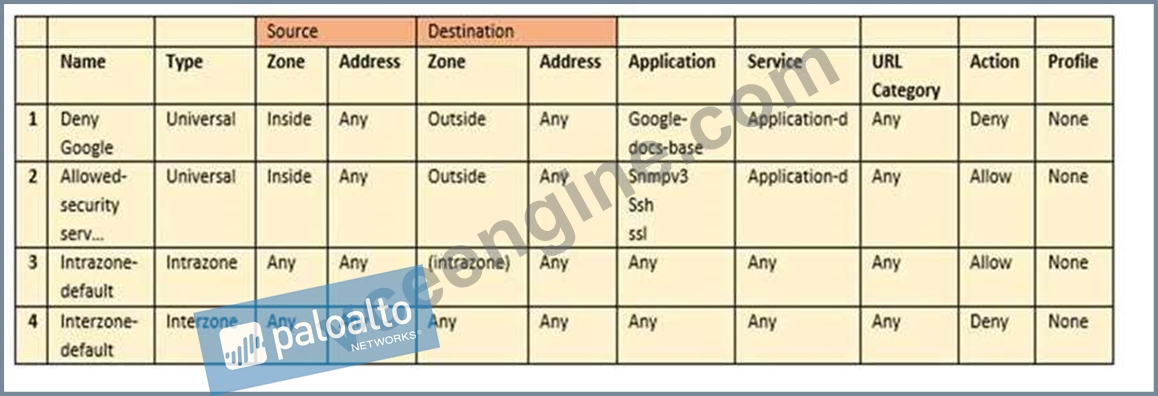
- A. 0
- B. 1
- C. 2
- D. 3
Answer: B
NEW QUESTION # 143
At which stage of the cyber-attack lifecycle would the attacker attach an infected PDF file to an email?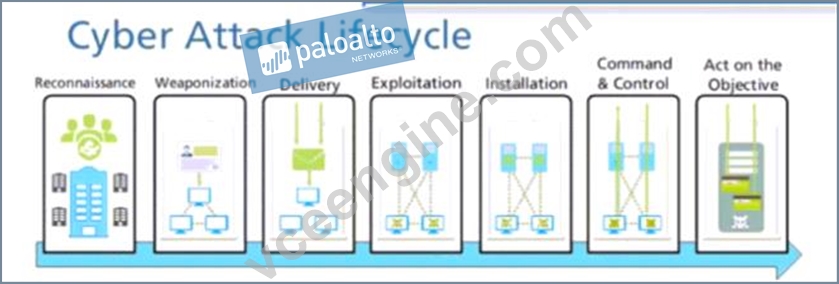
- A. installation
- B. explotation
- C. command and control
- D. delivery
- E. reinsurance
Answer: D
NEW QUESTION # 144
An administrator needs to create a Security policy rule that matches DNS traffic within the LAN zone, and also needs to match DNS traffic within the DMZ zone The administrator does not want to allow traffic between the DMZ and LAN zones.
Which Security policy rule type should they use?
- A. universal
- B. default
- C. interzone
- D. intrazone
Answer: D
NEW QUESTION # 145
When creating a Source NAT policy, which entry in the Translated Packet tab will display the options Dynamic IP and Port, Dynamic, Static IP, and None?
- A. Interface
- B. Translation Type
- C. IP Address
- D. Address Type
Answer: B
NEW QUESTION # 146
What do dynamic user groups you to do?
- A. create a QoS policy that provides auto-remediation for anomalous user behavior and malicious activity
- B. create a policy that provides auto-sizing for anomalous user behavior and malicious activity
- C. create a policy that provides auto-remediation for anomalous user behavior and malicious activity
- D. create a dynamic list of firewall administrators
Answer: C
Explanation:
https://docs.paloaltonetworks.com/pan-os/9-1/pan-os-new-features/user-id-features/dynamic-user-groups#:~:text
NEW QUESTION # 147
An administrator wants to create a NAT policy to allow multiple source IP addresses to be translated to the same public IP address. What is the most appropriate NAT policy to achieve this?
- A. Static IP
- B. Dynamic IP
- C. Destination
- D. Dynamic IP and Port
Answer: D
NEW QUESTION # 148
Your company is highly concerned with their Intellectual property being accessed by unauthorized resources. There is a mature process to store and include metadata tags for all confidential documents. Which Security profile can further ensure that these documents do not exit the corporate network?
- A. URL Filtering
- B. Anti-Spyware
- C. Data Filtering
- D. File Blocking
Answer: C
Explanation:
Use Data Filtering Profiles to prevent sensitive, confidential, and proprietary information from leaving your network.
https://docs.paloaltonetworks.com/pan-os/10-1/pan-os-admin/threat-prevention/set-up-data- filtering
NEW QUESTION # 149
An administrator is configuring a NAT rule. At a minimum, which three forms of information are required? (Choose three.)
- A. destination zone
- B. destination interface
- C. source zone
- D. name
- E. destination address
Answer: A,C,D
NEW QUESTION # 150
Which two security profile types can be attached to a security policy? (Choose two.)
- A. DDoS protection
- B. threat
- C. antivirus
- D. vulnerability
Answer: C,D
NEW QUESTION # 151
Which type of administrative role must you assign to a firewall administrator account, if the account must include a custom set of firewall permissions?
- A. SAML
- B. Multi-Factor Authentication
- C. Dynamic
- D. Role-based
Answer: D
Explanation:
Role Based - Custom roles you can configure for more granular access control over the functional areas of the web interface, CLI, and XML API.
NEW QUESTION # 152
Four configuration choices are listed, and each could be used to block access to a specific URL. If you configured each choices to block the sameURL then which choice would be the last to block access to the URL?
- A. PAN-DB URL category in URL Filtering Profile.
- B. Custom URL category in URL Filtering Profile.
- C. EDL in URL Filtering Profile.
- D. Custom URL category in Security Policy rule.
Answer: C
NEW QUESTION # 153
Which two configurations does an administrator need to compare in order to see differences between the active configuration and potential changes if committed? (Choose two.)
- A. Running
- B. Device state
- C. Candidate
- D. Active
Answer: A,C
NEW QUESTION # 154
Which administrator type utilizes predefined roles for a local administrator account?
- A. Dynamic
- B. Superuser
- C. Role-based
- D. Device administrator
Answer: A
Explanation:
Explanation/Reference: https://docs.paloaltonetworks.com/pan-os/8-0/pan-os-cli-quick-start/get-started-with-the-cli/give- administrators-access-to-the-cli/administrative-privileges?PageSpeed=noscript
NEW QUESTION # 155
Match the network device with the correct User-ID technology.
Answer:
Explanation:
Explanation
Microsoft Exchange - Server monitoring
Linux authentication - syslog monitoring
Windows Client - client probing
Citrix client - Terminal Services agent
NEW QUESTION # 156
Which firewall plane provides configuration, logging, and reporting functions on a separate processor?
- A. control
- B. network processing
- C. security processing
- D. data
Answer: A
NEW QUESTION # 157
Order the steps needed to create a new security zone with a Palo Alto Networks firewall.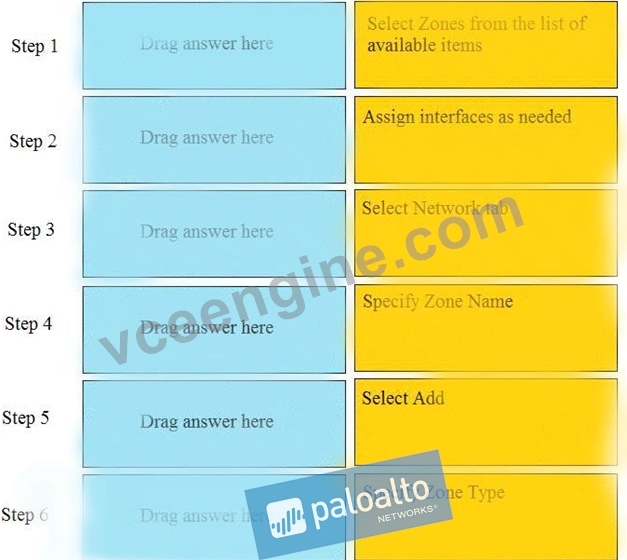
Answer:
Explanation:
Explanation
Step 1 - Select network tab
Step 2 - Select zones from the list of available items
Step 3 - Select Add
Step 4 - Specify Zone Name
Step 5 - Specify Zone Type
Step 6 - Assign interfaces as needed
NEW QUESTION # 158
How does an administrator schedule an Applications and Threats dynamic update while delaying installation of the update for a certain amount of time?
- A. Configure the option for "Threshold"
- B. Automatically "download only" and then install Applications and Threats later, after the administrator approves the update
- C. Disable automatic updates during weekdays
- D. Automatically "download and install" but with the "disable new applications" option used
Answer: A
NEW QUESTION # 159
Which two firewall components enable you to configure SYN flood protection thresholds? (Choose two.)
- A. QoS profile
- B. Zone Protection profile
- C. DoS Protection policy
- D. DoS Protection profile
Answer: B,D
Explanation:
Explanation
Explanation/Reference:
Reference:
https://docs.paloaltonetworks.com/pan-os/9-0/pan-os-admin/policy/security-profiles
NEW QUESTION # 160
Arrange the correct order that the URL classifications are processed within the system.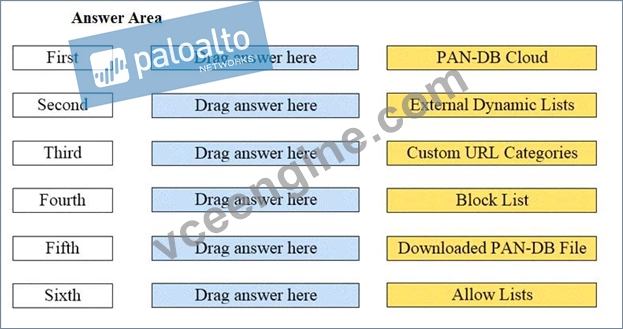
Answer:
Explanation:
Explanation
First - Block List
Second - Allow List
Third - Custom URL Categories
Fourth - External Dynamic Lists
Fifth - Downloaded PAN-DB Files
Sixth - PAN-DB Cloud
NEW QUESTION # 161
If users from the Trusted zone need to allow traffic to an SFTP server in the DMZ zone, how should a Security policy with App-ID be configured?
- A. Source Zone: Trusted
Destination Zone: DMZ
Services: Application-Default
Applications: SSH
Action: Deny - B. Source Zone: Trusted
Destination Zone: DMZ
Services: Application-Default
Applications: SSH
Action: Allow - C. Source Zone: Trusted
Destination Zone: DMZ
Services: SSH
Applications: Any
Action: Allow - D. Source Zone: Trusted
Destination Zone: DMZ
Services: SSH
Applications: Any
Action: Deny
Answer: B
NEW QUESTION # 162
......
2025 New Preparation Guide of Palo Alto Networks PCNSA Exam: https://www.vceengine.com/PCNSA-vce-test-engine.html
PCNSA Exam Prep Guide: Prep guide for the PCNSA Exam: https://drive.google.com/open?id=1Vzm7_PHLFcCWc9mzxlmIP1UZ7QXhZEa7
