

[Jun-2025] CNSP exam torrent The SecOps Group study guide
Use Valid New CNSP Test Notes & CNSP Valid Exam Guide
The SecOps Group CNSP Exam Syllabus Topics:
| Topic | Details |
|---|---|
| Topic 1 |
|
| Topic 2 |
|
| Topic 3 |
|
| Topic 4 |
|
| Topic 5 |
|
| Topic 6 |
|
| Topic 7 |
|
| Topic 8 |
|
| Topic 9 |
|
| Topic 10 |
|
| Topic 11 |
|
| Topic 12 |
|
| Topic 13 |
|
| Topic 14 |
|
NEW QUESTION # 37
What types of attacks are phishing, spear phishing, vishing, scareware, and watering hole?
- A. Insider threats
- B. Social engineering
- C. Ransomware
- D. Probes
Answer: B
Explanation:
Social engineering exploits human psychology to manipulate individuals into divulging sensitive information, granting access, or performing actions that compromise security. Unlike technical exploits, it targets the "human factor," often bypassing technical defenses. The listed attacks fit this category:
Phishing: Mass, untargeted emails (e.g., fake bank alerts) trick users into entering credentials on spoofed sites. Uses tactics like urgency or trust (e.g., typosquatting domains).
Spear Phishing: Targeted phishing against specific individuals/organizations (e.g., CEO fraud), leveraging reconnaissance (e.g., LinkedIn data) for credibility.
Vishing (Voice Phishing): Phone-based attacks (e.g., fake tech support calls) extract info via verbal manipulation. Often spoofs caller ID.
Scareware: Fake alerts (e.g., "Your PC is infected!" pop-ups) scare users into installing malware or paying for bogus fixes. Exploits fear and urgency.
Watering Hole: Compromises trusted websites frequented by a target group (e.g., industry forums), infecting visitors via drive-by downloads. Relies on habitual trust.
Technical Details:
Delivery: Email (phishing), VoIP (vishing), web (watering hole/scareware).
Payloads: Credential theft, malware (e.g., trojans), or financial fraud.
Mitigation: User training, email filters (e.g., DMARC), endpoint protection.
Security Implications: Social engineering accounts for ~90% of breaches (e.g., Verizon DBIR 2023), as it exploits unpatchable human error. CNSP likely emphasizes awareness (e.g., phishing simulations) and layered defenses (e.g., MFA).
Why other options are incorrect:
A . Probes: Reconnaissance techniques (e.g., port scanning) to identify vulnerabilities, not manipulation-based like these attacks.
B . Insider threats: Malicious actions by authorized users (e.g., data theft by employees), not external human-targeting tactics.
D . Ransomware: A malware type (e.g., WannaCry) that encrypts data for ransom, not a manipulation method-though phishing often delivers it.
Real-World Context: The 2016 DNC hack used spear phishing to steal credentials, showing social engineering's potency.
NEW QUESTION # 38
In the context of a Unix-based system, where does a daemon process execute in the memory?
- A. User space
- B. Kernel space
Answer: A
Explanation:
In Unix-based systems, memory is divided into two primary regions: kernel space and user space, each serving distinct purposes for process execution and system stability.
Why B is correct: Daemon processes are background services (e.g., sshd, cron) that run with elevated privileges but operate in user space. User space is the memory area allocated for user applications and processes, isolated from kernel space to prevent direct hardware access or system crashes. CNSP highlights that daemons run in user space to maintain system integrity, interacting with the kernel via system calls.
Why other option is incorrect:
A . Kernel space: Kernel space is reserved for the operating system kernel and device drivers, which have unrestricted access to hardware. Running daemons in kernel space would pose significant security and stability risks, and it is not the standard practice in Unix systems.
NEW QUESTION # 39
Which one of the following is a phishing email?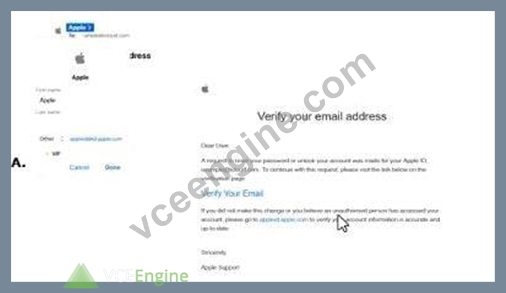

- A. None of the above
- B. Only B
- C. Both A and B
- D. Only A
Answer: B
Explanation:
The screenshot shows an email labeled "B" with the subject "Verify your email address" purportedly from Apple. To determine if this is a phishing email, we need to analyze its content and characteristics against common phishing indicators as outlined in CNSP documentation. Since option A is not provided in the screenshot, we will evaluate email B and infer the context for A.
Analysis of Email B:
Sender and Branding: The email claims to be from "Apple Support" and includes an Apple logo, which is a common tactic to establish trust. However, phishing emails often impersonate legitimate brands like Apple to deceive users.
Subject and Content: The subject "Verify your email address" and the body requesting the user to verify their email by clicking a link ("Verify Your Email") are typical of phishing attempts. Legitimate companies like Apple may send verification emails, but the tone and context here raise suspicion.
Link Presence: The email contains a clickable link ("Verify Your Email") that is purportedly for email verification. The screenshot does not show the URL, but phishing emails often include malicious links that lead to fake login pages to steal credentials. CNSP emphasizes that unsolicited requests to click links for verification are a red flag.
Urgency and Vague Instructions: The email includes a statement, "If you did not make this change or believe an unauthorized person has accessed your account, click here to cancel and secure your account." This creates a sense of urgency, a common phishing tactic to prompt immediate action without critical thinking.
Generic Greeting: The email starts with "Dear User," a generic greeting often used in phishing emails. Legitimate companies like Apple typically personalize emails with the user's name.
Suspicious Elements: The email mentions "your Apple ID ([email protected])," which is a placeholder rather than a specific email address, further indicating a mass phishing campaign rather than a targeted, legitimate communication.
Phishing Indicators (per CNSP):
CNSP documentation on phishing identification lists several red flags:
Unsolicited requests for verification or account updates.
Generic greetings (e.g., "Dear User" instead of a personalized name).
Presence of links that may lead to malicious sites (not verifiable in the screenshot but implied).
Urgency or threats (e.g., "click here to cancel and secure your account").
Impersonation of trusted brands (e.g., Apple).
Email B exhibits multiple indicators: the generic greeting, unsolicited verification request, urgent call to action, and impersonation of Apple.
Option A Context:
Since the screenshot only shows email B, and the correct answer is "Only B," we can infer that email A (not shown) does not exhibit phishing characteristics. For example, A might be a legitimate email from Apple with proper personalization, no suspicious links, or a different context (e.g., a purchase confirmation rather than a verification request).
Evaluation of Options:
1. Only A: Incorrect, as email A is not shown, and the correct answer indicates B as the phishing email.
2. Only B: Correct. Email B shows clear phishing characteristics, such as impersonation, a generic greeting, an unsolicited verification link, and urgency, aligning with CNSP's phishing criteria.
3. Both A and B: Incorrect, as A is implied to be non-phishing based on the correct answer.
4. None of the above: Incorrect, as B is a phishing email.
Conclusion: Email B is a phishing email due to its impersonation of Apple, generic greeting, unsolicited verification request with a link, and use of urgency to prompt action. Since A is not shown but implied to be non-phishing, the correct answer is "Only B."
NEW QUESTION # 40
Which of the following is not a DDoS attack?
- A. NTP Amplification
- B. UDP Flood
- C. Brute Force
- D. SYN Flood
Answer: C
Explanation:
DDoS (Distributed Denial of Service) attacks aim to overwhelm a target's resources with excessive traffic, disrupting availability, whereas other attack types target different goals.
Why D is correct: Brute force attacks focus on guessing credentials (e.g., passwords) to gain unauthorized access, not on denying service. CNSP classifies it as an authentication attack, not a DDoS method.
Why other options are incorrect:
A: SYN Flood exhausts TCP connection resources, a classic DDoS attack.
B: NTP Amplification leverages amplified responses to flood targets, a DDoS technique.
C: UDP Flood overwhelms a system with UDP packets, another DDoS method.
NEW QUESTION # 41
What is the response from an open UDP port which is not behind a firewall?
- A. ICMP message showing Port Unreachable
- B. A FIN packet
- C. A SYN packet
- D. No response
Answer: D
Explanation:
UDP's connectionless nature means it lacks inherent acknowledgment mechanisms, affecting its port response behavior.
Why B is correct: An open UDP port does not respond unless an application explicitly sends a reply. Without a firewall or application response, the sender receives no feedback, per CNSP scanning guidelines.
Why other options are incorrect:
A: ICMP Port Unreachable indicates a closed port, not an open one.
C: SYN packets are TCP-specific, not UDP.
D: FIN packets are also TCP-specific.
NEW QUESTION # 42
Where is the system registry file stored in a Microsoft Windows Operating System?
- A. All of the above
- B. C:\Windows\security
- C. C:\Windows\debug
- D. C:\Windows\System32\Config
Answer: D
Explanation:
The Windows Registry is a hierarchical database storing configuration settings for the operating system, applications, and hardware. It's physically stored as hive files on disk, located in the directory C:\Windows\System32\Config. These files are loaded into memory at boot time and managed by the Windows kernel. Key hive files include:
SYSTEM: Contains hardware and system configuration (e.g., drivers, services).
SOFTWARE: Stores software settings.
SAM: Security Accounts Manager data (e.g., local user accounts, passwords).
SECURITY: Security policies and permissions.
DEFAULT: Default user profile settings.
USERDIFF and user-specific hives (e.g., NTUSER.DAT in C:\Users<username>) for individual profiles, though these are linked to Config indirectly.
Technical Details:
Path: C:\Windows\System32\Config is the primary location for system-wide hives. Files lack extensions (e.g., "SYSTEM" not "SYSTEM.DAT") and are backed by transaction logs (e.g., SYSTEM.LOG) for recovery.
Access: Direct file access is restricted while Windows runs, as the kernel locks them. Tools like reg save or offline forensic utilities (e.g., RegRipper) can extract them.
Backup: Copies may exist in C:\Windows\System32\config\RegBack (pre-Windows 10 1803) or repair folders (e.g., C:\Windows\Repair).
Security Implications: The registry is a prime target for attackers (e.g., persistence via Run keys) and malware (e.g., WannaCry modified registry entries). CNSP likely emphasizes securing this directory (e.g., NTFS permissions) and auditing changes (e.g., via Event Viewer, Event ID 4657). Compromising these files offline (e.g., via physical access) can extract password hashes from SAM.
Why other options are incorrect:
A . C:\Windows\debug: Used for debug logs (e.g., memory.dmp) or tools like DebugView, not registry hives. It's unrelated to core configuration storage.
C . C:\Windows\security: Contains security-related files (e.g., audit logs, policy templates), but not the registry hives themselves.
D . All of the above: Only B is correct; including A and C dilutes accuracy.
Real-World Context: Forensic analysts target C:\Windows\System32\Config during investigations (e.g., parsing SAM with Mimikatz offline).
NEW QUESTION # 43
What user account is required to create a Golden Ticket in Active Directory?
- A. Local User account
- B. Service account
- C. KRBTGT account
- D. Domain User account
Answer: C
Explanation:
A Golden Ticket is a forged Kerberos Ticket-Granting Ticket (TGT) in Active Directory (AD), granting an attacker unrestricted access to domain resources by impersonating any user (e.g., with Domain Admin privileges). Kerberos, per RFC 4120, relies on the KRBTGT account-a built-in service account on every domain controller-to encrypt and sign TGTs. To forge a Golden Ticket, an attacker needs:
The KRBTGT password hash (NTLM or Kerberos key), typically extracted from a domain controller's memory using tools like Mimikatz.
Additional domain details (e.g., SID, domain name).
Process:
Compromise a domain controller (e.g., via privilege escalation).
Extract the KRBTGT hash (e.g., lsadump::dcsync /user:krbtgt).
Forge a TGT with arbitrary privileges using the hash (e.g., Mimikatz's kerberos::golden command).
The KRBTGT account itself isn't "used" to create the ticket; its hash is the key ingredient. Unlike legitimate TGTs issued by the KDC, a Golden Ticket bypasses authentication checks, persisting until the KRBTGT password is reset (a rare event in most environments). CNSP likely highlights this as a high-severity AD attack vector.
Why other options are incorrect:
A . Local User account: Local accounts are machine-specific, lack domain privileges, and can't access the KRBTGT hash stored on domain controllers.
B . Domain User account: A standard user has no inherent access to domain controller credentials or the KRBTGT hash without escalation.
C . Service account: While service accounts may have elevated privileges, they don't automatically provide the KRBTGT hash unless compromised to domain admin level-still insufficient without targeting KRBTGT specifically.
Real-World Context: The 2014 Sony Pictures hack leveraged Golden Tickets, emphasizing the need for KRBTGT hash rotation post-breach (a complex remediation step).
NEW QUESTION # 44
Which of the following is a valid DNS record type?
- A. All of the above
- B. NAPTR record
- C. TXT record
- D. SRV record
Answer: A
Explanation:
DNS (Domain Name System) records define how domain names are mapped to various types of data, each serving a specific purpose in network operations. The question asks for valid DNS record types, and all listed options are recognized.
Why D is correct:
A . NAPTR record: The Naming Authority Pointer (NAPTR) record is used for service discovery and mapping domain names to services, protocols, and ports (e.g., in SIP or ENUM systems).
B . SRV record: The Service (SRV) record specifies the hostname and port for specific services (e.g., LDAP, XMPP), aiding in service location.
C . TXT record: The Text (TXT) record stores arbitrary text data, often for SPF, DKIM, or domain verification.
All are valid DNS record types per RFC standards and CNSP documentation, making "All of the above" the correct answer.
Why other options are incomplete: A, B, or C alone exclude other valid types listed, so D is the most comprehensive response.
NEW QUESTION # 45
Which of the following files has the SGID permission set?
-rwxr-sr-x 1 root root 4096 Jan 1 08:00 myfile
-rwsr-xr-x 1 root root 4096 Jan 1 00:08 myprogram
-rw-r--r-s 1 root root 4896 Jan 1 00:00 anotherfile
- A. All of the above
- B. myprogram
- C. myfile
- D. anotherfile
Answer: C
Explanation:
In Linux, the SGID (Set Group ID) bit alters execution or directory behavior:
On executables: Runs with the group owner's permissions (e.g., s in group execute position).
On directories: New files inherit the directory's group ownership.
Notation: s in group execute field (e.g., -rwxr-sr-x), or S if no execute (e.g., -rwxr-Sr-x).
Analysis:
-rwxr-sr-x (myfile): User: rwx, Group: r-s (SGID), Others: r-x. The s in group execute confirms SGID.
-rwsr-xr-x (myprogram): User: rws (SUID), Group: r-x, Others: r-x. The s is in user execute, not group-no SGID.
-rw-r--r-s (anotherfile): User: rw-, Group: r--, Others: r-s. The s is in others execute, but no x exists, rendering it meaningless (not SGID; could be a typo or sticky bit misapplied).
Security Implications: SGID executables (e.g., /usr/bin/wall) or directories (e.g., /var/local) manage group access. Misuse risks privilege escalation. CNSP likely teaches auditing with find / -perm -g=s.
Why other options are incorrect:
B: SUID, not SGID.
C: No valid SGID; s in others is irrelevant without execute.
D: Only A has SGID.
Real-World Context: SGID on /var/mail ensures mail files inherit the mail group.
NEW QUESTION # 46
What is the response from an open TCP port which is not behind a firewall?
- A. A SYN and an ACK packet
- B. A RST and an ACK packet
- C. A SYN packet
- D. A FIN and an ACK packet
Answer: A
Explanation:
TCP's three-way handshake, per RFC 793, establishes a connection:
Client → Server: SYN (Synchronize) packet (e.g., port 80).
Server → Client: SYN-ACK (Synchronize-Acknowledge) packet if the port is open and listening.
Client → Server: ACK (Acknowledge) completes the connection.
Scenario: An open TCP port (e.g., 80 for HTTP) with no firewall. When a client sends a SYN to an open port (e.g., via telnet 192.168.1.1 80), the server responds with a SYN-ACK packet, indicating willingness to connect. No firewall means no filtering alters this standard response.
Packet Details:
SYN-ACK: Sets SYN and ACK flags in the TCP header, with a sequence number and acknowledgment number.
Example: Client SYN (Seq=100), Server SYN-ACK (Seq=200, Ack=101).
Security Implications: Open ports responding with SYN-ACK are easily detected (e.g., Nmap "open" state), inviting exploits if unneeded (e.g., Telnet on 23). CNSP likely stresses port minimization and monitoring.
Why other options are incorrect:
A . A FIN and an ACK packet: FIN-ACK closes an established connection, not a response to a new SYN.
B . A SYN packet: SYN initiates a connection from the client, not a server response.
D . A RST and an ACK packet: RST-ACK rejects a connection (e.g., closed port), not an open one.
Real-World Context: SYN-ACK from SSH (22/TCP) confirms a server's presence during reconnaissance.
NEW QUESTION # 47
What is the response from a closed TCP port which is behind a firewall?
- A. RST and an ACK packet
- B. A FIN and an ACK packet
- C. No response
- D. A SYN and an ACK packet
Answer: C
NEW QUESTION # 48
An 'EICAR' file can be used to?
- A. Test the response of an antivirus program
- B. Test the encryption algorithms
Answer: A
Explanation:
The EICAR test file is a standardized tool in security testing, designed for a specific purpose.
Why A is correct: The EICAR file (a 68-byte string) triggers antivirus detection without harm, testing response capabilities. CNSP recommends it for AV validation.
Why B is incorrect: It has no role in testing encryption; it's solely for AV functionality.
NEW QUESTION # 49
Which of the following protocols is not vulnerable to address spoofing attacks if implemented correctly?
- A. IP
- B. UDP
- C. ARP
- D. TCP
Answer: D
Explanation:
Address spoofing fakes a source address (e.g., IP, MAC) to impersonate or amplify attacks. Analyzing protocol resilience:
C . TCP (Transmission Control Protocol):
Mechanism: Three-way handshake (SYN, SYN-ACK, ACK) verifies both endpoints.
Client SYN (Seq=X), Server SYN-ACK (Seq=Y, Ack=X+1), Client ACK (Ack=Y+1).
Spoofing Resistance: Spoofer must predict the server's sequence number (randomized in modern stacks) and receive SYN-ACK, impractical without session hijacking or MITM.
Correct Implementation: RFC 793-compliant, with anti-spoofing (e.g., Linux tcp_syncookies).
A . UDP:
Connectionless (RFC 768), no handshake. Spoofed packets (e.g., source IP 1.2.3.4) are accepted if port is open, enabling reflection attacks (e.g., DNS amplification).
B . ARP (Address Resolution Protocol):
No authentication (RFC 826). Spoofed ARP replies (e.g., fake MAC for gateway IP) poison caches, enabling MITM (e.g., arpspoof).
D . IP:
No inherent validation at Layer 3 (RFC 791). Spoofed source IPs pass unless filtered (e.g., ingress filtering, RFC 2827).
Security Implications: TCP's handshake makes spoofing harder, though not impossible (e.g., blind spoofing with sequence prediction, mitigated since BSD 4.4). CNSP likely contrasts this with UDP/IP's vulnerabilities in DDoS contexts.
Why other options are incorrect:
A, B, D: Lack handshake or authentication, inherently spoofable.
Real-World Context: TCP spoofing was viable pre-1990s (e.g., Mitnick attack); modern randomization thwarts it.
NEW QUESTION # 50
Which SMB (Server Message Block) network protocol versions are vulnerable to the EternalBlue (MS17-010) Windows exploit?
- A. SMBv1 only
- B. SMBv3 only
- C. SMBv2 only
- D. Both SMBv1 and SMBv2
Answer: A
Explanation:
EternalBlue (MS17-010) is an exploit targeting a buffer overflow in Microsoft's SMB (Server Message Block) implementation, leaked by the Shadow Brokers in 2017. SMB enables file/printer sharing:
SMBv1 (1980s): Legacy, used in Windows NT/XP.
SMBv2 (2006, Vista): Enhanced performance/security.
SMBv3 (2012, Windows 8): Adds encryption, multichannel.
Vulnerability:
EternalBlue exploits a flaw in SMBv1's SRVNET driver (srv.sys), allowing remote code execution via crafted packets. Microsoft patched it in March 2017 (MS17-010).
Affected OS: Windows XP to Server 2016 (pre-patch), if SMBv1 enabled.
Proof: WannaCry/NotPetya used it, targeting port 445/TCP.
SMBv1 Only: The bug resides in SMBv1's packet handling (e.g., TRANS2 requests). SMBv2/v3 rewrote this code, immune to the specific overflow.
Microsoft: Post-patch, SMBv1 is disabled by default (Windows 10 1709+).
Security Implications: CNSP likely stresses disabling SMBv1 (e.g., via Group Policy) and patching, as EternalBlue remains a threat in legacy environments.
Why other options are incorrect:
B, C: SMBv2/v3 aren't vulnerable; the flaw is SMBv1-specific.
D: SMBv2 isn't affected, only SMBv1.
Real-World Context: WannaCry's 2017 rampage hit unpatched SMBv1 systems (e.g., NHS), costing billions.
NEW QUESTION # 51
If a hash begins with $2a$, what hashing algorithm has been used?
- A. SHA256
- B. SHA512
- C. Blowfish
- D. MD5
Answer: C
Explanation:
The prefix $2a$ identifies the bcrypt hashing algorithm, which is based on the Blowfish symmetric encryption cipher (developed by Bruce Schneier). Bcrypt is purpose-built for password hashing, incorporating:
Salt: A random string (e.g., 22 Base64 characters) to thwart rainbow table attacks.
Work Factor: A cost parameter (e.g., $2a$10$ means 2^10 iterations), making it computationally expensive to brute-force.
Format: $2a$[cost]$[salt][hash]
Example: $2a$10$N9qo8uLOickgx2ZMRZoMyeIjZAgcfl7p92ldGxad68LJZdL17lhWy
$2a$: Bcrypt variant (original is $2$; $2a$ fixes a minor bug).
$10$: 1024 iterations.
Next 22 characters: Salt.
Remaining: Hashed password.
Used in /etc/shadow on Linux, bcrypt's adaptive nature ensures it remains secure as hardware improves. CNSP likely includes it in cryptography modules for its strength over older algorithms like MD5.
Why other options are incorrect:
B . SHA256: Part of the SHA-2 family, outputs a 64-character hexadecimal string (e.g., e3b0c442...), no $ prefix. It's faster, less suited for passwords.
C . MD5: Produces a 32-character hex string (e.g., d41d8cd9...), no prefix. It's cryptographically broken (collisions found).
D . SHA512: SHA-2 variant, 128-character hex (e.g., cf83e135...), no $ prefix, not salted by default.
Real-World Context: Bcrypt protects SSH keys and web app passwords (e.g., in PHP's password_hash()).
NEW QUESTION # 52
The application is showing a TLS error message as a result of a website administrator failing to timely renew the TLS certificate. But upon deeper analysis, it appears that the problem is brought on by the expiration of the TLS certificate. Which of the following statements is correct?
- A. The communication between the browser and the server is still over TLS.
- B. The communication between the browser and the server is now no longer over TLS.
Answer: B
Explanation:
TLS (Transport Layer Security) secures communication (e.g., HTTPS) using certificates, per RFC 8446. A certificate includes:
Validity Period: Start and end dates (e.g., "Not After: March 8, 2025").
Purpose: Authenticates the server and encrypts the session.
Scenario: An expired TLS certificate (e.g., past "Not After" date). Modern browsers (e.g., Chrome, Firefox) validate certificates during the handshake:
ClientHello: Browser initiates TLS.
ServerHello: Server sends its certificate.
Validation: Browser checks expiration, CA trust, etc.
If expired, browsers reject the handshake, displaying errors (e.g., "NET::ERR_CERT_DATE_INVALID"). No session key is negotiated, and communication doesn't proceed over TLS. Users may bypass warnings (e.g., "Advanced > Proceed"), but this is unencrypted or uses a fallback (not standard TLS), breaking security guarantees.
Security Implications: Expired certificates expose sites to MITM attacks, as trust is lost. CNSP likely emphasizes certificate management (e.g., automation with Let's Encrypt) to avoid this.
Why other options are incorrect:
B . The communication is still over TLS: False; an expired certificate halts the TLS handshake in compliant browsers. Legacy systems might negotiate insecurely, but this isn't "TLS" per standards.
Real-World Context: The 2019 Equifax breach partially stemmed from expired certificates missing vulnerabilities.
NEW QUESTION # 53
What kind of files are "Dotfiles" in a Linux-based architecture?
- A. System files
- B. Hidden files
- C. Driver files
- D. Library files
Answer: B
Explanation:
In Linux, file visibility is determined by naming conventions, impacting how files are listed or accessed in the file system.
Why D is correct: "Dotfiles" are files or directories with names starting with a dot (e.g., .bashrc), making them hidden by default in directory listings (e.g., ls requires -a to show them). They are commonly used for user configuration, as per CNSP's Linux security overview.
Why other options are incorrect:
A: Library files (e.g., in /lib) aren't inherently hidden.
B: Driver files (e.g., kernel modules in /lib/modules) aren't dotfiles by convention.
C: System files may or may not be hidden; "dotfiles" specifically denotes hidden status.
NEW QUESTION # 54
You are performing a security audit on a company's network infrastructure and have discovered the SNMP community string set to the default value of "public" on several devices. What security risks could this pose, and how might you exploit it?
- A. Both A and B.
- B. None of the above.
- C. The potential risk is that an attacker could use the SNMP protocol to gather sensitive information about the devices. You might use a tool like Snmpwalk to query the devices for information.
- D. The potential risk is that an attacker could use the SNMP protocol to modify the devices' configuration settings. You might use a tool like Snmpset to change the settings.
Answer: C
Explanation:
SNMP (Simple Network Management Protocol) uses community strings as a basic form of authentication. The default read-only community string "public" is widely known, and if left unchanged, it exposes devices to unauthorized access. The primary risk with "public" is information disclosure, as it typically grants read-only access, allowing attackers to gather sensitive data (e.g., device configurations, network topology) without altering settings.
Why A is correct: With the "public" string, an attacker can use tools like snmpwalk to enumerate device details (e.g., system uptime, interfaces, or software versions) via SNMP queries. This aligns with CNSP's focus on reconnaissance risks during security audits, emphasizing the danger of default credentials enabling passive data collection.
Why other options are incorrect:
B: While modifying settings is a risk with SNMP, the default "public" string is typically read-only. Changing configurations requires a read-write community string (e.g., "private"), which isn't implied here. Thus, snmpset would not work with "public" alone.
C: Since B is incorrect in this context, C (both A and B) cannot be the answer.
D: The risk in A is valid, so "none of the above" is incorrect.
NEW QUESTION # 55
How many octets are there in an IPv6 address?
- A. 0
- B. 1
- C. 2
- D. 3
Answer: A
Explanation:
An IPv6 address, defined in RFC 4291, is a 128-bit address designed to replace IPv4's 32-bit scheme, vastly expanding address space (2^128 vs. 2^32). An octet is 8 bits (1 byte). To calculate octets in IPv6:
128 bits ÷ 8 bits/octet = 16 octets.
Representation:
IPv6 is written as eight 16-bit hexadecimal blocks (e.g., 2001:0db8:85a3:0000:0000:8a2e:0370:7334), separated by colons.
Each block is 16 bits (2 bytes), so 8 blocks = 16 octets.
Contrast with IPv4 (e.g., 192.168.0.1), which has 4 octets (32 bits).
Technical Note: Your original input flagged this question's phrasing as potentially misleading, suggesting "octets" is an IPv4 term, while IPv6 uses "16-bit groups" or "hextets." While technically accurate (RFC 4291 uses "16-bit blocks"), "octets" remains a common, if informal, term in security contexts for byte-wise analysis (e.g., packet crafting). CNSP might use "octets" to test byte-level understanding, though "groups" is more precise for IPv6. Here, 16 octets (128 bits) is correct either way.
Security Implications: IPv6's larger address space complicates scanning (e.g., Nmap struggles with 2^128 possibilities) but introduces risks like misconfigured Neighbor Discovery Protocol (NDP). Understanding its structure aids in firewall rules and IDS signatures.
Why other options are incorrect:
B . 32: Implies 256 bits (32 × 8), far exceeding IPv6's 128-bit design.
C . 64: Suggests 512 bits (64 × 8), unrelated to IPv6 or any IP standard.
D . 128: Misinterprets octets as bits; 128 bits = 16 octets, not 128 octets.
Real-World Context: IPv6 packet analysis (e.g., Wireshark) breaks addresses into 16 octets for raw data inspection.
NEW QUESTION # 56
Which one of the following services is not a UDP-based protocol?
- A. IKE
- B. NTP
- C. SSH
- D. SNMP
Answer: C
Explanation:
Protocols are defined by their transport layer usage (TCP or UDP), impacting their security and performance characteristics.
Why D is correct: SSH (Secure Shell) uses TCP (port 22) for reliable, connection-oriented communication, unlike the UDP-based options. CNSP contrasts TCP and UDP protocol security.
Why other options are incorrect:
A: SNMP uses UDP (ports 161, 162) for lightweight network management.
B: NTP uses UDP (port 123) for time synchronization.
C: IKE (IPsec key exchange) uses UDP (ports 500, 4500).
NEW QUESTION # 57
Which of the following commands will work on a Microsoft operating system to add a new domain admin user?
- A. net group "Administrator" John /add
- B. net user John "Domain Admins" /add /domain
- C. net group "Domain Admins" John /add /domain
- D. net user John /add /domain /admin
Answer: C
Explanation:
Adding a user to a domain group like "Domain Admins" requires the correct command and scope (domain vs. local).
Why A is correct: net group "Domain Admins" John /add /domain adds user John to the domain-level "Domain Admins" group, per CNSP's domain privilege management.
Why other options are incorrect:
B: net user creates users, not group memberships; syntax is wrong.
C: /admin is invalid; correct group specification is missing.
D: Targets local "Administrator" group, not domain "Domain Admins".
NEW QUESTION # 58
In a Linux-based architecture, what does the /mnt directory contain?
- A. Temporary-mounted filesystems
- B. System files which represent the current state of the kernel
- C. Loadable driver modules needed to boot the system
- D. System configuration files and initialization scripts
Answer: A
Explanation:
The Linux Filesystem Hierarchy Standard (FHS), per FHS 3.0, defines directory purposes:
/mnt: Designated for temporarily mounted filesystems, typically by system administrators.
Use: Mount points for removable media (e.g., USB drives: mount /dev/sdb1 /mnt/usb) or network shares (e.g., NFS).
Nature: Transient, user-managed, not persistent across reboots (unlike /etc/fstab mounts).
Contrast:
/media: Auto-mounts removable devices (e.g., by desktop environments like GNOME).
/mnt vs. /media: /mnt is manual, /media is system-driven.
Technical Details:
Empty by default; subdirectories (e.g., /mnt/usb) are created as needed.
Permissions: Typically root-owned (0755), requiring sudo for mounts.
Security Implications: Misconfigured /mnt mounts (e.g., world-writable) risk unauthorized access. CNSP likely covers mount security (e.g., nosuid option).
Why other options are incorrect:
B . System config/init scripts: Found in /etc (e.g., /etc/passwd, /etc/init.d).
C . Driver modules: Located in /lib/modules/<kernel-version>.
D . Kernel state: Resides in /proc (e.g., /proc/cpuinfo).
Real-World Context: Admins mount ISOs at /mnt during server provisioning (e.g., mount -o loop image.iso /mnt).
NEW QUESTION # 59
Which one of the following is not an online attack?
- A. Brute force attack
- B. Password spraying attack
- C. Rainbow table attack
- D. Phishing attack
Answer: C
Explanation:
Online attacks require real-time interaction with a target system (e.g., a login interface), whereas offline attacks occur without direct system interaction, typically after obtaining data like password hashes. A rainbow table attack is an offline method that uses precomputed tables of hash values to reverse-engineer passwords from stolen hash databases, distinguishing it from the other options, which are online.
Why B is correct: Rainbow table attacks are performed offline after an attacker has already acquired a hash (e.g., from a compromised database). The attacker matches the hash against precomputed tables to find the plaintext password, requiring no interaction with the target system during the attack. CNSP classifies this as an offline password recovery technique.
Why other options are incorrect:
A: Brute force attacks involve repeatedly submitting password guesses to a live system (e.g., via SSH or a web login), making it an online attack.
C: Password spraying attacks test a few common passwords across many accounts on a live system, also an online attack aimed at avoiding lockouts.
D: Phishing attacks trick users into submitting credentials through fake interfaces (e.g., emails or websites), requiring real-time interaction and thus classified as online.
NEW QUESTION # 60
Which of the following files has the SUID permission set?
-rwxr-sr-x 1 root root 4096 Jan 1 00:00 myfile
-rwsr-xr-x 1 root root 4896 Jan 1 08:00 myprogram
-rw-r--r-s 1 root root 4096 Jan 1 00:00 anotherfile
- A. All of the above
- B. myfile
- C. myprogram
- D. anotherfile
Answer: C
Explanation:
In Linux/Unix, file permissions are displayed in a 10-character string (e.g., -rwxr-xr-x), where the first character is the file type (- for regular files) and the next nine are permissions for user (owner), group, and others (rwx = read, write, execute). Special bits like SUID (Set User ID) modify execution behavior:
SUID: When set, a program runs with the owner's permissions (e.g., root) rather than the executor's. It's denoted by an s in the user execute position (replacing x if executable, or capitalized S if not).
Analysis:
-rwxr-sr-x (myfile): User: rwx, Group: r-s (SGID), Others: r-x. The s is in the group execute position, indicating SGID, not SUID.
-rwsr-xr-x (myprogram): User: rws (SUID), Group: r-x, Others: r-x. The s in the user execute position confirms SUID; owned by root, it runs as root.
-rw-r--r-s (anotherfile): User: rw-, Group: r--, Others: r-s. The s is in the others execute position, but no x exists, making it irrelevant (and not SUID). Typically, s here would be a sticky bit on directories, not files.
Security Implications: SUID binaries (e.g., /usr/bin/passwd) are common targets for privilege escalation if misconfigured (e.g., writable by non-root users). CNSP likely emphasizes auditing SUID permissions with find / -perm -u=s.
Why other options are incorrect:
A . myfile: Has SGID (s in group), not SUID.
C . anotherfile: The s doesn't indicate SUID; it's a misapplied bit without execute permission.
D . All of the above: Only myprogram has SUID.
Real-World Context: Exploiting SUID binaries is a classic Linux attack vector (e.g., CVE-2016-1247 for Nginx).
NEW QUESTION # 61
What is the response from a closed TCP port which is not behind a firewall?
- A. ICMP message showing Port Unreachable
- B. A RST and an ACK packet
- C. A FIN and an ACK packet
- D. A SYN and an ACK packet
Answer: B
Explanation:
TCP uses a structured handshake, and its response to a connection attempt on a closed port follows a specific protocol when unobstructed by a firewall.
Why C is correct: A closed TCP port responds with a RST (Reset) and ACK (Acknowledgment) packet to terminate the connection attempt immediately. CNSP highlights this as a key scanning indicator.
Why other options are incorrect:
A: ICMP Port Unreachable is for UDP, not TCP.
B: FIN/ACK is for closing active connections, not rejecting new ones.
D: SYN/ACK indicates an open port during the TCP handshake.
NEW QUESTION # 62
......
CNSP Exam questions and answers: https://www.vceengine.com/CNSP-vce-test-engine.html
CNSP Actual Questions Answers PDF 100% Cover Real Exam Questions: https://drive.google.com/open?id=1AjCKjW8xft1CcNRPzmwa7ZxK0SNREjqt
