

Jun-2025 Get Totally Free Updates on ATM Dumps PDF Questions
Prepare With Top Rated High-quality ATM Dumps For Success in ATM Exam
NEW QUESTION # 21
Which one of the following metrics to be produced needs traceability between the test cases and each item in a proper test basis?
- A. Trends in the lag time from defect reporting to resolution
- B. Requirements coverage
- C. Cumulative number of reported defects versus cumulative number of resolved defects
- D. Mean time between failures for the system
Answer: B
Explanation:
Explanation/Reference:
Explanation:
NEW QUESTION # 22
A chart showing the trend in the lag time from defect reporting to resolution during system testing is also available. The chart shows that the daily closure period is consistently and significantly above the rolling closure period for a long period of the system testing phase.
Almost all defects found during system testing have been related to the system as a whole, not related to single units or integrations issues. Almost all quality risks have been addressed during the unit and integration testing phase and no residual quality risks were present in the integrated system. This has been confirmed by exploratory testing sessions performed during system testing, targeted at finding defects in these quality risk areas.
Based on the given information only, which one of the following areas would you expect to be considered more in the retrospective meeting in order to be improved?
- A. The quality risk analysis process
- B. The requirements review
- C. The defect management process
- D. The system design and architecture design reviews
Answer: C
Explanation:
Section: Improving the Testing Process
Explanation/Reference:
NEW QUESTION # 23
Consider the following list of statements about audits and management reviews:
I. Audits are usually more effective than management reviews at finding defects
II. Audits and management reviews have the same main goals, the only difference is
related to the roles and level of formality
III. A typical outcome of an audit includes observations and recommendations, corrective
actions and a pass/fail assessment
IV. An audit is not the appropriate mechanism to use at the code review in order to detect
defects prior to dynamic testing
Which of the following statements is true?
K2 1 credit
- A. II. and III are true; I. and IV. are false;
- B. III. and IV. are true; I and II are false;
- C. I. and III. are true; II. and IV. are false;
- D. I, III and IV are true; II. is false;
Answer: B
NEW QUESTION # 24
What is the purpose of lest control?
- A. To return the test environment to its starting state and data
- B. To monitor the testing
- C. To project detect trends and outcomes
- D. To take corrective actions required to meet the test objectives
Answer: D
Explanation:
* Definition:
* Test control involves monitoring and taking actions to align testing with objectives, addressing deviations in test progress or outcomes.
* Evaluation of Options:
* A. To monitor the testing:
* Incorrect. Monitoring is part of the process but does not define the purpose of test control.
* B. To return the test environment to its starting state and data:
* Incorrect. This pertains to test environment setup or cleanup, not test control.
* C. To project detect trends and outcomes:
* Incorrect. Detecting trends is part of monitoring, not control.
* D. To take corrective actions required to meet the test objectives:
* Correct. Test control is proactive, focusing on corrective measures to ensure test objectives are met (Syllabus section TM-1.5.3).
References:
* ISTQB Advanced Level Test Management Syllabus=========================
NEW QUESTION # 25
What occurs In the retrospective closing?
- A. A brainstorming session is held to discuss the solutions to the root causes of the most significant issues
- B. The strengths and opportunities for improvement in the retrospectives are discussed
- C. The data collection methods are reviewed
- D. Everyone shakes hands
Answer: B
Explanation:
* Purpose of Retrospectives:
* Retrospectives are team meetings aimed at reflecting on the work process to identify what went well (strengths) and areas that can be improved (opportunities).
* This aligns with continuous process improvement practices.
* Evaluation of Options:
* A(Everyone shakes hands) is trivial and not a core activity.
* B(Reviewing data collection methods) may be part of broader discussions but is not the primary focus.
* Cis correct because it directly reflects retrospective goals.
* D(Brainstorming solutions) typically occurs in follow-up sessions, not during the retrospective itself.
References and Syllabus Alignment:
* Retrospective practices are emphasized in "Improving the Test Process" (TM-1.5.4) in the syllabus.
NEW QUESTION # 26
Assume that you are the Test Manager for a small insurance application development project.
You have decided to adopt a risk-based testing strategy: 5 product risks (R1, R2, R3, R4, R5) have been identified and their levels of risk have been assessed. 10 test cases (T1, ..., T10) have been designed to cover all the product risks.
The following table shows the risk level and the test cases associated to the identified product risks (higher risk level means higher risk):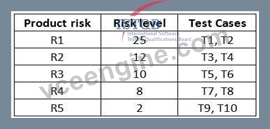
You are not confident with the assessment of the risk level and you suspect that it will be possible to find high- priority bugs in low-risk areas.
Furthermore the period for test execution is very short. Your goal is to test all the product risks in a risk-based way, while assuring that each product risk gets at least some amount of testing.
Which of the following answers describes the best test execution schedule in this scenario?
- A. T10, T9, T8, T7, T6, T5, T4, T3, T2, T1
- B. T10, T8, T6, T4, T2, T9, T7, T5, T3, T1
- C. T1, T3, T5, T7, T9, T2, T4, T6, T8, T10
- D. T1, T2, T3, T4, T5, T6, T7, T8, T9, T10
Answer: C
Explanation:
Section: Testing Process
Explanation/Reference:
NEW QUESTION # 27
Assume you are working on a CAS (Conditional Access System) for Pay-TV that allows the
access, selection and transfer of services and media to authorized users. Authorized users
can choose their services through different channels: Web Customer Portal, IVR
(Interactive Voice Response), Call Centre and SMS. The system uses a Smart Card to
receive and decrypt the broadcasted encrypted control words which allow decrypting pay-
per-view TV. Every authorized user must have a Smart Card and a Set-Top Box to view the
contents.
The following is an excerpt from the product risk analysis document:
Both likelihood and impact have been rated on the following scale: (1 - Very low, 2 - Low,
3 - Medium, 4 - High, 5 - Very High).
The required test environment and code have been delivered. All test cases for each
identified product risk item have been written and are ready to be executed. The Database
used to contain the Smart Cards is empty and so only new Smart Cards can be used
during test execution.
A Smart Card can only be activated if it has been previously pre-activated. This means the
post-conditions for the execution of the test cases to test the pre-activation of the Smart
Card are the pre-conditions for activation of the Smart Card.
Which of the following statements represents the most effective contribution of the
stakeholders to the completion of the failure mode analysis table?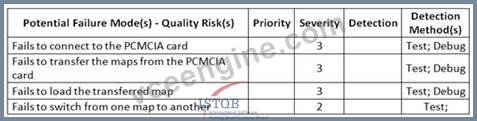
K4 3 credits
- A. The aircraft pilot and the customer representative should contribute to assess the
detection. The chief software engineer, the system architect and the expert tester should
contribute to assess the priority. - B. The aircraft pilot and the customer representative should contribute to assess the
priority. The chief software engineer, the system architect and the expert tester should
contribute to assess the detection. - C. The system architect and the chief software engineer should contribute to assess the
priority. The expert tester is the only one who should contribute to assess the detection. - D. The aircraft pilot is the only one qualified to contribute to assess the priority and thus
should be assigned this task. The customer representative should contribute to assess the
detection.
Answer: B
NEW QUESTION # 28
The following chart plots the cumulative number of defects opened against the cumulative number of defects closed during system testing of a software product.
Which of the following statements is true?
- A. The chart can be used to reveal test progress problems
- B. The chart seems to indicate that the defect management process is working well
- C. The chart indicates that you have plenty of problems left to find
- D. The chart seems to indicate that the defect management process is not working well
Answer: B
Explanation:
Section: Test Management
Explanation/Reference:
NEW QUESTION # 29
Which one of the following metrics to be produced needs traceability between the test
cases and each item in a proper test basis?
K2 1 credit
- A. Trends in the lag time from defect reporting to resolution
- B. Requirements coverage
- C. Cumulative number of reported defects versus cumulative number of resolved defects
- D. Mean time between failures for the system
Answer: B
NEW QUESTION # 30
Which of the Mowing should be used to understand the context of testing within an organization?
- A. The organizational test strategy
- B. Stakeholder organization chart
- C. The schedule
- D. The budget
Answer: A
Explanation:
* Context Analysis:
* The test strategy defines thContext Analysis:
* Monitoring code coverage is inherently tied to knowledge of the internal structure of the software, a characteristic of white-box testing.
* Evaluation of Options:
* A. Black-box:
* Incorrect. Black-box testing focuses on functionality without knowledge of internal structures.
* B. White-box:
* Correct. White-box testing uses internal code knowledge to determine areas that need more coverage.
* C. Functional:
* Incorrect. Functional testing assesses functionality without inspecting internal code.
* D. Non-functional:
* Incorrect. Non-functional testing focuses on performance, usability, etc., not code coverage.
* Syllabus Alignment:
* ISTQB associates code coverage monitoring with white-box testing techniques (TM-1.2.6).
References:
* ISTQB Advanced Level Test Management Syllabus (TM-1.2.6)
* approach, resources, and processes for testing within an organization. It provides insight into the testing context.
* Evaluation of Options:
* A. The organizational test strategy:
* Correct. It offers a comprehensive understanding of the organization's testing framework.
* B. Stakeholder organization chart:
* Incorrect. Useful for identifying roles but does not provide a testing context.
* C. The schedule:
* Incorrect. Reflects timelines but not testing approaches or resources.
* D. The budget:
* Incorrect. Indicates financial constraints but not the testing context.
* Syllabus Alignment:
* ISTQB emphasizes using the organizational test strategy to understand the testing context (TM-
1.4.1).
References:
* ISTQB Advanced Level Test Management Syllabus (TM-1.4.1)
NEW QUESTION # 31
In the next two months some new features will be constantly added to new releases of a
project you are working on as Test Manager.
You have identified as one of the main project risks, that the requirements specification will
still be incomplete when your team starts the test design and implementation phase.
Some requirements will most likely be completed too late to allow a proper test preparation.
You and your test team have already worked on several similar past projects in the same
organization.
Which one of the following options would you expect to be the most effective at mitigating
this risk?
K4 3 credits
- A. Don't design any test until the test execution starts, then communicate that test
execution is blocked due to incomplete requirements - B. Don't prepare any test and just run the regression test suite to check that the new
features don't introduce regression - C. Make reasonable assumptions about the missing details and design lightweight tests
that can be easily updated during test execution - D. Even if there are only few details missing, escalate the risk to the project manager
without preparing any tests
Answer: C
NEW QUESTION # 32
In your organization the following tools of the same vendor are currently in use a requirements management tool, a test management tool and a bug tracking tool.
You are the Test Manager.
You are currently evaluating a test automation tool of the same vendor (to complete the vendor's tool suite) against an interesting open-source test automation tool under the GNU GPL (General Public License).
There are no initial costs associated to that open-source tool.
Which of the following statements associated to the selection of the open-source tool is correct in this scenario?
- A. There are no initial costs for the open-source tool but you should carefully consider the costs associated to the integration with the existing tools and also evaluate the recurring costs
- B. The open-source tool can be modified but only if the community of developers of that tool gives you the formal permission to modify it
- C. The open-source tool can be modified but it can't be distributed further in any way
- D. There are no initial costs for the open-source tool because open-source tools are usually low-quality, while vendor tools have always a better quality than the corresponding open-source tools
Answer: A
Explanation:
Explanation/Reference:
Explanation:
NEW QUESTION # 33
You are working for an outsource testing company You have a client that will only consider candidates that are highly skilled with Salesforce. regardless of the number of years they have spent testing similar products You have looked through your skills matrix and you have no one with the right type of experience for this project.
What competence area is your team lacking?
- A. Professional competence because they do not have the required domain knowledge in Salesforce
- B. Personal competence because they are not confident enough to pass the interviews with the client and they are not willing to learn Salesforce
- C. Methodical competence because they lack the ability to create test cases from a Salesforce requirements document
- D. Social competence because they are lacking the ability to work with the rest of the team
Answer: A
Explanation:
* Competence Analysis:
* Professional competence refers to the knowledge and skills related to the specific domain, in this case, Salesforce.
* The client's requirement emphasizes expertise in Salesforce, which your team lacks.
* Evaluation of Options:
* A(Social competence) andB(Personal competence) focus on interpersonal skills and attitude, not domain knowledge.
* C(Methodical competence) involves creating test cases, which is unrelated to the issue described.
* Dis correct as the team lacks the required Salesforce-specific professional competence.
References and Syllabus Alignment:
* Professional competence is highlighted under "Test Team Competencies" (TM-3.1.1).
NEW QUESTION # 34
Assume you are working on a CAS (Conditional Access System) for Pay-TV that allows the access, selection and transfer of services and media to authorized users. Authorized users can choose their services through different channels: Web Customer Portal, IVR (Interactive Voice Response), Call Centre and SMS. The system uses a Smart Card to receive and decrypt the broadcasted encrypted control words which allow decrypting pay-per-view TV. Every authorized user must have a Smart Card and a Set-Top Box to view the contents.
The following is an excerpt from the product risk analysis document:
Both likelihood and impact have been rated on the following scale: (1 - Very low, 2 - Low, 3 - Medium, 4 - High, 5 - Very High).
The required test environment and code have been delivered. All test cases for each identified product risk item have been written and are ready to be executed. The Database used to contain the Smart Cards is empty and so only new Smart Cards can be used during test execution.
A Smart Card can only be activated if it has been previously pre-activated. This means the post-conditions for the execution of the test cases to test the pre-activation of the Smart Card are the pre-conditions for activation of the Smart Card.
Which of the following statements represents the most effective contribution of the stakeholders to the completion of the failure mode analysis table?
- A. The aircraft pilot and the customer representative should contribute to assess the priority. The chief software engineer, the system architect and the expert tester should contribute to assess the detection.
- B. The aircraft pilot and the customer representative should contribute to assess the detection. The chief software engineer, the system architect and the expert tester should contribute to assess the priority.
- C. The system architect and the chief software engineer should contribute to assess the priority. The expert tester is the only one who should contribute to assess the detection.
- D. The aircraft pilot is the only one qualified to contribute to assess the priority and thus should be assigned this task. The customer representative should contribute to assess the detection.
Answer: A
Explanation:
Explanation/Reference:
Explanation:
NEW QUESTION # 35
In the test strategy document your organization declares:
- To adopt a V-model development lifecycle, with three formal levels of testing unit, integration and system testing
- To use a blended risk-based and regression-averse testing strategy for each level of testing The following is an excerpt of the "approach" section for the system test plan document of a new project:
"Testing will only use manual tests. Due to the short period of time for test execution, the following activities will be performed in parallel with test execution: Test planning, test analysis and test design.
Basic metrics will be taken for test effort (i.e. person-hours), test cases executed (passed/failed), and incidents (no more metrics, such as code coverage, will be collected)." In the system test plan, no deviations from the test strategy are described.
Based only on the given information, which of the following statements is true?
- A. The approach described in the system test plan document is consistent with the regression testing strategy, but it is inconsistent with the risk-based testing strategy
- B. The approach described the system test plan document is inconsistent with both the risk-based and regression testing strategies
- C. The approach described in the system test plan document is consistent with the test strategy
- D. The approach described in the system test plan document is consistent with the risk-based testing strategy, but it is inconsistent with the regression testing strategy
Answer: B
Explanation:
Explanation/Reference:
Explanation:
NEW QUESTION # 36
The main objectives the senior management team wants to achieve are:
- to reduce the costs associated with dynamic testing
- to use reviews to ensure that the project is on course for success and following the plan
- to use reviews as a well-documented and effective bug-removal activity following a formal
process with well-defined roles
- to determine the effectiveness of reviews in terms of phase containment
- to improve phase containment effectiveness
Which of the following answers would you expect to describe the best way to achieve these
objectives?
K4 3 credits
- A. You should plan for formal exit-phase reviews at the end of each development and
testing phase, and plan for a process of gathering information from testing to perform an
analysis of the bugs found during testing to determine the phase in which they have been
introduced - B. You should plan for formal exit-phase reviews at the end of each development phase
and testing phase, and plan for a process of gathering information from testing to perform
an analysis of the bugs found during testing to determine the people responsible for those
bugs - C. You should plan for lightweight exit-phase reviews at the end of each development and
testing phase, and plan for a process of gathering information from testing to perform an
analysis aimed at identifying the larger cluster of defects - D. You should plan for formal exit-phase reviews at the end of each development and
testing phase, and plan for a process of gathering information from testing to perform an
analysis aimed at identifying the larger cluster of defects
Answer: A
NEW QUESTION # 37
Assume you are the Test Manager for a new software release of an e-commerce application.
The server farm consists of six servers providing different capabilities. Each capability is provided through a set of web services.
The requirements specification document contains several SLAs (Service Level Agreements) like the following:
SLA-001: 99.5 percent of all transactions shall have a response time less than five seconds under a load of up-to 5000 concurrent users
The main objective is to assure that all the SLAs specified in the requirements specification document will be met before system release. You decide to apply a risk-based testing strategy and an early risk analysis confirms that performance is high risk. You can count on a well-written requirements specification and on a model of the system behavior under various load levels produced by the system architect.
Which of the following test activities would you expect to be the less important ones to achieve the test objectives in this scenario?
- A. Perform unit performance testing for each single web service
- B. Monitor the SLAs after the system has been released into the production environment
- C. Perform static performance testing by reviewing the architectural model of the system under various load levels
- D. Perform system performance testing, consisting of several performance testing sessions, to verify if all the SLAs have been met
Answer: B
Explanation:
Explanation/Reference:
Explanation:
NEW QUESTION # 38
Which of the following is an example of the test closure activity indicated as "lessons learned"?
- A. Deliver an automated regression test suite, used during the system test phase of a software product released into production, to the team responsible for maintenance testing
- B. Deliver a list of the open defects of a software product released into production to the service desk team
- C. Archive all the test results of the acceptance testing phase
- D. Participate in a meeting at the end of a project aimed at better managing the events and problems of future projects
Answer: D
Explanation:
Section: Testing Process
Explanation/Reference:
NEW QUESTION # 39
Assume you are a Test Manager involved in system testing of a CRM application for a Pay-
TV company. Currently the application is able to support a proper number of users assuring
the required responsiveness. Since the business is expected to grow, you have been
asked to evaluate the ability of the application to grow to support more users while
maintaining the same responsiveness.
Which of the following tools would you expect to be the most useful at performing this
evaluation?
K2 1 credit
- A. Coverage tools
- B. Performance tools
- C. Static analysis tools
- D. Test management tools
Answer: B
NEW QUESTION # 40
Your team has been working on anAgile project for two months.There is a retrospective at the end of each sprint One of the data items reviewed is how many defects are being caught by users rather than bytesters.The test team is being blamed for these escapes What do you need to do to make these sessions more productive?
- A. You should help the team brainstorm ideas on how to improve the testing to eliminate the escapes
- B. You should attend the retrospective instead of the individual testers
- C. You should gather metrics to present to the team regarding all the hours spent testing
- D. You should do root cause analysis to prove the developers are responsible
Answer: A
Explanation:
* Understanding the Agile Context:
* Retrospectives aim to identify and implement process improvements collaboratively.
* Focusing on solutions, not blame, aligns with Agile principles.
* Evaluation of Options:
* A. You should attend the retrospective instead of the individual testers:
* Incorrect. Retrospectives are team-wide events; excluding testers undermines collaboration.
* B. You should do root cause analysis to prove the developers are responsible:
* Incorrect. Assigning blame contradicts Agile's collaborative ethos.
* C. You should gather metrics to present to the team regarding all the hours spent testing:
* Incorrect. Metrics may provide insights but are insufficient to address process improvement.
* D. You should help the team brainstorm ideas on how to improve the testing to eliminate the escapes:
* Correct. Encouraging collaborative problem-solving directly addresses the root causes of defects escaping to users.
* Syllabus Alignment:
* ISTQB highlights retrospectives as opportunities for continuous improvement in Agile projects (TM-1.2.4).
References:
* ISTQB Advanced Level Test Management Syllabus (TM-1.2.4)
NEW QUESTION # 41
Which of the following statements describing the consequences of specifying test
conditions at a detailed level is NOT true?
K2 1 credit
- A. The specification of test conditions at a detailed level can be effective when no formal
requirements or other development work products are available - B. The specification of test conditions at a detailed level can require the implementation of
an adequate level of formality across the team - C. For system testing, the specification of test conditions at a detailed level, carried out
early in the project as soon as the test basis is established, can contribute to defect
prevention - D. In an environment where the test basis is continuously changing, it is recommended to
specify test conditions at a detailed level in order to achieve a better maintainability
Answer: D
NEW QUESTION # 42
Consider a defect report and assume that a part of its lifecycle includes the following states:
New: Is the initial state
Working. Means that the developers are addressing the defect in order to produce a fix for the defect Clarification: Means that the developers need more information from the tester to address the defect and produce a fix for the defect and the tester is working to provide this information to the developers Verification: Means that a fix for the defect has been produced and the tester is running the adequate tests to verify whether the fix solves the defect
Closed. is the final state
Which of the following answers represents an invalid sequence of states that can't lead the bug report to the "Closed" state?
- A. New, Working, Verification, Working, Clarification, Working, Verification, Closed
- B. New, Working, Verification, Closed
- C. New, Working, Clarification, Working, Verification, Closed
- D. New, Working, Verification, Working, Clarification, Working, Closed
Answer: D
Explanation:
Explanation/Reference:
Explanation:
NEW QUESTION # 43
You are the Test Manager for a project to develop a client-server application that allows wine vendors to order custom-assorted packages of wines of several winemakers to sell special packages in their wine shops.
You decide to apply a blended risk-based and reactive testing strategy. Below the exit criteria for the system testing.
EXCR1- Each "critical" quality risk item must be covered by at least one test condition EXCR2- Each "critical" requirement must be covered by at least one test condition The following are the "critical" requirements of the application:
REQ-SEL-1. The application shall allow the user to order only one package at a time REQ-SEL-2. The application shall allow the user to select between four different packages (2-bottles, 6- bottles, 12-bottles, 15-bottles)
REQ-SEL-3. The application shall allow the user to order a package containing at least 1 bottle and no more bottles than the package size. No error messages shall be displayed if the user selects a valid number of bottles (at least 1 bottle and no more than the package size) REQ-SEL-4. The application shall display an error message "Invalid number of bottles" if an invalid number of bottles is selected by the user (zero bottles or a number higher than the package size) REQ-PAY-1. The application shall allow the user to pay with the three accepted credit cards (Visa, MasterCard, American Express)
REQ-PAY-2. The application shall display an error message "Invalid credit card" if invalid credit card data are given by the user
The following is the unique "critical" quality risk item that has been identified:
CR-RSK-1. The GUI of the application might accept non-integer values for the input field designed to get the number of bottles from the user
Test analysis for system testing has just begun and the following test conditions have been identified.
TC-SEL-2. Test the selection of the package sizes
TC-SEL-4. Test wrong numbers of bottles for an order
TC-CR-RSK-1. Test the accepted values from the input field designed to get the number of bottles from the user
Assume that you have used traceability to determine the logical test cases that cover all the requirements and the single risk item identified in that scenario.
Which of the following is a positive logical test that is complete and correct, and covers the REQ-SEL-4 requirement?
- A. Select a 6-bottles package, then try to insert 7 bottles
- B. Select a 6-bottles package, then try to insert 7 bottles; verify that the "Invalid number of bottles" message is displayed
- C. Select a 6-bottles package, then try to insert 7 bottles; verify that no error messages are displayed
- D. Select a 6-bottles package, then try to insert 5 bottles; verify that no error messages are displayed
Answer: B
Explanation:
Explanation/Reference:
Explanation:
NEW QUESTION # 44
......
Get 100% Success with Latest ISTQB Test Manager ATM Exam Dumps: https://www.vceengine.com/ATM-vce-test-engine.html
ATM Free Certification Exam Easy to Download PDF Format 2025: https://drive.google.com/open?id=1JO1ahYt8GwHZKkVXevbg3ytNApWM-KrF
