

Pass Your 300-710 Exam Easily - Real 300-710 Practice Dump Updated Nov 28, 2021
2021 Realistic Verified Free Cisco 300-710 Exam Questions
Cisco 300-710 Exam Syllabus Topics:
| Topic | Details |
|---|---|
| Topic 1 |
|
| Topic 2 |
|
| Topic 3 |
|
| Topic 4 |
|
| Topic 5 |
|
| Topic 6 |
|
| Topic 7 |
|
| Topic 8 |
|
| Topic 9 |
|
| Topic 10 |
|
Introduction to Securing Networks with Cisco Firepower (300-710 SNCF) Exam
The Securing Networks with Cisco Firepower (300-710 SNCF) test is a 90-minute CCNP Security and Cisco Accredited Specialist-Network Security Firepower certification-related exam. This exam evaluates the Cisco Firepower Threat Protection and Firepower knowledge of a applicant, including policy settings, integrations, implementations, management and troubleshooting. These courses, Cisco Firepower Securing Networks, and Cisco Firepower Next-Generation Intrusion Prevention System Securing Network, help candidates prepare for this test.
The primary objective of the exam is to acquire information about the implementation of advanced features of the Next-Generation Firewall (NGFW) and Next-Generation Intrusion Prevention System (NGIPS), including network intelligence, identification of file types, detection of network-based malware, and deep inspection of packets.
This exam tests your knowledge of virtual appliances in the Cisco Firepower Threat Protection and Firepower 7000 and 8000 Series, including:
- Integrations
- Management and troubleshooting
- Policy configurations
- Deployments
Topics of Securing Networks with Cisco Firepower (300-710 SNCF) Exam
These core topics isted below are general recommendations for the material that is likely to be used for the examination. However, on any particular delivery of the test, other similar topics could also appear. The guidelines below can update at any time without notice to better represent the contents of the exam and for clarity purposes.
It is recommended that, where possible, the applicant use these courses and/or other resources to provide background information on the exam objectives. The syllabus for the Securing Networks with Cisco Firepower (300-710 SNCF) examination is listed below in detail of each section and their topics:
1. Deployment (30%)
Objectives covered by this section:
Objective 1.1 â Implement NGFW modes:
- Routed mode
- Transparent mode
Objective 1.2 â Implement NGIPS modes:
- Inline
- Passive
Objective 1.3 â Implement high availability options:
- Link redundancy
- Active/standby failover
- Multi-instance
Objective 1.4 â Describe IRB configurations
2. Configuration (30%)
Objectives covered by this section:
Objective 2.1 â Configure system settings in Cisco Firepower Management Center
Objective 2.2 â Configure these policies in Cisco Firepower Management Center:
- Identity
- Prefilter
- Access control
- Malware and file
Objective 2.3 â Configure these features using Cisco Firepower Management Center:
- Correlation
- Actions
- Network discovery
- Application detectors (Open AppID)
Objective 2.4 â Configure objects using Firepower Management Center:
- Object Management
- Intrusion Rules
Objective 2.5 â Configure devices using Firepower Management Center:
- NAT
- QoS
- Device Management
3. Management and Troubleshooting (25%)
Objectives covered by this section:
Objective 3.1 â Troubleshoot with FMC CLI and GUI
Objective 3.3 â Troubleshoot using packet capture procedures
Objective 3.4 â Analyze risk and standard reports
Objective 3.2 â Configure dashboards and reporting in FMC
4. Integration (15%)
Objectives covered by this section:
Objective 4.5 â Describe Cisco FMC PxGrid Integration with Cisco Identify Services Engine (ISE)
Objective 4.1 â Configure Cisco AMP for Networks in Firepower Management Center
Objective 4.4 â Describe using Cisco Threat Response for security investigations
Objective 4.2 â Configure Cisco AMP for Endpoints in Firepower Management Center
Objective 4.6 â Describe Rapid Threat Containment (RTC) functionality within Firepower Management Center
NEW QUESTION 86
Which command is run at the CLI when logged in to an FTD unit, to determine whether the unit is managed locally or by a remote FMC server?
- A. system generate-troubleshoot
- B. show running-config | include manager
- C. show managers
- D. show configuration session
Answer: C
NEW QUESTION 87
When do you need the file-size command option during troubleshooting with packet capture?
- A. when capture packets exceed 32 MB
- B. when capture packets are restricted from the secondary memory
- C. when capture packets exceed 10 GB
- D. when capture packets are less than 16 MB
Answer: A
Explanation:
Reference:
https://www.cisco.com/c/en/us/td/docs/security/firepower/620/configuration/guide/fpmc-config- guide-v62/troubleshooting_the_system.html
NEW QUESTION 88
Which command is run at the CLI when logged in to an FTD unit, to determine whether the unit is managed locally or by a remote FMC server?
- A. system generate-troubleshoot
- B. show running-config | include manager
- C. show managers
- D. show configuration session
Answer: C
Explanation:
Section: Management and Troubleshooting
Explanation/Reference: https://www.cisco.com/c/en/us/td/docs/security/firepower/command_ref/ b_Command_Reference_for_Firepower_Threat_Defense/c_3.html
NEW QUESTION 89
An analyst using the security analyst account permissions is trying to view the Correlations Events Widget but is not able to access it. However, other dashboards are accessible. Why is this occurring?
- A. The security analyst role does not have permission to view this widget.
- B. The widget is not configured within the Cisco FMC.
- C. The widget is configured to display only when active events are present.
- D. An API restriction within the Cisco FMC is preventing the widget from displaying.
Answer: A
NEW QUESTION 90
An engineer configures an access control rule that deploys file policy configurations to security zones or tunnel zones, and it causes the device to restart. What is the reason for the restart?
- A. Source or destination security zones in the access control rule matches the security zones that are associated with interfaces on the target devices.
- B. The source tunnel zone in the rule does not match a tunnel zone that is assigned to a tunnel rule in the destination policy.
- C. Source or destination security zones in the source tunnel zone do not match the security zones that are associated with interfaces on the target devices.
- D. The source tunnel zone in the rule does not match a tunnel zone that is assigned to a tunnel rule in the source policy.
Answer: A
NEW QUESTION 91
Refer to the exhibit.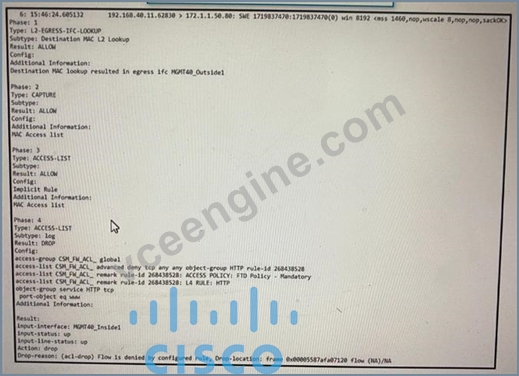
What must be done to fix access to this website while preventing the same communication to all other websites?
- A. Create an access control policy rule to allow port 443 to only 172.1.1 50
- B. Create an intrusion policy rule to have Snort allow port 443 to only 172.1.1.50
- C. Create an intrusion policy rule to have Snort allow port 80 to only 172.1.1 50.
- D. Create an access control policy rule to allow port 80 to only 172.1.1 50.
Answer: D
NEW QUESTION 92
Refer to the exhibit.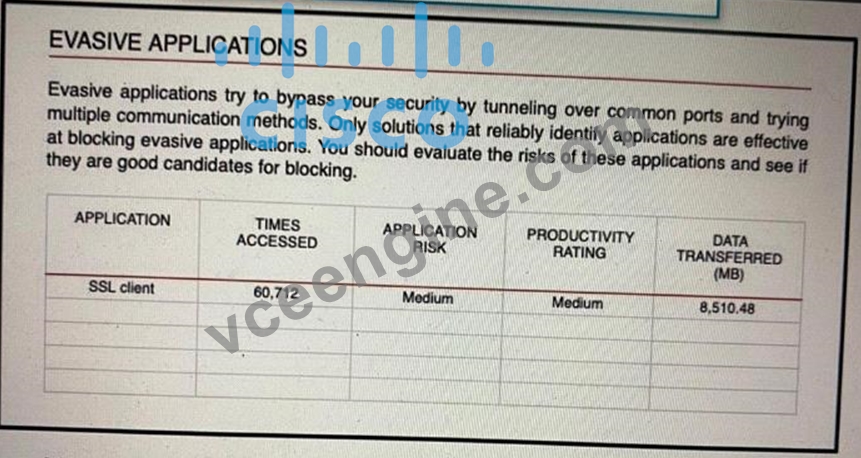
An administrator is looking at some of the reporting capabilities for Cisco Firepower and noticed this section of the Network Risk report showing a lot of SSL activity that cloud be used for evasion. Which action will mitigate this risk?
- A. Use Cisco Tetration to track SSL connections to servers.
- B. Use Cisco AMP for Endpoints to block all SSL connection
- C. Use SSL decryption to analyze the packets.
- D. Use encrypted traffic analytics to detect attacks
Answer: C
NEW QUESTION 93
An engineer is troubleshooting application failures through a FTD deployment. While using the FMC CLI. it has been determined that the traffic in question is not matching the desired policy. What should be done to correct this?
- A. Use the system support application-identification-debug command to determine which rules the traffic matching and modify the rule accordingly
- B. Use the system support firewall-engine-debug command to determine which rules the traffic matching and modify the rule accordingly
- C. Use the system support network-options command to fine tune the policy.
- D. Use the system support firewall-engine-dump-user-f density-data command to change the policy and allow the application through the firewall.
Answer: A
NEW QUESTION 94
Which two OSPF routing features are configured in Cisco FMC and propagated to Cisco FTD? (Choose two.)
- A. MD5 authentication to OSPF packets
- B. virtual links
- C. area boundary router type 1 LSA filtering
- D. OSPFv2 with IPv6 capabilities
- E. SHA authentication to OSPF packets
Answer: B,C
Explanation:
Reference: https://www.cisco.com/c/en/us/td/docs/security/firepower/620/configuration/guide/fpmc-config-guide-v62/ospf_for_firepower_threat_defense.html
NEW QUESTION 95
When do you need the file-size command option during troubleshooting with packet capture?
- A. when capture packets exceed 32 MB
- B. when capture packets are restricted from the secondary memory
- C. when capture packets exceed 10 GB
- D. when capture packets are less than 16 MB
Answer: A
NEW QUESTION 96
An engineer is implementing Cisco FTD in the network and is determining which Firepower mode to use. The organization needs to have multiple virtual Firepower devices working separately inside of the FTD appliance to provide traffic segmentation Which deployment mode should be configured in the Cisco Firepower Management Console to support these requirements?
- A. single deployment
- B. multiple deployment
- C. single-context
- D. multi-instance
Answer: D
NEW QUESTION 97
Which two types of objects are reusable and supported by Cisco FMC? (Choose two.)
- A. reputation-based objects, such as URL categories
- B. network-based objects that represent FQDN mappings and networks, port/protocol pairs, VXLAN tags, security zones and origin/destination country
- C. network-based objects that represent IP address and networks, port/protocols pairs, VLAN tags, security zones, and origin/destination country
- D. reputation-based objects that represent Security Intelligence feeds and lists, application filters based on category and reputation, and file lists
- E. dynamic key mapping objects that help link HTTP and HTTPS GET requests to Layer 7 application protocols.
Answer: C,D
Explanation:
Reference:
https://www.cisco.com/c/en/us/td/docs/security/firepower/620/configuration/guide/fpmc-config- guide-v62/reusable_objects.html#ID-2243-00000414
NEW QUESTION 98
What is the difference between inline and inline tap on Cisco Firepower?
- A. Inline tap mode can send a copy of the traffic to another device.
- B. Inline tap mode does full packet capture.
- C. Inline mode can drop malicious traffic.
- D. Inline mode cannot do SSL decryption.
Answer: C
Explanation:
Section: Deployment
NEW QUESTION 99
What is the disadvantage of setting up a site-to-site VPN in a clustered-units environment?
- A. Only established VPN connections are maintained when a new master unit is elected.
- B. Smart License is required to maintain VPN connections simultaneously across all cluster units.
- C. VPN connections can be re-established only if the failed master unit recovers.
- D. VPN connections must be re-established when a new master unit is elected.
Answer: D
Explanation:
Reference:
https://www.cisco.com/c/en/us/td/docs/security/firepower/fxos/clustering/ftd-cluster- solution.html#concept_g32_yml_y2b
NEW QUESTION 100
Which limitation applies to Cisco Firepower Management Center dashboards in a multidomain environment?
- A. Child domains cannot view dashboards that originate from an ancestor domain.
- B. Child domains can view but not edit dashboards that originate from an ancestor domain.
- C. Child domains have access to only a limited set of widgets from ancestor domains.
- D. Only the administrator of the top ancestor domain can view dashboards.
Answer: A
NEW QUESTION 101
An organization does not want to use the default Cisco Firepower block page when blocking HTTP traffic. The organization wants to include information about its policies and procedures to help educate the users whenever a block occurs. Which two steps must be taken to meet these requirements? (Choose two.)
- A. Write CSS code with the information for the policies and procedures.
- B. Modify the system-provided block page result using Python.
- C. Edit the HTTP request handling in the access control policy to customized block.
- D. Create HTML code with the information for the policies and procedures.
- E. Change the HTTP response in the access control policy to custom.
Answer: C,E
NEW QUESTION 102
Drag and drop the steps to restore an automatic device registration failure on the standby Cisco FMC from the left into the correct order on the right. Not all options are used.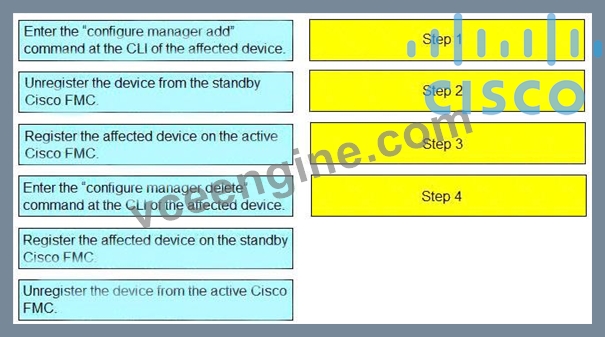
Answer:
Explanation: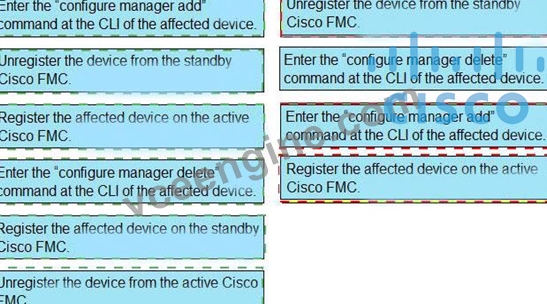
Explanation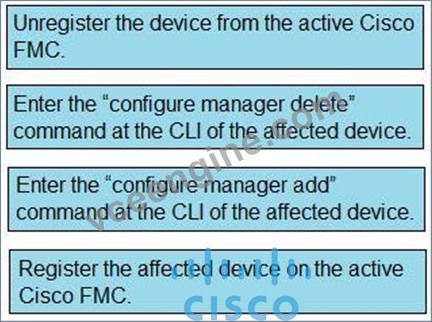
Explanation
Reference: https://www.cisco.com/c/en/us/td/docs/security/firepower/620/configuration/guide/fpmc-config- guide-v62/firepower_management_center_high_availability.html#id_32288
NEW QUESTION 103
Which two remediation options are available when Cisco FMC is integrated with Cisco ISE? (Choose two.)
- A. quarantine
- B. port shutdown
- C. dynamic null route configured
- D. host shutdown
- E. DHCP pool disablement
Answer: A,B
Explanation:
Section: Integration
Explanation/Reference: https://www.cisco.com/c/en/us/support/docs/security/identity-services-engine/210524-configure- firepower-6-1-pxgrid-remediati.html
NEW QUESTION 104
An engineer is investigating connectivity problems on Cisco Firepower that is using service group tags. Specific devices are not being tagged correctly, which is preventing clients from using the proper policies when going through the firewall How is this issue resolved?
- A. Use a packet sniffer with correct filtering
- B. Use a packet capture with match criteria.
- C. Use traceroute with advanced options.
- D. Use Wireshark with an IP subnet filter.
Answer: C
NEW QUESTION 105
......
300-710 Real Exam Questions and Answers FREE: https://www.vceengine.com/300-710-vce-test-engine.html
300-710 Exam Questions | Real 300-710 Practice Dumps: https://drive.google.com/open?id=1Ewr7ankldEWrKYMVnpK0NJFMBp7dHHNP
