

Pass Your Oracle Database 19c 1Z0-083 Exam on Jan 14, 2024 with 285 Questions
1Z0-083 Free Exam Study Guide! (Updated 285 Questions)
To prepare for the Oracle 1Z1-083 Exam, candidates should have practical experience in managing and administering Oracle databases. They can also enroll in training courses designed to prepare for the exam, such as Oracle Database Administration II: Backup and Recovery and Oracle Database Performance Tuning. Candidates can also use study materials, such as practice exams, study guides, and online forums, to enhance their study and preparation.
Average Salary of Oracle Database Administration II Exam Number: 1Z0-083 Certified Professionals
The average salary is between $69k and $127k.
Certification Path for Oracle Database Administration II Exam Number: 1Z0-083
Oracle Database Administration II Exam Number: 1Z0-083 is an advanced exam. Successful completion by candidates of Data Administrator I and II will allow them to achieve Oracle Certified Database Administrator status.
NEW QUESTION # 45
Which three are true about using Database Resource Manager in an Oracle multitenant environment?
(Choose three.)
- A. A CDB-level resource plan can limit PDB CPU utilization.
- B. A CDB-level resource plan is mandatory when using PDB-level resource plans.
- C. PDB-level resource plans can limit uncommitted UNDO per consumer group.
- D. A CDB-level resource plan can limit session CPU utilization.
- E. A CDB-level resource plan can limit PDB UNDO use.
- F. A PDB-level resource plan can limit session PGA memory.
Answer: B,D,E
NEW QUESTION # 46
For which two requirements can you use the USER_TABLESPACE clause with the CREATE PLUGGABLE DATABASE command? (Choose two.)
- A. to include specific user tablespaces only when relocating a PDB
- B. to exclude all tablespaces except SYSTEM, SYSAUX, and TEMP when plugging in a PDB
- C. to exclude a temp tablespace when plugging in a PDB
- D. to specify the list of user tablespaces to include when moving a non-CDB to a PDB
- E. to specify a default tablespace in a PDB cloned from another PDB in the same CDB.
- F. to specify the list of tablespaces to include when creating a PDB from the CDB seed
Answer: C,F
NEW QUESTION # 47
Which three are true about the SQL Tuning Advisor? (Choose three.)
- A. It checks each query being analyzed for missing statistics.
- B. It checks each query being analyzed for stale statistics.
- C. It only recommends syntactic changes to SQL statements.
- D. It builds SQL profiles for each poorly performing SQL statement to prevent regressions.
- E. It can recommend semantic changes to SQL statements.
- F. It considers all SQL statements being analyzed by the advisor task as a group.
Answer: A,B,D
Explanation:
Reference:
https://docs.oracle.com/database/121/TGSQL/tgsql_sqltune.htm#TGSQL540
NEW QUESTION # 48
Which two are true about diagnosing Oracle Database failure situations using Data Recovery Advisor?
- A. Using the Data Recovery Advisor list failure command always requires that the database for which failures are to be listed is in mount state.
- B. A failure can be closed only when it has been repaired.
- C. The Data Recovery Advisor change failure command can be used only to change failure priorities.
- D. Data Recovery Advisor can proactively check for failures.
- E. Data Recovery Advisor can be used if a database is closed.
Answer: B,E
NEW QUESTION # 49
Examine this output: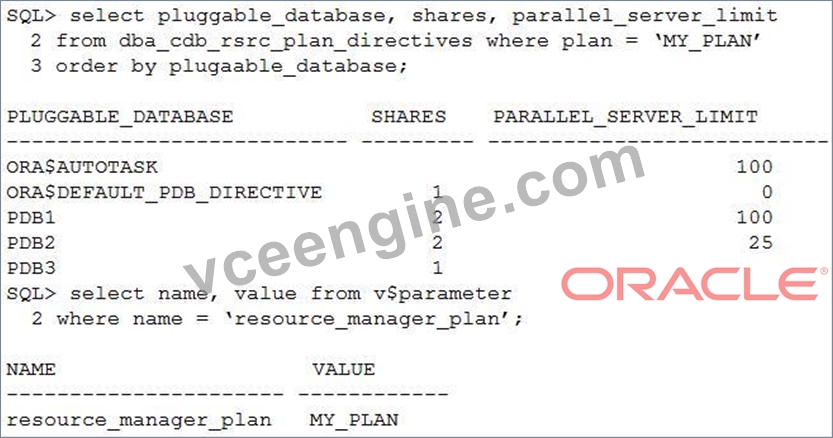
Which two are true? (Choose two.)
- A. PDB3 can use all available parallel execution processes at times.
- B. PDB3 is guaranteed to receive at least 20% of the available system resources if there is enough demand.
- C. Any PDB not specified in the plan will be able to use a maximum of 16.5% of the available system resources.
- D. PDB1 is always limited to 40% of the available system resources regardless of demand.
- E. Any PDB not specified in the plan will be unable to execute statements in parallel.
- F. PDB2 is guaranteed at least 25% of the available parallel execution processes if there is enough demand.
Answer: B,E
NEW QUESTION # 50
Examine this configuration:
1. CDB1 is a container database.
2. APP_ROOT is an application root in CDB1.
3. APP_PDB1 is an application PDB in APP_ROOT.
4. FLASHBACK DATABASE is ON.
You execute these commands:
Which table or set of tables will exist after the Flashback operation has completed?
- A. CDB1_TAB and APP_PDB1_TAB
- B. CDB1_TAB only
- C. CDB1_TAB and APP_ROOT_TAB
- D. CDB1_TAB, APP_ROOT_TAB, and APP_PDB1_TAB
- E. none of the tables, because all three tables will be dropped
Answer: D
NEW QUESTION # 51
Examine these queries and their output: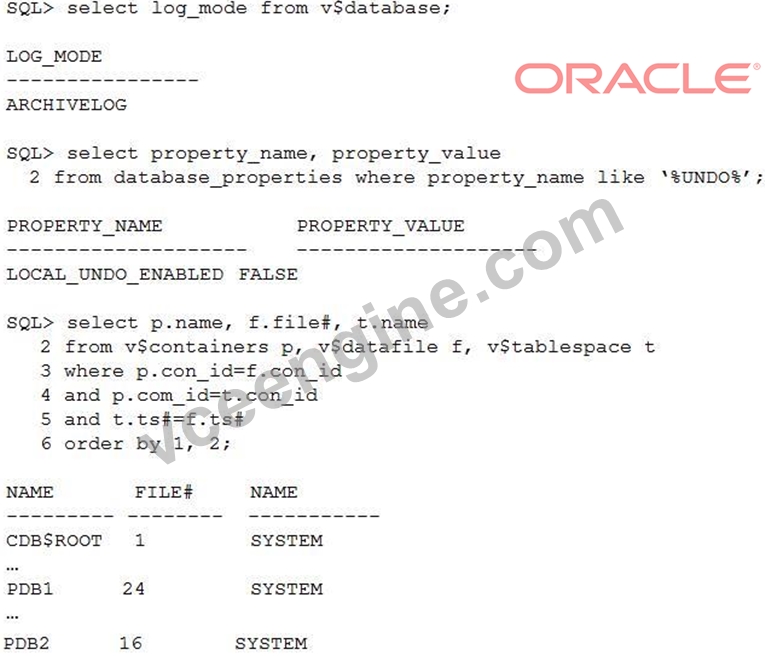
After a system crash, an instance restart and an attempted opening of the PDBs result in: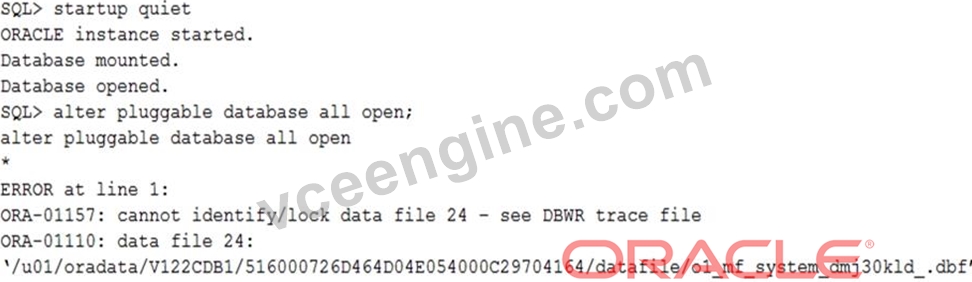
Which two are true? (Choose two.)
- A. Data file 24 can be recovered while CDB$ROOT and PDB$SEED are opened.
- B. Data file 24 can be recovered while PDB2 is opened.
- C. Data file 24 must be recovered while PDB2 is closed.
- D. Data file 24 must be recovered while the CDB is opened.
- E. Data file 24 cannot be recovered while the CDB is opened.
Answer: D,E
NEW QUESTION # 52
While backing up to the Oracle Fast Recovery Area (FRA), you determined the backup is taking too long and suspect a performance bottleneck.
Which three are true about diagnosing and tuning these problems? (Choose three.)
- A. If an RMAN BACKUP VALIDATE command takes roughly the same time as an actual backup, then both read and write I/O are likely bottlenecks.
- B. Setting DBWR_IO_SLAVES to a non zero value can improve backup performance when using synchronous I/O.
- C. Data files with a high value in V$BACKUP_ASYNC_IO.SHORT_WAITS are a potential performance bottleneck when asynchronous I/O is used.
- D. If an RMAN BACKUP VALIDATE command takes roughly the same time as an actual backup, then read I/O is a likely bottleneck.
- E. Data files with a high value in V$BACKUP_SYNC_IO.DISCRETE_BYTES_PER_SECOND are a potential performance bottleneck when synchronous I/O is used.
- F. If an RMAN BACKUP VALIDATE command takes noticeably less than an actual backup, then write I/O is a likely bottleneck.
- G. Setting DBWR_IO_SLAVES to a non zero value can improve backup performance when using asynchronous I/O/
Answer: B,E,F
NEW QUESTION # 53
You plan to install Oracle Grid Infrastructure for a Standalone Server and Oracle Database for the first time on a server.
Examine this command and its outcome:
Which two are true? (Choose two.)
- A. oracle can own an Oracle Database installation but not an Oracle Grid Infrastructure installation.
- B. oracle will be an owner of the Oracle Inventory.
- C. oracle must be the owner of every Oracle Database installation.
- D. oracle will be granted the SYSASM privilege when installing the Oracle Database software.
- E. The user account, oracle, and group, oinstall, can be used for all Oracle software installations.
Answer: A,D
NEW QUESTION # 54
Which two are true about flashback features in Oracle Database 19c and later releases?
- A. Flashback logs are automatically purged whenever the value
Of DB_FLASHBACK_RETENTION_TARGET is changed. - B. Flashback logs are monitored and proactively deleted when beyond the retention period defined in DB_flashback_retention_TARGET only after there is space pressure
- C. Flashback logs are monitored and proactively deleted when beyond the retention period defined in db_flashback_retention_target before there is space pressure.
- D. Flashback logs are automatically purged when db_flashback_retention_target is set lower than the time they have already been retained.
- E. Flashback logs are monitored for being older than the retention period defined in db_flashback_retention_target and can be deleted by an administrator written event trigger.
Answer: C,E
NEW QUESTION # 55
choose three Which three are true about RMAN duplexed backup sets or image copies?
- A. An image copy on sbt can be copied to disk.
- B. A backup set may be duplexed with both copies written to sbt.
- C. A backup set may be duplexed so that one copy is written to sbt and the other to disk.
- D. A backup set may be duplexed with both copies written to disk.
- E. An image copy on disk can be copied to disk.
- F. An image copy on disk can be copied to sbt.
Answer: B,D,E
NEW QUESTION # 56
While backing up to the Oracle Fast Recovery Area (FRA), you determined the backup is taking too long and suspect a performance bottleneck.
Which three are true about diagnosing and tuning these problems? (Choose three.)
- A. If an RMAN BACKUP VALIDATE command takes roughly the same time as an actual backup, then both read and write I/O are likely bottlenecks.
- B. Setting DBWR_IO_SLAVES to a non zero value can improve backup performance when using synchronous I/O.
- C. Data files with a high value in V$BACKUP_ASYNC_IO.SHORT_WAITS are a potential performance bottleneck when asynchronous I/O is used.
- D. If an RMAN BACKUP VALIDATE command takes roughly the same time as an actual backup, then read I/O is a likely bottleneck.
- E. Data files with a high value in V$BACKUP_SYNC_IO.DISCRETE_BYTES_PER_SECOND are a potential performance bottleneck when synchronous I/O is used.
- F. If an RMAN BACKUP VALIDATE command takes noticeably less than an actual backup, then write I/O is a likely bottleneck.
- G. Setting DBWR_IO_SLAVES to a non zero value can improve backup performance when using asynchronous I/O/
Answer: B,E,F
Explanation:
Reference:
https://web.stanford.edu/dept/itss/docs/oracle/10gR2/backup.102/b14191/rcmtunin003.htm
NEW QUESTION # 57
Examine this configuration: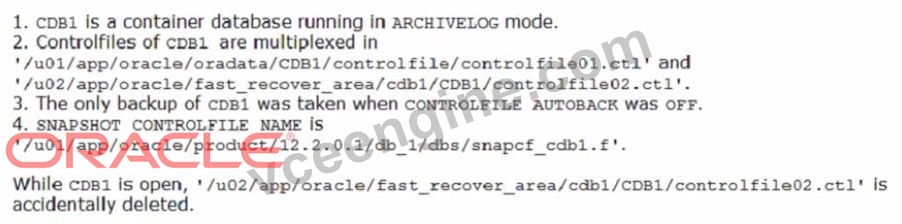
To recover from this critical failure, you execute these commands: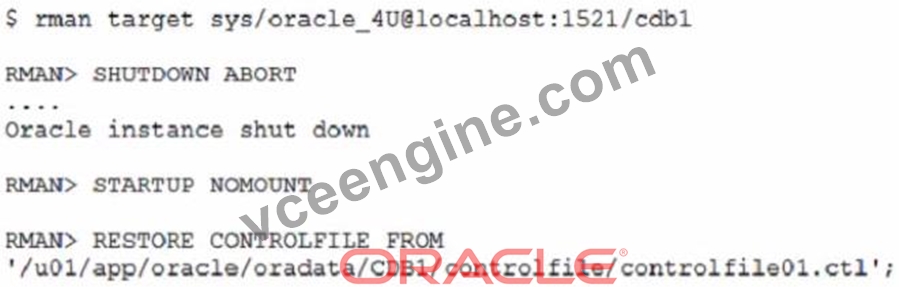
What will be the outcome?
- A. Option

- B. Option

- C. Option

- D. Option

- E. Option

Answer: E
NEW QUESTION # 58
Choose two. Which two are true about unplugging an application container from a container database and plugging it into a different container database?
- A. It requires local UNDO mode in both container databases.
- B. Plugging the application root into a different CDB plugs in all its application PDBs.
- C. It requires only local UNDO mode in the database where the application container will be unplugged.
- D. Unplugging the application root from a CDB unplugs all its application PDBs.
- E. Application PDBs in the application container must be unplugged before the application root is unplugged.
- F. The application root of an application container should be plugged into the other CDB before its application PDBs are plugged in.
Answer: E,F
NEW QUESTION # 59
Which two are true about the execution of operating system scripts starting from Oracle Database 19c?
(Choose two.)
- A. root.shcan be executed automatically by the Database installer only by using sudocredentials.
- B. orainstRoot.shcan be executed automatically by the Database installer by using sudoor root credentials.
- C. The sudopassword must be specified in a response file.
- D. root.shcan be executed automatically by the Database Installer only if it is provided with root credentials.
- E. The rootpassword cannot be specified in a response file.
- F. The sudopassword can be specified in a response file.
Answer: B,E
Explanation:
Explanation
NEW QUESTION # 60
Examine these actions:
1. Create a new database for a recovery catalog.
2. Create a tablespace with sufficient space in the catalog database for the recovery catalog.
3. Configure archivelog mode for the catalog database.
4. Create a user to own the recovery catalog schema with quota on the tablespace that will contain the catalog.
5. Grant the recovery_catalog_owner role to the recovery catalog schema owner.
6. Grant the sysbackup privilege to the recovery catalog schema owner.
Which are the minimum actions that must be performed before executing the create catalog command?
- A. 1,2,4, 5
- B. 1,2,3,4, 5,6
- C. 2, 4, 5
- D. 2, 4, 5, 6
- E. 1,3,4, 5
Answer: E
NEW QUESTION # 61
Examine these queries and their output: An online RMAN backup of the CDB was taken an hour before Restore Point R1 was created. You want to recover PDB1 to Restore Point R1. How do you achieve this?
- A. Execute FLASHBACK PLUGGABLE DATABASE PDB1 TO RESTORE POINT R1by using SQL while connected to CDB$ROOT.
- B. Execute FLASHBACK PLUGGABLE DATABASE PDB1 TO RESTORE POINT R1by using RMAN while connected to CDB$ROOT.
- C. Execute FLASHBACK PLUGGABLE DATABASE PDB1 TO RESTORE POINT R1by using RMAN while connected to PDB1.
- D. Execute FLASHBACK PLUGGABLE DATABASE PDB1 TO RESTORE POINT R1by using SQL while connected to PDB1.
- E. This cannot be done due to the lack of a clean restore point.
Answer: E
NEW QUESTION # 62
Choose three. Which three are true about recovery operations done without using Recovery Manager (RMAN)?
- A. A lost PFILE can be re-created from alert.log using SQL*PLUS.
- B. A lost index tablespace can be re-created without performing any recovery.
- C. A lost TEMPFILE must always be re-created manually.
- D. A lost SPFILE can be recovered from memory using SQL*PLUS.
- E. A lost password file can be manually re-created with the orapwd utility.
- F. A lost password file can be re-created with SQL*PLUS.
Answer: C,D,E
NEW QUESTION # 63
Which three are true about Database Point-in-Time Recovery? (Choose three.)
- A. The Database must be in ARCHIVE LOG mode.
- B. The database must be open RESETLOGS after Database Point-in-Time Recovery.
- C. Database Point-in-Time Recovery is performed by the Managed Recovery Process (MRP)
- D. The target point for the recovery must be specified as a stime or System Change Number (SCN).
- E. The database must be in MOUNT state when performing Database Point-in-Time Recovery.
- F. The database must have FLASHBACK DATABASE ON to perform Database Point-in-Time Recovery.
Answer: A,B,E
NEW QUESTION # 64
Which two are true about data movement between a non-CDB and a PDB using Data Pump?
- A. Oracle attempts to convert common users to conventional users when moving schemas from a PDB to a non-CDB.
- B. Moving data from a PDB to a non-CDB is only possible by using transportable tablespace export and import.
- C. Moving data from a non-CDB to a PDB is only possible by using conventional export and import.
- D. Tablespaces are automatically created as needed while importing full exports in either a non-CDB or a PDB.
- E. A new PDB is automatically created when importing a non-CDB into a CDB.
- F. Oracle attempts to convert conventional database users to local users when moving schemas from a non-CDB to a PDB.
Answer: D,E
NEW QUESTION # 65
Which four are true about duplicating a database using Recovery Manager (RMAN)? (Choose four.)
- A. Duplication can be done by having the target database instance push copies to the auxiliary database instance.
- B. Duplication can be done by having the auxiliary database instance pull backup sets from the target database instance.
- C. A connection to the recovery catalog instance is always required.
- D. A connection to an auxiliary instance is always required.
- E. A subset of the target database can be duplicated.
- F. A connection to the target database instance is always required.
- G. A backup of the target database is always required.
- H. A new DBID is always created for the duplicated database.
Answer: A,B,D,E
Explanation:
Explanation
A duplicate database is a copy of your target database. With the FOR STANDBY clause, it keeps the same unique database identifier(DBID); If FOR STANDBY not specified it creates a new DBID. The duplicate database can include the same content or only a subset from the source database. It can be in the same host or a separate host. The principal work of the duplication is performed by the auxiliary channels.These channels correspond to a server session on the auxiliary instance on the destination host for backup based duplication.
For active database duplication the target channels perform the work of pushing data file copies to the auxiliary instance (if number of allocated target channels is greater than the number of allocated auxiliary channels).
NEW QUESTION # 66
Examine this configuration:
You execute these commands before upgrading the database to the current release:
For which databases will fixup scripts be created?
- A. CDB1, PDB$SEED, PDB1, and PDB2
- B. CDB1, PDB$SEED, and PDB1 only
- C. CDB1 and PDB$SEED only
- D. CDB1, PDB1, and PDB2 only
- E. PDB$SEED, PDB1, and PDB2 only
Answer: C
NEW QUESTION # 67
Which three are true about RMAN persistent configuration settings, administration, and their effects? (Choose three.)
- A. A DBA must specify either a redundancy retention policy or a recovery window retention policy.
- B. The RMAN SHOW ALL command displays only settings with nondefault values.
- C. A target database's persistent RMAN configuration settings are always synchronized automatically with the RMAN catalog.
- D. A target database's persistent RMAN configuration settings are always stored in the target's control file
- E. The V$RMAN_CONFIGURATION view displays only settings with values that have been modified.
- F. Backup older than the recovery window retention policy are always deleted automatically if the backup location has insufficient space.
- G. Backups written to the fast recovery area (FRA) that are oboslete based on the redundancy retention policy can be deleted automatically to free space.
Answer: D,E,F
Explanation:
Reference:
https://books.google.com.pk/books? id=pUEkAAAAQBAJ&pg=PA114&lpg=PA114&dq=V$RMAN_CONFIGURATION+view+displays+only+settings
+with+values+that+have+been+modified&source=bl&ots=fhC9A7ULeX&sig=ACfU3U2- cGhTjmAOpCZhvlL5R4j6ixLRAw&hl=en&sa=X&ved=2ahUKEwjJzf- WmtnoAhXT8eAKHQ9uBG8Q6AEwAHoECAwQJg#v=onepage&q=V%24RMAN_CONFIGURATION%20view
%20displays%20only%20settings%20with%20values%20that%20have%20been%20modified&f=false
NEW QUESTION # 68
......
1Z0-083 Dumps for Oracle Database 19c Certified Exam Questions and Answer: https://www.vceengine.com/1Z0-083-vce-test-engine.html
Realistic Verified 1Z0-083 exam dumps Q&As - 1Z0-083 Free Update: https://drive.google.com/open?id=1_sIUsh0UAZsJaXP_q0Np9CkUzTPJzjxM
