

The CS0-003 PDF Dumps Greatest for the CompTIA Exam Study Guide!
Read Online CS0-003 Test Practice Test Questions Exam Dumps
NEW QUESTION # 198
A security analyst is trying to detect connections to a suspicious IP address by collecting the packet captures from the gateway. Which of the following commands should the security analyst consider running?
- A. tcpdump -n -r packets.pcap host [IP address]
- B. grep [IP address] packets.pcap
- C. cat packets.pcap | grep [IP Address]
- D. strings packets.pcap | grep [IP Address]
Answer: A
Explanation:
Explanation
tcpdump is a command-line tool that can capture and analyze network packets from a given interface or file.
The -n option prevents tcpdump from resolving hostnames, which can speed up the analysis. The -r option reads packets from a file, in this case packets.pcap. The host [IP address] filter specifies that tcpdump should only display packets that have the given IP address as either the source or the destination. This command can help the security analyst detect connections to a suspicious IP address by collecting the packet captures from the gateway. Official References:
https://partners.comptia.org/docs/default-source/resources/comptia-cysa-cs0-002-exam-objectives
https://www.techtarget.com/searchsecurity/quiz/Sample-CompTIA-CySA-test-questions-with-answers
https://www.reddit.com/r/CompTIA/comments/tmxx84/passed_cysa_heres_my_experience_and_how_i_st
NEW QUESTION # 199
An employee downloads a freeware program to change the desktop to the classic look of legacy Windows.
Shortly after the employee installs the program, a high volume of random DNS queries begin to originate from the system. An investigation on the system reveals the following:
Add-MpPreference -ExclusionPath '%Program Filest\ksysconfig'
Which of the following is possibly occurring?
- A. Defense evasion
- B. Persistence
- C. Privilege escalation
- D. Credential harvesting
Answer: A
Explanation:
Defense evasion is the technique of avoiding detection or prevention by security tools or mechanisms. In this case, the freeware program is likely a malware that generates random DNS queries to communicate with a command and control server or exfiltrate data. The command Add-MpPreference -ExclusionPath '%Program Filest\ksysconfig' is used to add an exclusion path to Windows Defender, which is a built-in antivirus software, to prevent it from scanning the malware folder. References: CompTIA CySA+ Study Guide: Exam CS0-003, 3rd Edition, Chapter 5, page 204; CompTIA CySA+ CS0-003 Certification Study Guide, Chapter 5, page 212. pr
NEW QUESTION # 200
An organization wants to move non-essential services into a cloud computing environment. The management team has a cost focus and would like to achieve a recovery time objective of 12 hours. Which of the following cloud recovery strategies would work best to attain the desired outcome?
- A. Duplicate all services in another instance and load balance between the instances.
- B. Configure the systems with a cold site at another cloud provider that can be used for failover.
- C. Set up a warm disaster recovery site with the same cloud provider in a different region.
- D. Establish a hot site with active replication to another region within the same cloud provider.
Answer: C
Explanation:
Setting up a warm disaster recovery site with the same cloud provider in a different region can help to achieve a recovery time objective (RTO) of 12 hours while keeping the costs low. A warm disaster recovery site is a partially configured site that has some of the essential hardware and software components ready to be activated in case of a disaster. A warm site can provide faster recovery than a cold site, which has no preconfigured components, but lower costs than a hot site, which has fully configured and replicated components. Using the same cloud provider can help to simplify the migration and synchronization processes, while using a different region can help to avoid regional outages or disasters .
NEW QUESTION # 201
An organization utilizes multiple vendors, each with its own portal that a security analyst must sign in to daily. Which of the following is the best solution for the organization to use to eliminate the need for multiple authentication credentials?
- A. MFA
- B. SSO
- C. VPN
- D. API
Answer: B
Explanation:
* Single Sign-On (SSO) allows users to authenticate once and gain access to multiple applications without needing to re-enter credentials for each one.
* It reduces password fatigue, improves security, and streamlines authentication across vendor portals.
Why Not Other Options?
* A (API) # APIs facilitate data exchange but do not solve authentication problems.
* B (MFA) # Enhances security but still requires multiple logins.
* D (VPN) # Secures connections but does not eliminate multiple logins.
NEW QUESTION # 202
A cybersecurity analyst notices unusual network scanning activity coming from a country that the company does not do business with. Which of the following is the best mitigation technique?
- A. Perform a historical trend analysis and look for similar scanning activity.
- B. Block the specific IP address of the scans at the network firewall.
- C. Geoblock the offending source country.
- D. Block the IP range of the scans at the network firewall.
Answer: D
Explanation:
Blocking the IP range of the scans at the network firewall is a proactive measure to prevent further network scanning activity from the suspicious source country. By blocking the entire IP range, you can effectively prevent any potential malicious traffic from that region from reaching your network, reducing the attack surface.
NEW QUESTION # 203
Due to reports of unauthorized activity that was occurring on the internal network, an analyst is performing a network discovery. The analyst runs an Nmap scan against a corporate network to evaluate which devices were operating in the environment. Given the following output: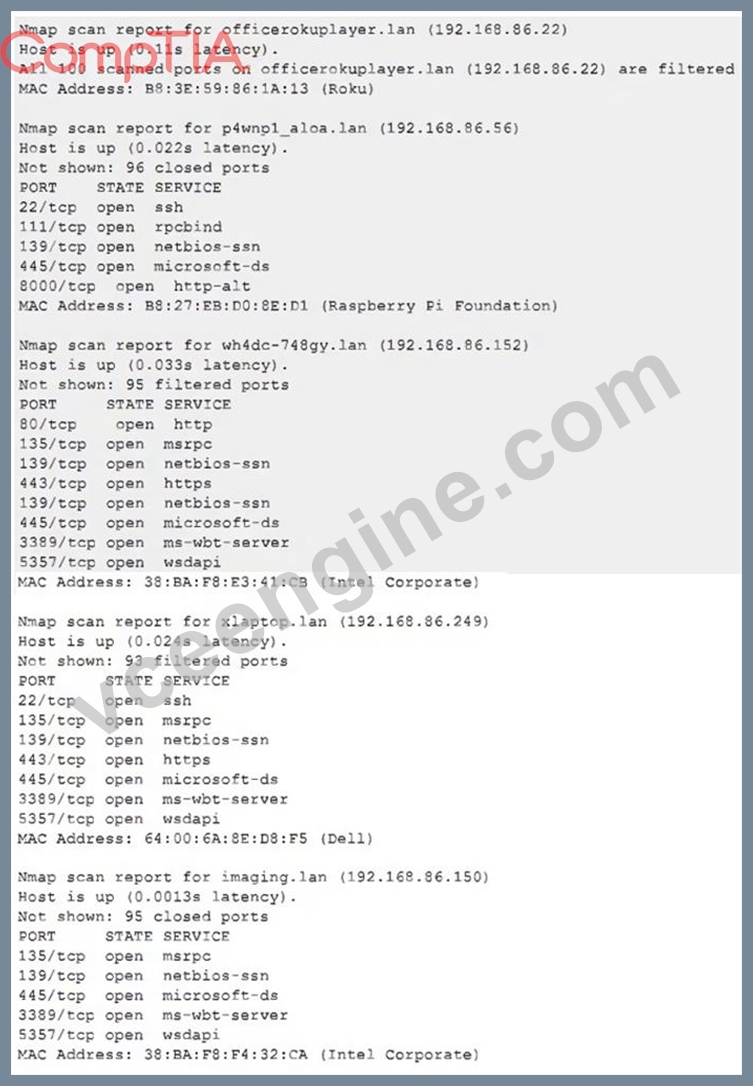
Which of the following choices should the analyst look at first?
- A. wh4dc-748gy.lan (192.168.86.152)
- B. lan (192.168.86.22)
- C. imaging.lan (192.168.86.150)
- D. xlaptop.lan (192.168.86.249)
- E. p4wnp1_aloa.lan (192.168.86.56)
Answer: E
Explanation:
Explanation
The analyst should look at p4wnp1_aloa.lan (192.168.86.56) first, as this is the most suspicious device on the network. P4wnP1 ALOA is a tool that can be used to create a malicious USB device that can perform various attacks, such as keystroke injection, network sniffing, man-in-the-middle, or backdoor creation. The presence of a device with this name on the network could indicate that an attacker has plugged in a malicious USB device to a system and gained access to the network. Official References:
https://github.com/mame82/P4wnP1_aloa
NEW QUESTION # 204
Which of the following best describes the goal of a tabletop exercise?
- A. To understand existing threat actors and how to replicate their techniques
- B. To perform attack exercises to check response effectiveness
- C. To check the effectiveness of the business continuity plan
- D. To test possible incident scenarios and how to react properly
Answer: D
Explanation:
A tabletop exercise is a type of simulation exercise that involves testing possible incident scenarios and how to react properly, without actually performing any actions or using any resources. A tabletop exercise is usually conducted by a facilitator who presents a realistic scenario to a group of participants, such as a cyberattack, a natural disaster, or a data breach. The participants then discuss and evaluate their roles, responsibilities, plans, procedures, and policies for responding to the incident, as well as the potential impacts and outcomes. A tabletop exercise can help identify strengths and weaknesses in the incident response plan, improve communication and coordination among the stakeholders, raise awareness and preparedness for potential incidents, and provide feedback and recommendations for improvement.
NEW QUESTION # 205
An organization's email account was compromised by a bad actor. Given the following Information:
Which of the following is the length of time the team took to detect the threat?
- A. 25 minutes
- B. 45 minutes
- C. 2 hours
- D. 40 minutes
Answer: D
Explanation:
The threat was detected from the time the emails were sent at 8:30 a.m. to when the recipients started alerting the organization's help desk about the email at 8:45 a.m., taking a total of 15 minutes. The detection time is the time elapsed between the occurrence of an incident and its discovery by the security team . The other options are either too short or too long based on the given information. References: : Detection Time : Incident Response Metrics: Mean Time to Detect and Mean Time to Respond
NEW QUESTION # 206
The security team reviews a web server for XSS and runs the following Nmap scan:
Which of the following most accurately describes the result of the scan?
- A. The vulnerable parameter ID hccp://l72.31.15.2/1.php?id-2 and unfiltered characters returned
- B. The vulnerable parameter and characters > and " with a reflected XSS attempt
- C. The vulnerable parameter and unfiltered or encoded characters passed > and " as unsafe
- D. An output of characters > and " as the parameters used m the attempt
Answer: B
Explanation:
Explanation
A cross-site scripting (XSS) attack is a type of web application attack that injects malicious code into a web page that is then executed by the browser of a victim user. A reflected XSS attack is a type of XSS attack where the malicious code is embedded in a URL or a form parameter that is sent to the web server and then reflected back to the user's browser. In this case, the Nmap scan shows that the web server is vulnerable to a reflected XSS attack, as it returns the characters > and " without any filtering or encoding. The vulnerable parameter is id in the URL http://172.31.15.2/1.php?id=2.
NEW QUESTION # 207
Which of the following is a nation-state actor least likely to be concerned with?
- A. Examination of its actions and objectives.
- B. Forensic analysis for legal action of the actions taken
- C. Detection by MITRE ATT&CK framework.
- D. Detection or prevention of reconnaissance activities.
Answer: B
Explanation:
A nation-state actor is a group or individual that conducts cyberattacks on behalf of a government or a political entity. They are usually motivated by national interests, such as espionage, sabotage, or influence operations. They are often highly skilled, resourced, and persistent, and they operate with the protection or support of their state sponsors. Therefore, they are less likely to be concerned with the forensic analysis for legal action of their actions, as they are unlikely to face prosecution or extradition in their own country or by international law. They are more likely to be concerned with the detection by the MITRE ATT&CK framework, which is a knowledge base of adversary tactics and techniques based on real-world observations.
The MITRE ATT&CK framework can help defenders identify, prevent, and respond to cyberattacks by nation-state actors. They are also likely to be concerned with the detection or prevention of reconnaissance activities, which are the preliminary steps of cyberattacks that involve gathering information about the target, such as vulnerabilities, network topology, or user credentials. Reconnaissance activities can expose the presence, intent, and capabilities of the attackers, and allow defenders to take countermeasures. Finally, they are likely to be concerned with the examination of their actions and objectives, which can reveal their motives, strategies, and goals, and help defenders understand their threat profile and attribution.
References:
* 1: MITRE ATT&CK
* 2: What is the MITRE ATT&CK Framework? | IBM
* 3: MITRE ATT&CK | MITRE
* 4: Cyber Forensics Explained: Reasons, Phases & Challenges of Cyber Forensics | Splunk
* 5: Digital Forensics: How to Identify the Cause of a Cyber Attack - G2
NEW QUESTION # 208
A managed security service provider is having difficulty retaining talent due to an increasing workload caused by a client doubling the number of devices connected to the network. Which of the following
would best aid in decreasing the workload without increasing staff?
- A. SOAR
- B. EDR
- C. XDR
- D. SIEM
Answer: A
Explanation:
SOAR stands for Security Orchestration, Automation and Response, which is a set of features that can help security teams manage, prioritize and respond to security incidents more efficiently and effectively. SOAR can help decrease the workload without increasing staff by automating repetitive tasks, streamlining workflows, integrating different tools and platforms, and providing actionable insights and recommendations. SOAR is also one of the current trends that CompTIA CySA+ covers in its exam objectives. Official Reference:
https://www.comptia.org/blog/the-new-comptia-cybersecurity-analyst-your-questions-answered
https://www.comptia.org/certifications/cybersecurity-analyst
https://partners.comptia.org/docs/default-source/resources/comptia-cysa-cs0-002-exam-objectives
NEW QUESTION # 209
Which of the following evidence collection methods is most likely to be acceptable in court cases?
- A. Providing a bit-level image of the hard drive
- B. Creating a file-level archive of all files
- C. Providing a full system backup inventory
- D. Copying all access files at the time of the incident
Answer: A
Explanation:
Comprehensive and Detailed Explanation:
A bit-level image is a forensic-grade copy that preserves all data on a disk, including unallocated space, deleted files, and metadata. This is the most legally defensible form of digital evidence collection, as it ensures that no potential evidence is missed.
* Copying all access files (Option A) only captures live files and omits deleted or system-level artifacts that may be critical.
* Creating a file-level archive (Option B) is insufficient because it does not capture system metadata or slack space where forensic artifacts reside.
* Providing a full system backup inventory (Option C) may include important files, but it lacks forensic integrity because backups often modify timestamps and do not capture all system states.
Thus, the correct answer is D, as a bit-level image ensures forensic integrity and completeness of evidence.
NEW QUESTION # 210
An incident response team receives an alert to start an investigation of an internet outage. The outage is preventing all users in multiple locations from accessing external SaaS resources. The team determines the organization was impacted by a DDoS attack. Which of the following logs should the team review first?
- A. CDN
- B. Vulnerability scanner
- C. DNS
- D. Web server
Answer: C
Explanation:
A distributed denial-of-service (DDoS) attack is a type of cyberattack that aims to overwhelm a target's network or server with a large volume of traffic from multiple sources. A common technique for launching a DDoS attack is to compromise DNS servers, which are responsible for resolving domain names into IP addresses. By flooding DNS servers with malicious requests, attackers can disrupt the normal functioning of the internet and prevent users from accessing external SaaS resources. Official References:
https://www.eccouncil.org/cybersecurity-exchange/threat-intelligence/cyber-kill-chain-seven-steps-cyberattack/
NEW QUESTION # 211
An attacker has just gained access to the syslog server on a LAN. Reviewing the syslog entries has allowed the attacker to prioritize possible next targets. Which of the following is this an example of?
- A. Service port identification
- B. Passive network footprinting
- C. Application versioning
- D. OS fingerprinting
Answer: B
NEW QUESTION # 212
A cybersecurity analyst is tasked with scanning a web application to understand where the scan will go and whether there are URIs that should be denied access prior to more in-depth scanning.
Which of following best fits the type of scanning activity requested?
- A. Vulnerability scan
- B. Uncredentialed scan
- C. Discovery scan
- D. Credentialed scan
Answer: C
Explanation:
A discovery scan is a type of web application scanning that involves identifying active, internet- facing web applications and their URIs, without performing any intrusive or in-depth tests. This type of scan can help to understand the scope and structure of a web application before conducting more comprehensive vulnerability scans.
NEW QUESTION # 213
......
CS0-003 Certification All-in-One Exam Guide Jun-2025: https://www.vceengine.com/CS0-003-vce-test-engine.html
Easily To Pass New CS0-003 Premium Exam: https://drive.google.com/open?id=1rGtiAvQp-dc7Q9z5a21jNgoBleYynkgj
