

Searching for L6M2 real exam questions and answer to pass your CIPS certification exam then you are at right place. I just got through my L6M2 certification
 Gustave


Practice questions should stay close to the real exam. VCEEngine updates the CIPS Global Commercial Strategy engine according to actual exam changes — 40 practice questions for the L6M2 exam, always relevant in 2026.
| Certification Vendor: | CIPS (Chartered Institute of Procurement & Supply) |
|---|---|
| Exam Name: | Global Commercial Strategy |
| Exam Number: | L6M2 |
| Passing Score: | Typically 50% (CIPS standard, may vary by session) |
| Certificate Validity Period: | 5 years for CIPS qualifications (subject to CIPS progression rules) |
| Related Certifications: | CIPS Level 6 Diploma in Procurement and Supply MCIPS Chartered Status |
| Exam Duration: | 180 minutes |
| Exam Format: | Written exam (case study / essay-based questions) |
| Available Languages: | English |
| Recommended Training: | CIPS Official Study Resources |
| Exam Registration: | CIPS Qualifications Registration |
| Sample Questions: |  |
| Exam Way: | Computer-based or written examinations via CIPS-approved test centres / remote delivery depending on region |
| Pre Condition: | CIPS Level 5 Advanced Diploma or equivalent (or progression route into Level 6) |
| Official Syllabus URL: | https://www.cips.org |
| Section | Objectives |
|---|---|
| Topic 1: Global Commercial Environment | - Global market dynamics and trade factors - International commercial influences on procurement strategy |
| Topic 2: Commercial Strategy Development | - Strategic alignment of procurement and organisational goals - Value creation and competitive advantage |
| Topic 3: Risk, Compliance and Governance | - Ethics and sustainability in global procurement - Legal and regulatory considerations in global trade |
| Topic 4: Global Sourcing Strategy | - Sourcing models and global supplier selection - Risk in global supply chains |
Yes:
After any course, make practice efficient with the 40 practice questions for the CIPS Global Commercial Strategy — every answer expert-verified.
Right after payment we email you the download link — note it — and the product also arrives automatically within a minute, with 24/7 help if nothing shows up within 2 hours. Your information stays rigorously confidential throughout. If you fail the corresponding L6M2 exam within 60 days of purchase, we supply a whole refund: send a scanned enrollment slip plus the official Score Report PDF within 2 days of the exam, processed within 7 days. Excluded: exams within 3 days of purchase, candidate names that don't match the payer, and free or expired products. Or exchange for two equal-value products free.
The CIPS Global Commercial Strategy is CIPS's certification exam for CIPS Level 6 Professional Diploma in Procurement and Supply, at the Professional level. The certificate makes you advanced and competitive — priority in employment and promotion goes to the certified. Related credentials include CIPS Level 6 Diploma in Procurement and Supply, MCIPS Chartered Status.
Through the vendor's official registration channels:
The CIPS Global Commercial Strategy is delivered Computer-based or written examinations via CIPS-approved test centres / remote delivery depending on region — pick the arrangement that suits you when booking.
The CIPS Global Commercial Strategy blueprint spans 4 domains — including Global Sourcing Strategy, Commercial Strategy Development, Global Commercial Environment. Weight the heavy domains in your schedule; the complete outline above lists every subtopic.
CIPS Level 5 Advanced Diploma or equivalent (or progression route into Level 6) Eligibility rules change over time, so verify the current requirements on the official page (official L6M2 exam page) before registering.
Yes — the demo on our website is a genuine part of the complete CIPS Global Commercial Strategy dump, so what you try is what you buy. Purchases include 365 days of free updates with automatic email notifications; renew afterward at 50% off.
SIMULATION
Describe and evaluate the use of the VRIO Framework in understanding the internal resources and competencies of an organisation.
Correct Answer:
The VRIO Framework: Understanding Internal Resources and Competencies
The VRIO Framework is a strategic analysis tool used to assess an organization's internal resources and competencies to determine whether they provide a sustainable competitive advantage. Developed by Jay Barney, VRIO stands for Value, Rarity, Imitability, and Organization.
1. Explanation of the VRIO Framework
The VRIO model evaluates whether a firm's resources and capabilities contribute to a sustained competitive advantage.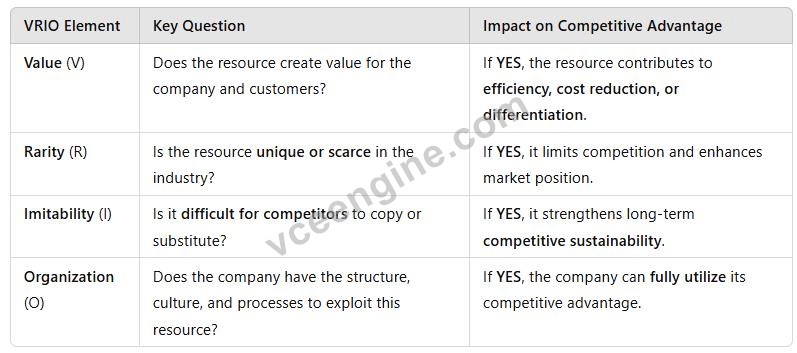
Example: Apple's software ecosystem (iOS, App Store) is valuable, rare, hard to imitate, and well-organized, giving it a sustainable competitive advantage.
2. The Use of VRIO in Assessing Internal Resources and Competencies
Companies use the VRIO framework to identify which resources provide temporary or sustainable competitive advantages.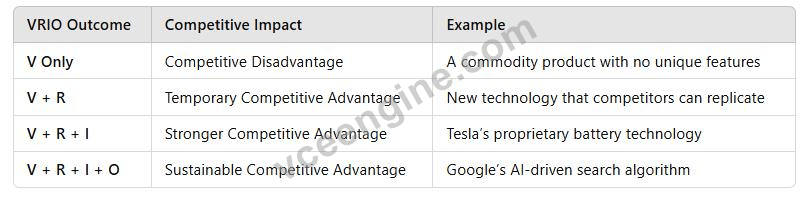
3. Advantages of Using VRIO in Strategic Decision-Making
✅ Identifies Core Competencies - Helps organizations focus on key strengths that drive long-term success.
✅ Guides Investment Decisions - Encourages businesses to invest in resources that are difficult to imitate.
✅ Improves Competitive Strategy - Helps firms differentiate between short-term vs. long-term advantages.
Example: Coca-Cola's brand equity is VRIO-positive, making it difficult for new entrants to replicate.
4. Limitations of the VRIO Framework
❌ Ignores External Factors - Unlike PESTLE or Porter's Five Forces, VRIO does not account for market conditions or regulatory changes.
❌ Subjectivity in Resource Evaluation - Assessing whether a resource is truly valuable or rare can be complex.
❌ Lack of Actionable Steps - VRIO identifies competitive strengths but does not provide strategies for leveraging them.
Example: A company may identify a rare talent pool, but poor organizational structure (O) can prevent it from leveraging this advantage.
5. Application of VRIO in Business Strategy
Businesses across different industries use VRIO to assess their internal strengths: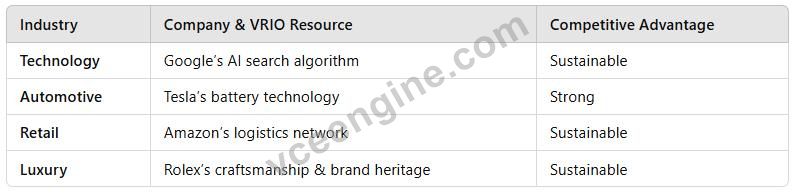
Conclusion
The VRIO Framework is a valuable tool for evaluating internal resources and capabilities, allowing businesses to identify sustainable competitive advantages. However, it should be used alongside external analysis tools (e.g., PESTLE, SWOT) to ensure a comprehensive strategic assessment.
SIMULATION
Provide a definition of a commodity product. What role does speculation and hedging play in the commodities market?
Correct Answer:
Commodity Products and the Role of Speculation & Hedging in the Commodities Market
1. Definition of a Commodity Product
A commodity product is a raw material or primary agricultural product that is uniform in quality and interchangeable with other products of the same type, regardless of the producer.
✅ Key Characteristics:
Standardized and homogeneous - Little differentiation between producers.
Traded on global markets - Bought and sold on commodity exchanges.
Price determined by supply & demand - Subject to market fluctuations.
Examples of Commodity Products:
Agricultural Commodities - Wheat, corn, coffee, cotton.
Energy Commodities - Crude oil, natural gas, coal.
Metals & Minerals - Gold, silver, copper, aluminum.
Key Takeaway: Commodities are essential goods used in global trade, where price is the primary competitive factor.
2. The Role of Speculation in the Commodities Market
Definition
Speculation involves buying and selling commodities for profit rather than for actual use, based on price predictions.
✅ How Speculation Works:
Traders and investors buy commodities expecting price increases (long positions).
They sell commodities expecting price declines (short positions).
No physical exchange of goods-transactions are purely financial.
Example:
A trader buys crude oil futures at $70 per barrel, expecting prices to rise. If oil reaches $80 per barrel, the trader sells for profit.
Advantages of Speculation
✔ Increases market liquidity - More buyers and sellers improve trading efficiency.
✔ Enhances price discovery - Helps determine fair market value.
✔ Absorbs market risk - Speculators take risks that producers or consumers avoid.
Disadvantages of Speculation
❌ Creates excessive volatility - Large speculative trades can cause price spikes or crashes.
❌ Detaches prices from real supply and demand - Can inflate bubbles or cause artificial declines.
❌ Market manipulation risks - Speculators with large holdings can distort prices.
Key Takeaway: Speculation adds liquidity and helps price discovery, but can lead to extreme volatility if unchecked.
3. The Role of Hedging in the Commodities Market
Definition
Hedging is a risk management strategy used by commodity producers and consumers to protect against price fluctuations.
✅ How Hedging Works:
Producers (e.g., farmers, oil companies) use futures contracts to lock in a price for future sales, reducing the risk of price drops.
Consumers (e.g., airlines, food manufacturers) hedge to secure stable input costs, avoiding sudden price surges.
Example:
An airline hedges against rising fuel costs by buying fuel futures at a fixed price for the next 12 months. If fuel prices rise, the airline is protected from increased expenses.
Advantages of Hedging
✔ Stabilizes revenue and costs - Helps businesses plan with certainty.
✔ Protects against price swings - Reduces exposure to unpredictable market conditions.
✔ Encourages long-term investment - Producers and buyers operate with confidence.
Disadvantages of Hedging
❌ Reduces potential profits - If prices move favorably, hedgers miss out on gains.
❌ Contract obligations - Hedgers must honor contract terms, even if market prices improve.
❌ Hedging costs - Fees and contract costs can be high.
Key Takeaway: Hedging protects businesses from commodity price risk, ensuring stable revenue and cost control.
4. Speculation vs. Hedging: Key Differences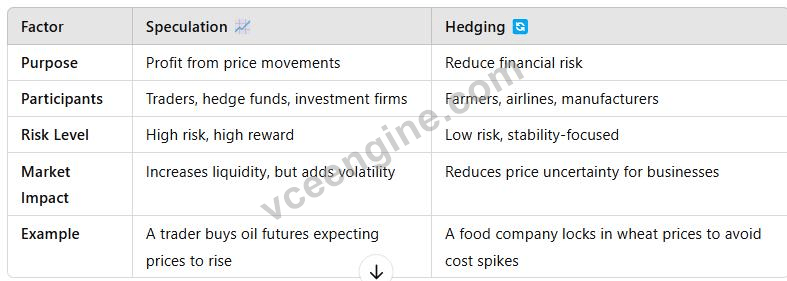
Key Takeaway: Speculation seeks profit from price changes, while hedging minimizes risk from price fluctuations.
5. Conclusion
✅ Commodity products are standardized raw materials traded globally, with prices driven by supply and demand dynamics.
✅ Speculation brings liquidity and price discovery but can increase volatility.
✅ Hedging helps businesses stabilize costs and revenues, ensuring financial predictability.
✅ Both strategies play essential roles in ensuring a balanced, functional commodities market.
SIMULATION
Explain how culture and historic influences can impact upon a business's strategic decisions and positioning within the marketplace
Correct Answer:
How Culture and Historic Influences Impact Strategic Decisions and Market Positioning A business's strategic decisions and positioning within the marketplace are shaped by both organizational culture and historical influences. These factors affect how a company develops strategy, interacts with customers, manages employees, and competes globally.
1. The Role of Organizational Culture in Strategic Decisions
Organizational culture is the shared values, beliefs, and behaviors within a company. It influences decision-making, innovation, and competitive advantage.
How Culture Affects Strategy
✅ Risk Appetite - A culture that embraces innovation (e.g., Google) will invest in R&D, while risk-averse cultures (e.g., traditional banks) focus on stability.
✅ Decision-Making Speed - Hierarchical cultures (e.g., Japanese firms) rely on consensus, while Western firms (e.g., Apple) may have centralized decision-making.
✅ Customer Engagement - A customer-centric culture (e.g., Amazon) leads to investment in personalization and AI-driven recommendations.
Example:
Toyota's Kaizen Culture (Continuous Improvement) has shaped its lean manufacturing strategy, giving it a competitive advantage in cost efficiency.
2. How Historic Influences Shape Business Strategy
Historical events, past business performance, economic trends, and industry evolution shape how businesses position themselves in the marketplace.
How History Affects Strategy
✅ Legacy of Innovation or Conservatism - Companies with a history of innovation (e.g., IBM, Tesla) continuously push boundaries, while firms with traditional roots (e.g., British banks) focus on risk management.
✅ Economic Crises and Financial Stability - Businesses that survived financial crises (e.g., 2008 recession) tend to develop risk-averse financial strategies.
✅ Market Reputation and Consumer Perception - A strong historical reputation can be leveraged for branding (e.g., Rolls-Royce's luxury image).
Example:
Lego nearly went bankrupt in the early 2000s, leading it to redefine its strategy, focus on digital gaming partnerships, and revive its brand.
3. The Influence of National and Corporate Culture on Global Positioning When expanding globally, businesses must align their strategies with different cultural expectations.
How Culture Affects Global Market Entry
✅ Consumer Preferences - Fast food chains adapt menus for local cultures (e.g., McDonald's in India offers vegetarian options).
✅ Negotiation & Communication Styles - Business negotiations in China emphasize relationships ("Guanxi"), while Western firms prioritize efficiency.
✅ Leadership and Management Approaches - German firms emphasize engineering precision, while Silicon Valley firms prioritize agility and experimentation.
Example:
IKEA modifies store layouts in different countries-small apartments in Japan vs. large home spaces in the U.S.
4. Strategic Positioning Based on Cultural & Historic Factors
A company's historical and cultural influences define its positioning strategy: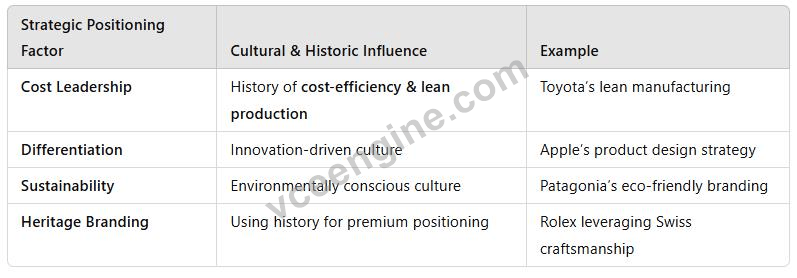
Conclusion
A business's strategic decisions and market positioning are deeply influenced by organizational culture, national culture, and historical performance. Companies that leverage their cultural strengths and adapt to market history can achieve long-term competitive advantage.
SIMULATION
XYZ is a manufacturing company based in the UK. It has a large complex supply chain and imports raw materials from Argentina and South Africa. It sells completed products internationally via their website. Evaluate the role of licencing and taxation on XYZ's operations.
Correct Answer:
Evaluation of the Role of Licensing and Taxation on XYZ's Operations
Introduction
Licensing and taxation play a critical role in international trade, supply chain management, and overall financial performance. For XYZ, a UK-based manufacturing company that imports raw materials from Argentina and South Africa and sells internationally via an e-commerce platform, compliance with licensing and taxation regulations is essential to ensure smooth operations, cost efficiency, and legal compliance.
This evaluation will assess the impact of licensing and taxation on XYZ's global supply chain, import/export activities, and financial performance.
1. The Role of Licensing in XYZ's Operations
1.1 Import and Export Licensing Regulations
As XYZ imports raw materials from Argentina and South Africa, it must comply with the UK's import licensing requirements and trade agreements with these countries.
✅ Impact on XYZ:
Import licenses may be required for certain restricted raw materials (e.g., metals, chemicals, agricultural products).
Export control laws may apply, depending on the destination of final products.
Delays or fines may occur if licenses are not properly managed.
Example: If XYZ imports metal components subject to UK trade restrictions, it must secure import licenses before shipment clearance.
1.2 Industry-Specific Licensing Requirements
Some industries require special licenses to manufacture and sell products globally.
✅ Impact on XYZ:
If XYZ manufactures electronics or chemical-based products, it may need compliance certifications (e.g., CE marking in the EU, FDA approval in the US).
Failure to meet licensing requirements can block international sales.
Example: A UK manufacturer selling medical devices must obtain MHRA (Medicines and Healthcare products Regulatory Agency) approval before distributing products.
1.3 E-Commerce & Digital Sales Licensing
As XYZ sells its products internationally via its website, it must comply with:
✅ Consumer Protection Laws (e.g., GDPR for EU customers).
✅ E-commerce business registration and online sales regulations.
Example: XYZ may need a VAT number in the EU if it sells products to European customers via its website.
2. The Role of Taxation in XYZ's Operations
2.1 Import Duties and Tariffs
XYZ's supply chain involves importing raw materials from Argentina and South Africa, which may attract import duties and tariffs.
✅ Impact on XYZ:
Higher import duties increase raw material costs and impact profitability.
Tariff-free trade agreements (e.g., UK-South Africa trade deal) may reduce costs.
Post-Brexit UK-EU trade regulations may affect supply chain tax structures.
Example: If the UK imposes high tariffs on South African goods, XYZ may need to find alternative suppliers or negotiate better deals.
2.2 Corporate Tax & International Tax Compliance
XYZ must comply with UK corporate tax laws and international taxation regulations.
✅ Impact on XYZ:
Paying corporate tax in the UK based on global sales revenue.
Managing international tax obligations when selling in multiple countries.
Risk of double taxation if the same income is taxed in multiple jurisdictions.
Example: If XYZ sells products in Germany and the US, it may need to register for tax in those countries and comply with local VAT/GST requirements.
2.3 Value Added Tax (VAT) & Sales Tax
Since XYZ sells internationally via its website, it must adhere to global VAT and sales tax rules.
✅ Impact on XYZ:
In the EU, VAT registration is required for online sales above a certain threshold.
In the US, sales tax regulations vary by state.
Compliance with UK VAT laws (e.g., 20% standard rate) on domestic sales.
Example: A UK company selling online to EU customers must comply with the EU One-Stop-Shop (OSS) VAT scheme.
2.4 Transfer Pricing & Tax Efficiency
If XYZ has international subsidiaries or supply chain partners, it must manage transfer pricing regulations.
✅ Impact on XYZ:
Ensuring fair pricing between UK operations and overseas suppliers to avoid tax penalties.
Optimizing tax-efficient supply chain structures to minimize tax burdens.
Example: Multinational companies like Apple and Amazon use tax-efficient structures to reduce liabilities.
3. Strategic Actions for XYZ to Manage Licensing and Taxation Effectively XYZ can take several steps to optimize tax compliance and licensing efficiency: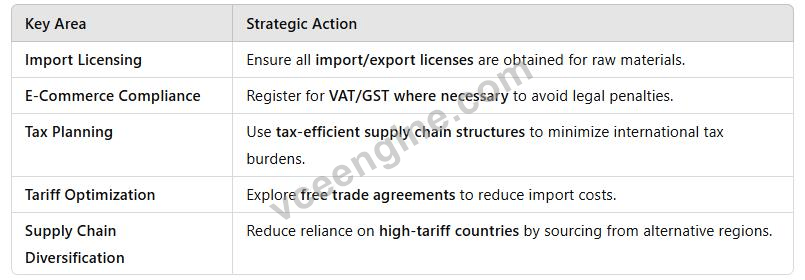
Conclusion
Licensing and taxation have a major impact on XYZ's international manufacturing and e-commerce operations. To maintain profitability and regulatory compliance, XYZ must:
✅ Ensure import/export licensing aligns with UK and international trade laws.
✅ Manage import duties, VAT, and corporate tax obligations effectively.
✅ Optimize its supply chain and tax planning to reduce costs.
By proactively managing these areas, XYZ can enhance its global competitiveness while minimizing risks.
Over 93193+ Satisfied Customers
Searching for L6M2 real exam questions and answer to pass your CIPS certification exam then you are at right place. I just got through my L6M2 certification
Gustave
With VCEEngine's help, I just finished my L6M2 exam. Right, passed it today. Congratulations on my success!
 Ingrid
Recommendation~~~~it is valid~~~~yes~~~~I pass the exam~~~~~happy~~~~
 Tab
Tab
This study guide prepare me to get a passing score on the L6M2 exam. I love the dump. Thanks a million for your help.
 Bridget
Thanks, I pass the exam L6M2 successful. I advised your website to my colleagues.
 Yves
Yves
You guys L6M2 always do great.
 Solomon
I used your L6M2 exam dumps for my study and good news! I cleared it first time.
 Randolph
Good L6M2 exam dumps to get reference for your L6M2 exam. And I really satisfied with my high scores. You are so professional and I feel grateful to find you!
 Sebastiane
I searched latest L6M2 exam questions by Google and found VCEEngine.
 Yedda
Yedda
Still valid, passed 95%, 3 to 4 new questions asked
 Tom
Tom
When I decide to buy the L6M2 exam dumps, I just want to try. But they help me to pass the exam, so surprising!
 Lionel
I used the L6M2 Q&As on your website, and I passed my exam. Thanks for all your help!
 Kyle
Kyle
You won’t regret. I did use L6M2 training guide last month and they worked very well for me!
 Muriel
VCEEngine Practice Exams are written to the highest standards of technical accuracy, using only certified subject matter experts and published authors for development - no all study materials.
If you prepare for the exams using our VCEEngine testing engine, It is easy to succeed for all certifications in the first attempt. You don't have to deal with all dumps or any free torrent / rapidshare all stuff.
We are committed to the process of vendor and third party approvals. We believe professionals and executives alike deserve the confidence of quality coverage these authorizations provide.
VCEEngine offers free demo of each product. You can check out the interface, question quality and usability of our practice exams before you decide to buy.


Choose our Test Practice Engine for your exam Preparation and enjoy the Simulated Test with our Valid Training Engine. Our Valid Test Practice Engine will provide you with Free Dumps Demo with Accurate Answers that based on the real exam.
Copyright © 2026 VCEEngine NETWORK CO.,LIMITED. All Rights Reserved. All trademarks used are properties of their respective owners. Privacy Policy
