

2023 Realistic AZ-120 Dumps Latest Microsoft Practice Tests Dumps
AZ-120 Dumps PDF - AZ-120 Real Exam Questions Answers
NEW QUESTION # 106
You plan to migrate an on-premises SAP development system to Azure.
Before the migration, you need to check the usage of the source system hardware, such as CPU, memory, network, etc.
Which transaction should you run from SAP GUI?
- A. SM51
- B. DB12
- C. OS07N
- D. DB01
Answer: C
Explanation:
SAP transaction OS07N (Remote Operating System Activity) is classified in the Basis Component module under application component Operating System Monitors and runs Monitoring Operating System program RSHOST1N upon execution.
Incorrect Answers:
A: Transaction code SM51 is to display list of active application servers that have registered in the SAP message server.
B: DB01 is a transaction code used for Analyze Exclusive Lockwaits in SAP.
C: Transaction code DB12 is to collects and presents information that is necessary to monitor database backups.
References:
http://www.saptransactions.com/codes/OS07N/
Design an Azure Solution to Support SAP Workloads
Testlet 1
Case Study
This is a case study. Case studies are not timed separately. You can use as much exam time as you would like to complete each case. However, there may be additional case studies and sections on this exam. You must manage your time to ensure that you are able to complete all questions included on this exam in the time provided.
To answer the questions included in a case study, you will need to reference information that is provided in the case study. Case studies might contain exhibits and other resources that provide more information about the scenario that is described in the case study. Each question is independent of the other questions in this case study.
At the end of this case study, a review screen will appear. This screen allows you to review your answers and to make changes before you move to the next section of the exam. After you begin a new section, you cannot return to this section.
To start the case study
To display the first question in this case study, click the Next button. Use the buttons in the left pane to explore the content of the case study before you answer the questions. Clicking these buttons displays information such as business requirements, existing environment, and problem statements. If the case study has an All Information tab, note that the information displayed is identical to the information displayed on the subsequent tabs. When you are ready to answer a question, click the Question button to return to the question.
Overview
Litware, Inc. is an international manufacturing company that has 3,000 employees.
Litware has two main offices. The offices are located in Miami, FL, and Madrid, Spain.
Existing Environment
Infrastructure
Litware currently uses a third-party provider to host a datacenter in Miami and a disaster recovery datacenter in Chicago, IL.
The network contains an Active Directory domain named litware.com. Litware has two third-party applications hosted in Azure.
Litware already implemented a site-to-site VPN connection between the on-premises network and Azure.
SAP Environment
Litware currently runs the following SAP products:
* Enhancement Pack6 for SAP ERP Central Component 6.0 (SAP ECC 6.0)
* SAP Extended Warehouse Management (SAP EWM)
* SAP Supply Chain Management (SAP SCM)
* SAP NetWeaver Process Integration (PI)
* SAP Business Warehouse (SAP BW)
* SAP Solution Manager
All servers run on the Windows Server platform. All databases use Microsoft SQL Server. Currently, you have
20 production servers.
You have 30 non-production servers including five testing servers, five development servers, five quality assurance (QA) servers, and 15 pre-production servers.
Currently, all SAP applications are in the litware.com domain.
Problem Statements
The current version of SAP ECC has a transaction that, when run in batches overnight, takes eight hours to complete. You confirm that upgrading to SAP Business Suite on HANA will improve performance because of code changes and the SAP HANA database platform.
Litware is dissatisfied with the performance of its current hosted infrastructure vendor. Litware experienced several hardware failures and the vendor struggled to adequately support its 24/7 business operations.
Requirements
Business Goals
Litware identifies the following business goals:
* Increase the performance of SAP ECC applications by moving to SAP HANA. All other SAP databases will remain on SQL Server.
* Move away from the current infrastructure vendor to increase the stability and availability of the SAP services.
* Use the new Environment, Health and Safety (EH&S) in Recipe Management function.
* Ensure that any migration activities can be completed within a 48-hour period during a weekend.
Planned Changes
Litware identifies the following planned changes:
* Migrate SAP to Azure.
* Upgrade and migrate SAP ECC to SAP Business Suite on HANA Enhancement Pack 8.
Technical Requirements
Litware identifies the following technical requirements:
* Implement automated backups.
* Support load testing during the migration.
* Identify opportunities to reduce costs during the migration.
* Continue to use the litware.com domain for all SAP landscapes.
* Ensure that all SAP applications and databases are highly available.
* Establish an automated monitoring solution to avoid unplanned outages.
* Remove all SAP components from the on-premises network once the migration is complete.
* Minimize the purchase of additional SAP licenses. SAP HANA licenses were already purchased.
* Ensure that SAP can provide technical support for all the SAP landscapes deployed to Azure.
NEW QUESTION # 107
You deploy an SAP environment on Azure.
You need to configure SAP NetWeaver to authenticate by using Azure Active Directory (Azure AD).
Which four actions should you perform in sequence? To answer, move the appropriate actions from the list of actions to the answer area and arrange them in the correct order.
Answer:
Explanation:
NEW QUESTION # 108
You are migrating SAP to Azure. The ASCS application servers are in one Azure zone, and the SAP database server in in a different Azure zone. ASCS/ERS is configured for high availability.
During performance testing, you discover increased response times in Azure, even though the Azure environment has better computer and memory configurations than the on-premises environment.
During the initial analysis, you discover an increased wait time for Enqueue.
What are three possible causes of the increased wait time? Each correct answer presents a complete solution.
NOTE: Each correct selection is worth one point.
- A. network latency between the database server and the SAP application servers
- B. a missing Enqueue profile
- C. disk I/O during Enqueue backup operations
- D. misconfigured load balancer rules and health check probes for Enqueue and ASCS
- E. active Enqueue replication
Answer: A,D,E
Explanation:
E: The network latency across Availability Zones is not the same in all Azure regions. In some cases, you can deploy and run the SAP application layer across different zones because the network latency from one zone to the active DBMS VM is acceptable. But in some Azure regions, the latency between the active DBMS VM and the SAP application instance, when deployed in different zones, might not be acceptable for SAP business processes.
References:
https://docs.microsoft.com/en-us/azure/virtual-machines/workloads/sap/sap-ha-availability-zones
NEW QUESTION # 109
You have a large and complex SAP environment on Azure.
You are designing a training landscape that will be used 10 times a year.
You need to recommend a solution to create the training landscape. The solution must meet the following requirements:
* Minimize the effort to build the training landscape.
* Minimize costs.
In which order should you recommend the actions be performed for the first training session? To answer, move all actions from the list of actions to the answer area and arrange them in the correct order.
Answer:
Explanation:
Explanation
Build
Snapshot
Custom Image
Deliver Training
Shutdown
References:
https://docs.microsoft.com/en-us/azure/virtual-machines/workloads/sap/planning-guide
NEW QUESTION # 110
You plan to migrate an SAP environment to Azure.
You need to create a design to facilitate end-user access to SAP applications over the Internet, while restricting user access to the virtual machines of the SAP application servers.
What should you include in the design?
- A. Configure point-to-site VPN connections for each user
- B. Use an SAP Web Dispatcher to route all incoming connections
- C. Configure a public IP address for each SAP application server
- D. Deploy an internal Azure Standard Load Balancer for incoming connections
Answer: B
Explanation:
* A public internet user can reach the SAP Web-Dispatcher over port 443
* The SAP Web-Dispatcher can reach the SAP Application server over port 443
* The App Subnet accepts traffic on port 443 from 10.0.0.0/24
* The SAP Application server sends traffic on port 30015 to the SAP DB server
* The DB subnet accepts traffic on port 30015 from 10.0.1.0/24.
* Public Internet Access is blocked on both App Subnet and DB Subnet.
References:
https://azure.microsoft.com/en-in/blog/sap-on-azure-architecture-designing-for-security/
NEW QUESTION # 111
You recently migrated an SAP HANA environment to Azure.
You plan to back up SAP HANA databases to disk on the virtual machines, and then move the backup tiles to Azure Blob storage for retention.
Which command should you run to move the backups to the Blob storage?
- A. scp
- B. backint
- C. azcopy
- D. robocopy
Answer: C
Explanation:
Explanation
To store directories and files on Azure storage, one could use CLI or PowerShell. There is also a ready-to-use utility, AzCopy, for copying data to Azure storage.
Reference:
https://docs.microsoft.com/en-us/azure/virtual-machines/workloads/sap/sap-hana-backup-file-level
NEW QUESTION # 112
You plan to migrate an SAP environment to Azure.
You need to design an Azure network infrastructure to meet the following requirements:
* Prevent end users from accessing the database servers.
* Isolate the application servers from the database servers.
* Ensure that end users can access the SAP systems over the internet
Minimize the costs associated to the communications between the application servers and database servers Which two actions should you include in the solution? Each correct answer presents pan of the solution.
NOTE: Each correct selection is worth one point.
- A. Configure an infernal Azure Standard Load Balancer for incoming connections.
- B. In the same Azure virtual network, segregate the SAP application service and database servers by using different subnets and network security groups.
- C. Segregate the SAP application servers and database servers by using different Azure virtual networks.
- D. Create a site-to-site VPN between the on premises network and Azure.
- E. Configure Azure Traffic Manager to route incoming connections.
Answer: B,D
NEW QUESTION # 113
You have an on-premises SAP environment that uses AIX servers and IBM DB2 as the database platform.
You plan to migrate SAP to Azure. In Azure, the SAP workloads will use Windows Server and Microsoft SQL Server as the database platform.
What should you use to export from DB2 and import the data to SQL Server?
- A. R3load
- B. SQL Server Management Studio (SSMS)
- C. Azure SQL Data Warehouse
- D. R3trans
Answer: A
Explanation:
Both R3load and SSMA can be used to migrate from DB2 to SQL Server. In the options there is not SSMA, but SSMS, the SSMS cannot be use to migrate DB2 to SQL Server. please refer to: https://techcommunity.microsoft.com/t5/running-sap-applications-on-the/sap-os-db-migration-to-sql-server-faq/ba-p/366986
https://sapnwnewbie.blogspot.com/2013/07/osdb-migration-cmd-str-toc-ext-r3load.html https://docs.microsoft.com/en-us/sql/ssma/sql-server-migration-assistant?view=sql-server-ver15
https://docs.microsoft.com/en-us/sql/ssms/sql-server-management-studio-ssms?view=sql-server-ver15
NEW QUESTION # 114
For each of the following statements, select Yes if the statement is true. Otherwise, select No. NOTE: Each correct selection is worth one point.
Answer:
Explanation:
Explanation
Graphical user interface, text, application, email Description automatically generated
Box 1: Yes
The following is a quick checklist of storage configuration best practices for running your SQL Server on Azure VM:
* Place data, log, and tempdb files on separate drives.
Box 2: Yes
Accelerated networking enables single root I/O virtualization (SR-IOV) to a VM, greatly improving its networking performance. This high-performance path bypasses the host from the data path, which reduces latency, jitter, and CPU utilization for the most demanding network workloads on supported VM types.
Box 3: No
Note: The maximum transmission unit (MTU) is the largest size frame (packet), specified in bytes, that can be sent over a network interface. The MTU is a configurable setting. The default MTU used on Azure VMs, and the default setting on most network devices globally, is 1,500 bytes.
Reference:
https://docs.microsoft.com/en-us/azure/virtual-network/create-vm-accelerated-networking-powershell
https://docs.microsoft.com/en-us/azure/azure-sql/virtual-machines/windows/performance-guidelines-best-practic
NEW QUESTION # 115
You have an existing on-premises SAP landscape that is hosted on VMware VSphere.
You plan to migrate the landscape to Azure.
You configure the Azure Site Recovery replication policy shown in the following exhibit.
Answer:
Explanation:
see the explanation for below image:
Explanation
Answer selected as in image below.
NEW QUESTION # 116
Note: This question is part of a series of questions that present the same scenario. Each question in the series contains a unique solution that might meet the stated goals. Some question sets might have more than one correct solution, while others might not have a correct solution.
After you answer a question in this section, you will NOT be able to return to it. As a result, these questions will not appear in the review screen.
You have a complex SAP environment that has both ABAP- and Java-based systems. The current on-premises landscapes are based on SAP NetWeaver 7.0 (Unicode and Non-Unicode) running on Windows Server and Microsoft SQL Server.
You need to migrate the SAP environment to a HANA-certified Azure environment.
Solution: You upgrade to SAP NetWeaver 7.4, and then you migrate SAP to Azure by using Azure Site Recovery.
Does this meet the goal?
- A. No
- B. Yes
Answer: B
Explanation:
Explanation
We need upgrade to SAP NetWeaver 7.4 before the migration. Then Azure Site Recovery is used for the migration to Azure.
Reference:
https://docs.microsoft.com/en-us/azure/site-recovery/vmware-azure-architecture
NEW QUESTION # 117
For each of the following statements, select Yes if the statement is true. Otherwise, select No.
NOTE: Each correct selection is worth one point.
Answer:
Explanation:
Explanation
NEW QUESTION # 118
You are designing the backup for an SAP database.
You have an Azure Storage account that is configured as shown in the following exhibit.
Use the drop-down menus to select the answer choice that completes each statement based on the information presented in the graphic.
NOTE: Each correct selection is worth one point.
Answer:
Explanation:
Explanation
Box 1: hard disk drives (HDDs)
Box 2: to another Azure region
Geo-redundant storage (GRS) copies your data synchronously three times within a single physical location in the primary region using LRS. It then copies your data asynchronously to a single physical location in a secondary region that is hundreds of miles away from the primary region.
References:
https://azure.microsoft.com/en-us/pricing/details/managed-disks/
https://docs.microsoft.com/en-us/azure/storage/common/storage-redundancy#geo-redundant-storage
https://docs.microsoft.com/en-us/azure/virtual-machines/workloads/sap/planning-guide-storage#azure-standard-h
NEW QUESTION # 119
You have SAP ERP on Azure.
For SAP high availability, you plan to deploy ASCS/ERS instances across Azure Availability Zones and to use failover clusters.
For each of the following statements, select Yes if the statement is true. Otherwise, select No.
NOTE: Each correct selection is worth one point.
Answer:
Explanation:
Explanation
Box 1: No
You can't use an Azure Basic Load Balancer to create failover cluster solutions based on Windows Server Failover Clustering or Linux Pacemaker. Instead, you need to use the Azure Standard Load Balancer SKU.
Box 2: Yes
Azure Availability Zones is one of the high-availability features that Azure provides. Using Availability Zones improves the overall availability of SAP workloads on Azure.
The SAP application layer is deployed across one Azure availability set. For high availability of SAP Central Services, you can deploy two VMs in a separate availability set.
Box 3: Yes
You must use Azure Managed Disks when you deploy to Azure Availability Zones.
Reference:
https://docs.microsoft.com/en-us/azure/virtual-machines/workloads/sap/sap-ha-availability-zones
https://docs.microsoft.com/en-us/azure/virtual-machines/workloads/sap/sap-proximity-placement-scenarios#com
https://docs.microsoft.com/en-us/azure/architecture/reference-architectures/sap/sap-netweaver
NEW QUESTION # 120
You have an on-premises SAP landscape that contains an IBM DB2 database.
You need to recommend a solution to migrate the landscape to Azure and the database to SAP HANA. The solution must meet the following requirements:
Be supported by SAP.
Minimize downtime.
What should you include in the recommendation?
- A. Azure Database Migration Service
- B. Azure Import/Export service
- C. SAP Database Migration Option (DMO) with System Move
- D. Azure Data Box Gateway
Answer: C
Explanation:
In 2013, SAP introduced new procedure called Database Migration Option (part of Software Update Manager), which can help you during the migration to HANA database. It combines Unicode conversion, system update and database migration into a single step which extremely simplified the overall process.
Reference:
https://blogs.sap.com/2017/10/05/your-sap-on-azure-part-2-dmo-with-system-move/
NEW QUESTION # 121
You deploy an Azure Internal load balancer.
You deploy a node of an SAP NetWeaver 7.4 ABAP system named SP1.
You plan to deploy a second node.
You need to verify that the health probe port is configured for the cluster. The cluster IP address resource name is SAP SP1 IP.
How should you complete the command? To answer, select the appropriate options in the answer area.
NOTE: Each correct selection is worth one point.
Answer:
Explanation:
Explanation
A picture containing text Description automatically generated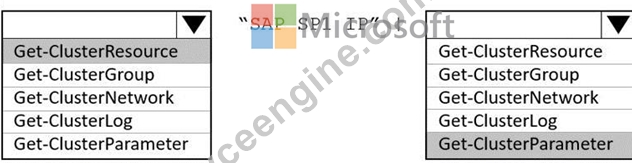
Box 1: Get-ClusterResource
Example:
Get-ClusterResource -Name $SAPIPresourceName | Get-ClusterParameter
Write-Output " "
Write-Output "Current probe port property of the SAP cluster resource '$SAPIPresourceName' is
'$OldProbePort'."
Write-Output " "
Write-Output "Setting the new probe port property of the SAP cluster resource '$SAPIPresourceName' to
'$ProbePort' ..."
Write-Output " "
Box 2: Get-ClusterParameter
Reference:
https://docs.microsoft.com/en-us/azure/virtual-machines/workloads/sap/sap-high-availability-installation-wsfc-sh
NEW QUESTION # 122
You have an SAP environment on Azure.
You use Azure Recovery Services to back up an SAP application server.
You need to test the restoration process of a file on the server.
Which three actions should you perform in sequence? To answer, move the appropriate actions from the list of actions to the answer area and arrange them in the correct order.
Answer:
Explanation:
Explanation:
Step 1: From Azure Recover Vault, select File Recovery
To restore files or folders from the recovery point, go to the virtual machine and choose the desired recovery point.
Step 2: Download and run the mount disk executable
Step 3: recover the file and unmount the disk
NEW QUESTION # 123
You have an Azure Availability Set that is configured as shown in the following exhibit.
Use the drop-down menus to select the answer choice that completes each statement based on the information presented in the graphic.
NOTE: Each correct selection is worth one point.
Answer:
Explanation:
Explanation
Box 1: the same fault domain
Fault domains define the group of virtual machines that share a common power source and network switch. If a storage fault domain fails due to hardware or software failure, only the VM instance with disks on the storage fault domain fails.
Box 2: managed disks
Managed disks provide better reliability for Availability Sets by ensuring that the disks of VMs in an Availability Set are sufficiently isolated from each other to avoid single points of failure. It does this by automatically placing the disks in different storage fault domains (storage clusters) and aligning them with the VM fault domain.
References:
https://docs.microsoft.com/en-us/azure/virtual-machines/windows/manage-availability
NEW QUESTION # 124
......
AZ-120 Premium Exam Engine pdf Download: https://www.vceengine.com/AZ-120-vce-test-engine.html
AZ-120 Exam [2023] Dumps Microsoft PDF Questions: https://drive.google.com/open?id=1PsoXt8t7qsB5h3O0UwBMMimdo0KARMAD
