

[Dec 21, 2021] Fully Updated Dumps PDF - Latest CKA Exam Questions and Answers
100% Free CKA Exam Dumps to Pass Exam Easily from VCEEngine
How to book the Linux Foundation-CKA: Certified Kubernetes Administrator Exam
To register for the CKA exam, go to CNCF Website.
Certification Path
There are no pre-requisites for Linux Foundation-CKA: Certified Kubernetes Administrator exam and the successful completion will give you the title of Certified Kubernetes Administrator
NEW QUESTION 22
Create an nginx pod which loads the secret as environment variables
- A. // create a yml file
kubectl run nginx --image=nginx --restart=Never --dry-run -o
yaml > nginx.yml
// add env section below and create
vim nginx.yaml
apiVersion: v1
kind: Pod
metadata:
labels:
run: nginx
name: nginx
spec:
containers:
- image: nginx
name: nginx
envFrom:
- secretRef:
name: my-secret
restartPolicy: Never
kubectl apply -f nginx.yaml
//verify
kubectl exec -it nginx - env - B. // create a yml file
kubectl run nginx --image=nginx --restart=Never --dry-run -o
yaml > nginx.yml
// add env section below and create
vim nginx.yaml
run: nginx
name: nginx
spec:
containers:
- image: nginx
name: nginx
envFrom:
- secretRef:
name: my-secret
restartPolicy: Never
kubectl apply -f nginx.yaml
//verify
kubectl exec -it nginx - env
Answer: A
NEW QUESTION 23
Scale the deployment webserver to
Answer:
Explanation:
See the solution below.
Explanation
solution
F:\Work\Data Entry Work\Data Entry\20200827\CKA\14 B.JPG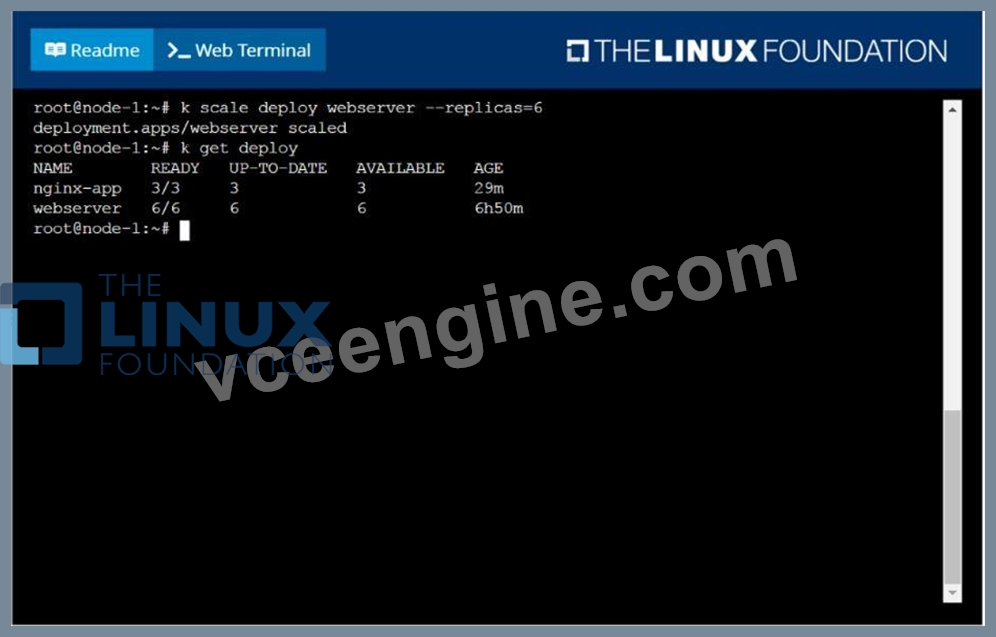
NEW QUESTION 24
To protect your firewall and network from single source denial of service (DoS) attacks that can overwhelm its packet buffer and cause legitimate traffic to drop, you can configure:
- A. PGP (Packet Gateway Protocol)
- B. PBP (Packet Buffer Protection)
- C. PBP (Protocol Based Protection)
- D. BGP (Border Gateway Protocol)
Answer: C
NEW QUESTION 25
Evict all existing pods from a node-1 and make the node unschedulable for new pods.
- A. kubectl get nodes
kubectl drain node-1 #It will evict pods running on node-1 to
other nodes in the cluster
// Verify
kubectl get no
When you cordon a node, the status shows "SchedulingDisabled" - B. kubectl get nodes
kubectl drain node-1 #It will evict pods running on node-1 to
other nodes in the cluster
kubectl cordon node-1 # New pods cannot be scheduled to the
node
// Verify
kubectl get no
When you cordon a node, the status shows "SchedulingDisabled"
Answer: B
NEW QUESTION 26
Print pod name and start time to "/opt/pod-status" file
Answer:
Explanation:
See the solution below.
Explanation
kubect1 get pods -o=jsonpath='{range
items[*]}{.metadata.name}{"\t"}{.status.podIP}{"\n"}{end}'
NEW QUESTION 27
Create a job named "hello-job" with the image busybox which echos "Hello I'm running job"
- A. kubectl create job hello-job --image=busybox --dry-run -o yaml
-- echo "Hello I'm running job" > hello-job.yaml
kubectl create -f hello-job.yaml
//Verify Job
kubectl get job
kubectl get po
kubectl logs hello-job-* - B. kubectl create job hello-job --image=busybox --dry-run -o yaml
-- echo "Hello I'm running job" > hello-job.yaml
kubectl create -f hello-job.yaml
//Verify Job
kubectl get po
kubectl logs hello-job-*
Answer: A
NEW QUESTION 28
An administrator accidentally closed the commit window/screen before the commit was finished. Which two options could the administrator use to verify the progress or success of that commit task? (Choose two)
- A. Task Manager
- B. Traffic Logs
- C. System Logs
- D. Configuration Logs
Answer: A,D
NEW QUESTION 29
Create a pod with init container which create a file "test.txt"
in "workdir" directory. Main container should check a file
"test.txt" exists and execute sleep 9999 if the file exists.
- A. // create an initial yaml file with this
kubectl run init-cont-pod --image=alpine --restart=Never --dry-run -o
yaml > init-cont-pod.yaml
// edit the yml as below and create it
vim init-cont-pod.yaml
apiVersion: v1
kind: Pod
metadata:
name: init-cont-pod
labels:
app: myapp
spec:
volumes:
- name: test-volume
emptyDir: {}
containers:
- name: main-container
image: busybox:1.28
command: ['sh', '-c', 'if [ -f /workdir/test.txt ]; then sleep
9999; fi']
volumeMounts:
image: busybox:1.28
command: ['sh', '-c', "mkdir /workdir; echo >
/workdir/test.txt"]
volumeMounts:
- name: test-volume
mountPath: /workdir
// Create the pod
kubectl apply -f init-cont-pod.yaml
kubectl get pods
// Check Events by doing
kubectl describe po init-cont-pod
Init Containers:
init-myservice:
Container ID:
docker://ebdbf5fad1c95111d9b0e0e2e743c2e347c81b8d4eb5abcccdfe1dd74524
0d4f
Image: busybox:1.28
Image ID: dockerpullable://busybox@sha256:141c253bc4c3fd0a201d32dc1f493bcf3fff003b6df
416dea4f41046e0f37d47
Port: <none>
Host Port: <none>
Command:
sh
-c
mkdir /workdir; echo > /workdir/test.txt
State: Terminated Reason: Completed - B. // create an initial yaml file with this
kubectl run init-cont-pod --image=alpine --restart=Never --dry-run -o
yaml > init-cont-pod.yaml
// edit the yml as below and create it
vim init-cont-pod.yaml
apiVersion: v1
kind: Pod
metadata:
name: init-cont-pod
labels:
app: myapp
spec:
volumes:
- name: test-volume
emptyDir: {}
containers:
- name: main-container
image: busybox:1.28
command: ['sh', '-c', 'if [ -f /workdir/test.txt ]; then sleep
9999; fi']
volumeMounts:
- name: test-volume
mountPath: /workdir
initContainers:
- name: init-myservice
image: busybox:1.28
command: ['sh', '-c', "mkdir /workdir; echo >
/workdir/test.txt"]
volumeMounts:
- name: test-volume
mountPath: /workdir
// Create the pod
kubectl apply -f init-cont-pod.yaml
kubectl get pods
// Check Events by doing
kubectl describe po init-cont-pod
Init Containers:
init-myservice:
Container ID:
docker://ebdbf5fad1c95111d9b0e0e2e743c2e347c81b8d4eb5abcccdfe1dd74524
0d4f
Image: busybox:1.28
Image ID: dockerpullable://busybox@sha256:141c253bc4c3fd0a201d32dc1f493bcf3fff003b6df
416dea4f41046e0f37d47
Port: <none>
Host Port: <none>
Command:
sh
-c
mkdir /workdir; echo > /workdir/test.txt
State: Terminated Reason: Completed
Answer: B
NEW QUESTION 30
Create PersistentVolume named task-pv-volume with storage 10Gi, access modes ReadWriteMany, storageClassName manual, and volume at /mnt/data and Create a PersistentVolumeClaim of at least 3Gi storage and access mode ReadWriteOnce and verify
- A. vim task-pv-volume.yaml
apiVersion: v1
kind: PersistentVolume
metadata:
name: task-pv-volume
labels:
type: local
spec:
storageClassName: manual
capacity:
storage: 10Gi
accessModes:
- ReadWriteMany
hostPath:
path: "/mnt/data"
kubectl apply -f task-pv-volume.yaml
//Verify
kubectl get pv
vim task-pvc-volume.yaml
apiVersion: v1
kind: PersistentVolumeClaim
metadata:
name: task-pv-claim
spec:
storageClassName: manual
accessModes:
- ReadWriteMany
resources:
requests:
storage: 3Gi
kubectl apply -f task-pvc-volume.yaml
//Verify
Kuk kubectl get pvc - B. vim task-pv-volume.yaml
apiVersion: v1
kind: PersistentVolume
metadata:
name: task-pv-volume
labels:
type: local
spec:
storageClassName: manual
capacity:
storage: 10Gi
accessModes:
- ReadWriteMany
hostPath:
path: "/mnt/data"
kubectl apply -f task-pv-volume.yaml
//Verify
kubectl get pv
vim task-pvc-volume.yaml
apiVersion: v1
- ReadWriteMany
resources:
requests:
storage: 3Gi
kubectl apply -f task-pvc-volume.yaml
//Verify
Kuk kubectl get pvc
Answer: A
NEW QUESTION 31
Check to see how many worker nodes are ready (not including nodes tainted NoSchedule) and write the number to /opt/KUCC00104/kucc00104.txt.
Answer:
Explanation:
See the solution below.
Explanation
solution
F:\Work\Data Entry Work\Data Entry\20200827\CKA\15 B.JPG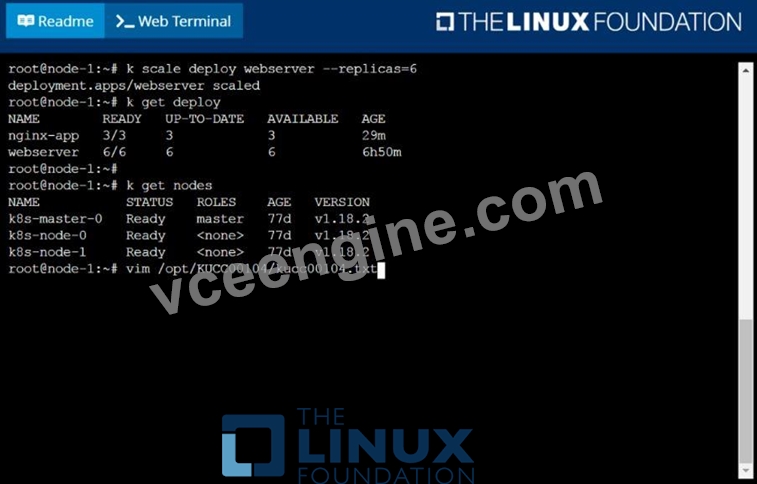
F:\Work\Data Entry Work\Data Entry\20200827\CKA\15 C.JPG
NEW QUESTION 32
Create a redis pod and expose it on port 6379
- A. kubectl run redis --image=redis --restart=Never --port=6379
YAML File :
apiVersion: v1
kind: Pod
metadata:
labels:
run: redis
name: redis
spec:
containers:
ports:
- containerPort: 6679
Rt restartPolicy: Alwaysf - B. kubectl run redis --image=redis --restart=Never --port=6379
YAML File :
apiVersion: v1
kind: Pod
metadata:
labels:
run: redis
name: redis
spec:
containers:
- image: redis
name: redis
ports:
- containerPort: 6379
Rt restartPolicy: Always
Answer: B
NEW QUESTION 33
Print pod name and start time to "/opt/pod-status" file
Answer:
Explanation:
kubect1 get pods -o=jsonpath='{range .items[*]}{.metadata.name}{"\t"}{.status.podIP}{"\n"}{end}'
NEW QUESTION 34
Check the Image version of nginx-dev pod using jsonpath
Answer:
Explanation:
kubect1 get po nginx-dev -o jsonpath='{.spec.containers[].image}{"\n"}'
NEW QUESTION 35
List all the pods sorted by name
Answer:
Explanation:
See the solution below.
Explanation
kubectl get pods --sort-by=.metadata.name
NEW QUESTION 36
Scale the deployment from 5 replicas to 20 replicas and verify
Answer:
Explanation:
kubectl scale deploy webapp --replicas=20 kubectl get deploy webapp kubectl get po -l app=webapp
NEW QUESTION 37
Change the label for one of the pod to env=uat and list all the pods to verify
Answer:
Explanation:
kubectl label pod/nginx-dev3 env=uat --overwrite kubectl get pods --show-labels
NEW QUESTION 38
Get list of all the pods showing name and namespace with a jsonpath expression.
Answer:
Explanation:
kubectl get pods -o=jsonpath="{.items[*]['metadata.name' , 'metadata.namespace']}"
NEW QUESTION 39
List all the pods showing name and namespace with a json path expression
Answer:
Explanation:
See the solution below.
Explanation
kubectl get pods -o=jsonpath="{.items[*]['metadata.name',
'metadata.namespace']}"
NEW QUESTION 40
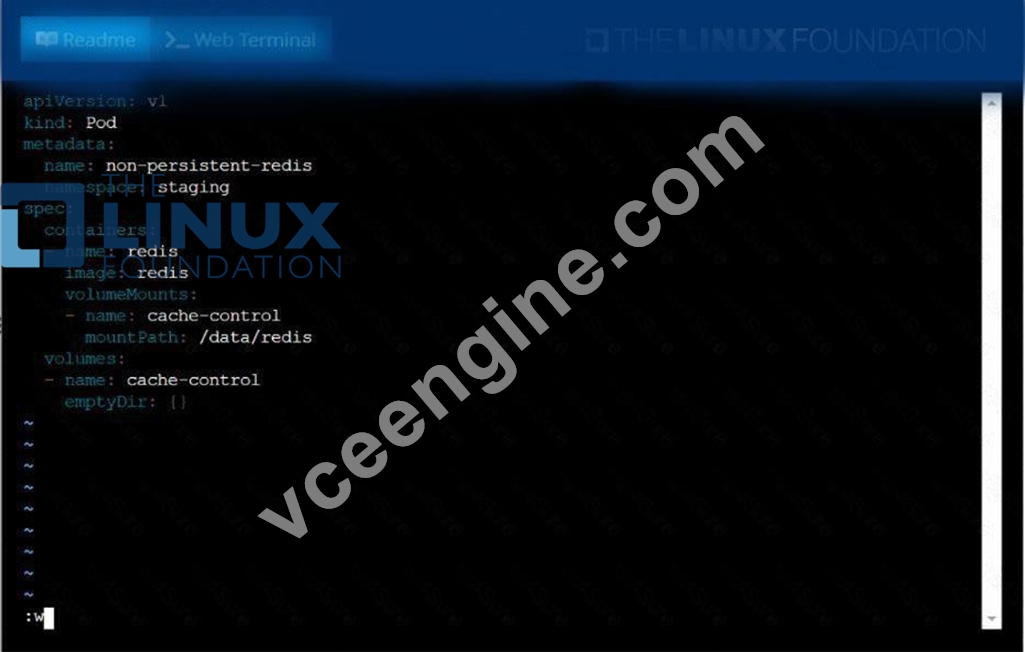
Create a pod as follows:
* Name:non-persistent-redis
* container Image:redis
* Volume with name:cache-control
* Mount path:/data/redis
The pod should launch in thestagingnamespace and the volumemust notbe persistent.
Answer:
Explanation:
See the solution below.
Explanation
solution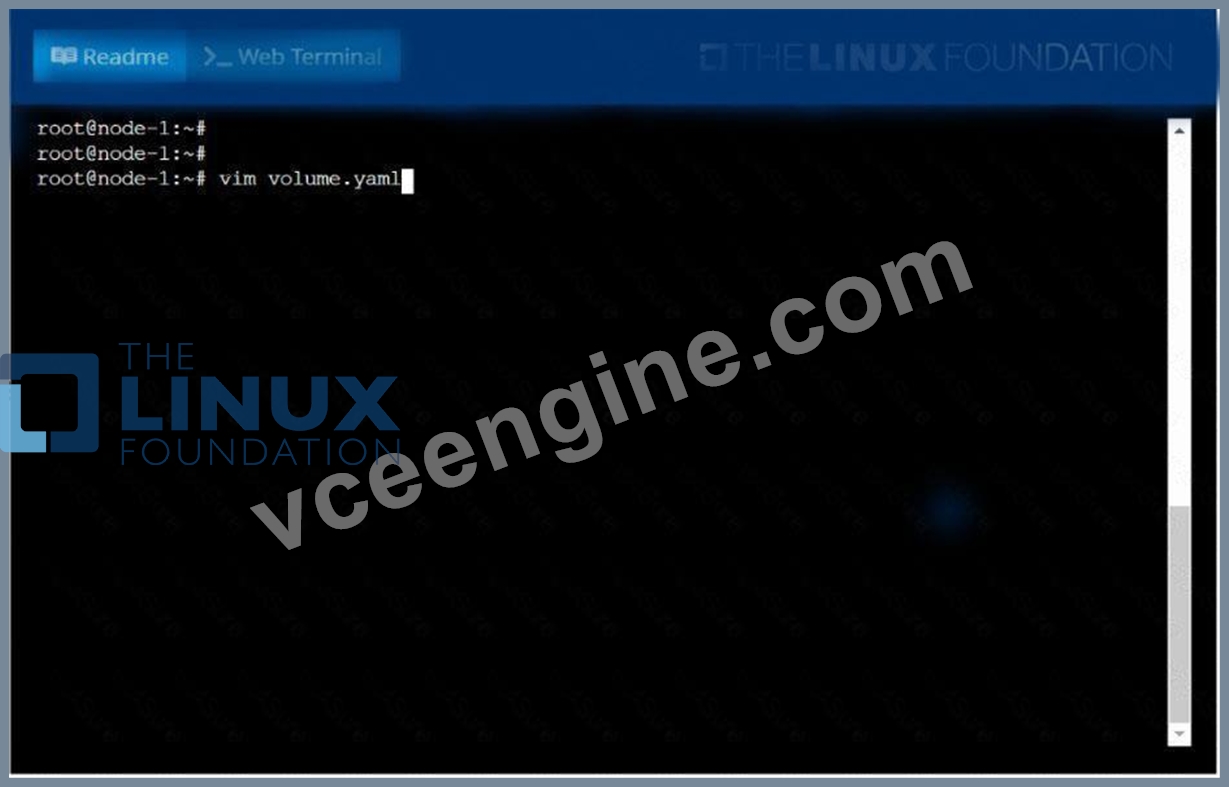

NEW QUESTION 41
Undo/Rollback deployment to specific revision "1"
- A. // Check Deployment History
kubectl rollout history deployment webapp
kubectl rollout undo deploymet webapp --to-revision=1 - B. // Check Deployment History
kubectl rollout history deployment webapp
//Rollback to particular revision
kubectl rollout undo deploymet webapp --to-revision=1
Answer: B
NEW QUESTION 42
Create a file:
/opt/KUCC00302/kucc00302.txt that lists all pods that implement service baz in namespace development.
The format of the file should be one pod name per line.
Answer:
Explanation:
See the solution below.
Explanation
solution
F:\Work\Data Entry Work\Data Entry\20200827\CKA\11 B.JPG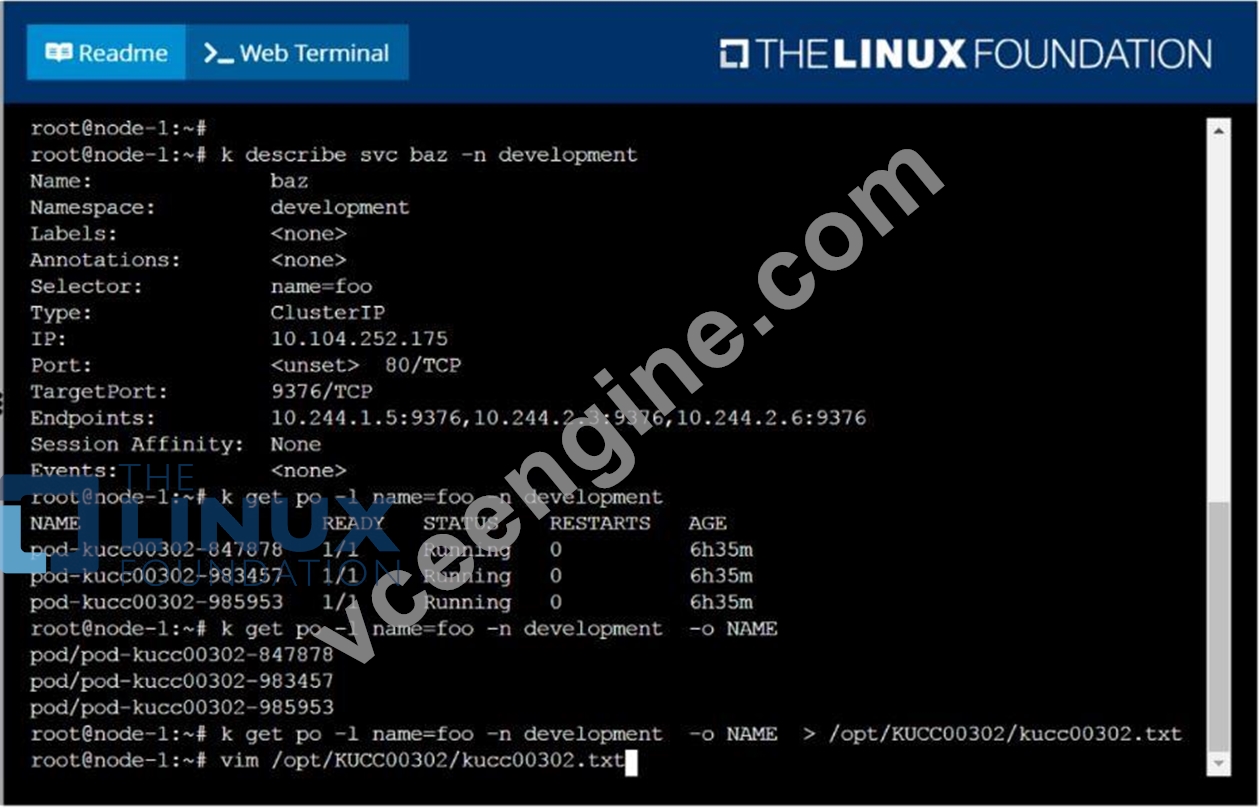
F:\Work\Data Entry Work\Data Entry\20200827\CKA\11 C.JPG
F:\Work\Data Entry Work\Data Entry\20200827\CKA\11 D.JPG
NEW QUESTION 43
......
Understanding of functional and technical aspects of Troubleshooting
Detect, diagnose, and remedy a variety of Kubernetes failures at the network, node, control-plane, and application levels. You will use tools included in Kubernetes, such as kubectl, as well as a variety of Linux operating system tools like systemctl, journalctl, ss, and openssl to build a comprehensive Kubernetes troubleshooting toolkit.
The following will be discussed in CNCF CKA dumps:
- Troubleshoot cluster component failure
- Manage container stdout & stderr logs
- Troubleshoot Kubernetes application failures
- Troubleshoot Kubernetes component failures
- Troubleshoot Kubernetes connection failures
- Evaluate cluster and node logging
- Troubleshoot Kubernetes node failures
- Understand how to monitor applications
- Troubleshoot application failure
- Troubleshoot networking
Free CKA Exam Questions CKA Actual Free Exam Questions: https://www.vceengine.com/CKA-vce-test-engine.html
Verified CKA dumps and 63 unique questions: https://drive.google.com/open?id=1xkHECltyB0MUvlSZCKDmb1ZIO_NNi5WN
