

[Oct 13, 2023] Get Unlimited Access to CISSP Certification Exam Cert Guide
Reliable Study Materials for CISSP Exam Success For Sure
Salary you can get after getting ISC CISSP Certification:
The average salary of an ISC CISSP in different countries, defined in ISC CISSP Dumps, is as follows:
- Australia - 91,200 USD
- Canada - 98,000 USD
- Germany - €95,000 USD
- United States - 122,000 USD
The ISC Foundation Exam
The ISC credential is divided into four levels: Professional Certified Security Analyst (PCSA), Associate Certified Security Analyst (ACSA), Certified Information Systems Security Professional (CISSP), and Master Certified Information Systems Security Professional (MCISSP). The Professional level normally requires six exams to achieve, while associate requires six exams to achieve. The Associate exam is an objective test that candidates can prepare by CISSP Dumps and can take online or skype, while professional exam candidates only have access to one option. Candidates are able to earn up to 12 continuing education units through their participation in the ISSA ISC2 Security Forum of Interest Community of Interest (COI) and 16 continuing education units through their participation in the IT Security Resources Community of Interest (CIOI).
The CISSP exam consists of 250 multiple-choice questions, and the exam duration is six hours. CISSP exam tests the candidate's knowledge in eight domains of information security, which include security and risk management, asset security, security architecture and engineering, communication and network security, identity and access management, security assessment and testing, security operations, and software development security.
NEW QUESTION # 355
What is enticement?
- A. Luring the perpetrator to an attractive area or presenting the perpetrator with a lucrative target after the crime has already been initiated
- B. Encouraging the commission of a crime when there was initially no intent to commit a crime
- C. Assisting in the commission of a crime
- D. Encouraging the commission of one crime over another
Answer: A
Explanation:
The correct answer is "Luring the perpetrator to an attractive area or presenting the perpetrator with a lucrative target after the crime has already been initiated", the definition of enticement.
*Answer "Encouraging the commission of a crime when there was initially no intent to commit a crime" is the definition of entrapment.
The other answers are distracters.
NEW QUESTION # 356
Tim is a network administrator of Acme inc. He is responsible for configuring the network devices.
John the new security manager reviews the configuration of the Firewall configured by Tim and identifies an issue. This specific firewall is configured in failover mode with another firewall. A sniffer on a PC connected to the same switch as the firewalls can decipher the credentials, used by Tim while configuring the firewalls. Which of the following should be used by Tim to ensure a that no one can eavesdrop on the communication?
- A. RSH
- B. SFTP
- C. SCP
- D. SSH
Answer: D
Explanation:
The SSH protocol provides an encrypted terminal session to the remote firewalls. By encrypting the data, it prevents sniffing attacks using a protocol analyzer also called a sniffer. With more and more computers installed in networked environments, it often becomes necessary to access hosts from a remote location. This normally means that a user sends login and password strings for authentication purposes. As long as these strings are transmitted as plain text, they could be intercepted and misused to gain access to that user account without the authorized user even knowing about it. Apart from the fact that this would open all the user's files to an attacker, the illegal account could be used to obtain administrator or root access or to penetrate other systems. In the past, remote connections were established with telnet, which offers no guards against eavesdropping in the form of encryption or other security mechanisms. There are other unprotected communication channels, like the traditional FTP protocol and some remote copying programs. The SSH suite provides the necessary protection by encrypting the authentication strings (usually a login name and a password) and all the other data exchanged between the hosts. With SSH, the data flow could still be recorded by a third party, but the contents are encrypted and cannot be reverted to plain text unless the encryption key is known. So SSH enables secure communications over insecure networks such as the Internet.
The following answers are incorrect: SCP and SFTP The SCP protocol is a network protocol that supports file transfers. The SCP protocol, which runs on port 22, is based on the BSD RCP protocol which is tunneled through the Secure Shell (SSH) protocol to provide encryption and authentication. SCP might not even be considered a protocol itself, but merely a combination of RCP and SSH. The RCP protocol performs the file transfer and the SSH protocol performs authentication and encryption. SCP protects the authenticity and confidentiality of the data in transit. It hinders the ability for packet sniffers to extract usable information from the data packets. The SCP protocol has been superseded by the more comprehensive SFTP protocol, which is also based on SSH.
RSH RSH(c) allows a user to execute commands on a remote system without having to log in to the system. For example, RSH can be used to remotely examine the status of a number of access servers without connecting to each communication server, executing the command, and then disconnecting from the communication server. As described in the rlogin article, the rsh protocol is not secure for network use, because it sends unencrypted information over the network, among other things. Some implementations also authenticate by sending unencrypted passwords over the network. rsh has largely been replaced by the very similar SSH (secure shell) program on untrusted networks like the internet. As an example of RSH use, the following executes the command mkdir testdir as user remote user on the computer remote computer: rsh -l remote user remote computer "mkdir testdir"
After the command has finished RSH terminates. If no command is specified then rsh will log in on the remote system using rlogin. The following reference(s) were/was used to create this question: http://www.novell.com/documentation/suse91/suselinux-adminguide/html/ch19s02html and http://en.wikipedia.org/wiki/Remote_Shell
and http://en.wikipedia.org/wiki/Secure_copy
NEW QUESTION # 357
What is the PRIMARY use of a password?
- A. Authenticate the user.
- B. Segregate various users' accesses.
- C. Allow access to files.
- D. Identify the user.
Answer: A
Explanation:
Explanation/Reference:
Explanation:
A protected string of characters, known as a password, is used to authenticate an individual.
Incorrect Answers:
A: The primary use of a password is not to allow access to files, it is to authenticate an individual.
B: The primary use of a password is not to identify an individual, it is to authenticate an individual.
D: The primary use of a password is not to divide various user's accesses, it is to authenticate an individual.
References:
Harris, Shon, All In One CISSP Exam Guide, 6th Edition, McGraw-Hill, 2013, p. 192
NEW QUESTION # 358
The US-EU Safe Harbor process has been created to address which of the following?
- A. Protection of personal data transferred between U.S and European companies
- B. Integrity of data transferred between U.S. and European companies
- C. Confidentiality of data transferred between European and international companies
- D. Confidentiality of data transferred between U.S and European companies
Answer: A
Explanation:
Explanation/Reference:
Explanation:
US-EU Safe Harbor process relates to privacy, that is protection of personal data. The Safe Harbor is a construct that outlines how U.S.-based companies can comply with the EU privacy. The Safe Harbor Privacy Principles states that if a non-European organization wants to do business with a European entity, it will need to adhere to the Safe Harbor requirements if certain types of data will be passed back and forth during business processes
Incorrect Answers:
A: The US-EU Safe Harbor process does not relate to the integrity of the data. It concerns the privacy of the data.
B: The US-EU Safe Harbor process does not relate to the Confidentiality of the data. It concerns the privacy of the data.
D: The US-EU Safe Harbor process does not relate to the Confidentiality of the data. It concerns the privacy of the data.
References:
Harris, Shon, All In One CISSP Exam Guide, 6th Edition, McGraw-Hill, New York, 2013, p. 992
NEW QUESTION # 359
To comply with industry requirements, a security assessment on the cloud server should identify which protocols and weaknesses are being exposed to attackers on the Internet.
Which of the following tools is the MOST appropriate to complete the assessment?
- A. Use tcpdump and parse the output file in a protocol analyzer.
- B. Use an IP scanner and target the cloud WAN network addressing
- C. Use nmap and set the servers' public IPs as the targets.
- D. Run netstat in each cloud server and retrieve the running processes.
Answer: C
NEW QUESTION # 360
Identify the component that MOST likely lacks digital accountability related to information access.
Click on the correct device in the image below.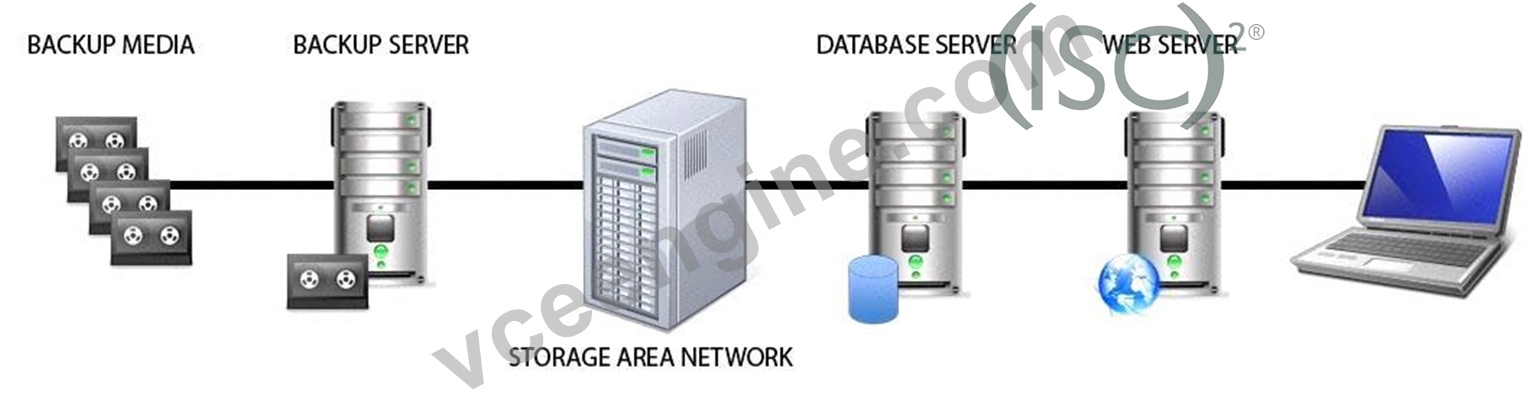
Answer:
Explanation: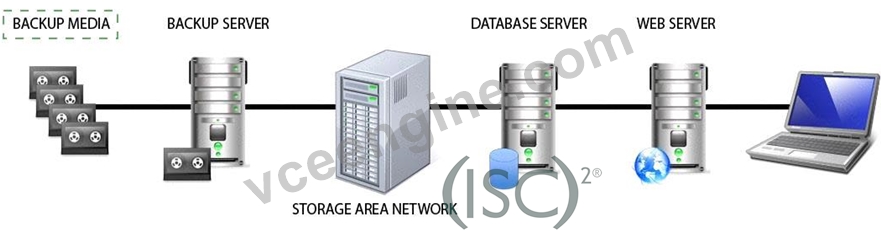
Explanation
Backup Media
Reference: Official (ISC)2 Guide to the CISSP CBK, Third Edition page 1029
NEW QUESTION # 361
Which of the following management process allows those services required for users to accomplish their tasks, change default user passwords, and set servers to retrieve antivirus updates?
- A. Configuration
- B. Identity
- C. Patch
- D. Compliance
Answer: A
NEW QUESTION # 362
Which of the following is NOT one of the five disaster recovery plan testing types?
- A. Checklist
- B. Mobile
- C. Full Interruption
- D. Simulation
Answer: B
Explanation:
The correct answer is mobile. The other three are proper examples of elements of the five disaster recovery plan testing types.
NEW QUESTION # 363
Which of the following best describes the Secure Electronic Transaction (SET) protocol?
- A. Originated by VISA and American Express as an Internet credit card protocol using SSL.
- B. Originated by VISA and MasterCard as an Internet credit card protocol using Message
Authentication Code. - C. Originated by VISA and MasterCard as an Internet credit card protocol using digital signatures.
- D. Originated by VISA and MasterCard as an Internet credit card protocol using the transport layer.
Answer: C
Explanation:
Secure Electronic Transaction (SET). Originated by VISA and MasterCard as an Internet credit card protocol using digital signatures. SET operates at the application layer which distinguishes it from SSL. SSL operates at the Transport layer.
Secure Electronic Transaction (SET) is a system for ensuring the security of financial transactions on the Internet. It was supported initially by Mastercard, Visa, Microsoft,
Netscape, and others. With SET, a user is given an electronic wallet (digital certificate) and a transaction is conducted and verified using a combination of digital certificates and digital signatures among the purchaser, a merchant, and the purchaser's bank in a way that ensures privacy and confidentiality. SET makes use of Netscape's Secure Sockets Layer
(SSL), Microsoft's Secure Transaction Technology (STT), and Terisa System's Secure
Hypertext Transfer Protocol (S-HTTP). SET uses some but not all aspects of a public key infrastructure (PKI).
Here's how SET works:
Assume that a customer has a SET-enabled browser such as Mozilla or Microsoft's
Internet Explorer and that the transaction provider (bank, store, etc.) has a SET-enabled server.
The customer opens a Mastercard or Visa bank account. Any issuer of a credit card is some kind of bank.
The customer receives a digital certificate. This electronic file functions as a credit card for online purchases or other transactions. It includes a public key with an expiration date. It has been through a digital switch to the bank to ensure its validity.
Third-party merchants also receive certificates from the bank. These certificates include the merchant's public key and the bank's public key.
The customer places an order over a Web page, by phone, or some other means.
The customer's browser receives and confirms from the merchant's certificate that the merchant is valid.
The browser sends the order information. This message is encrypted with the merchant's public key, the payment information, which is encrypted with the bank's public key (which can't be read by the merchant), and information that ensures the payment can only be used with this particular order.
The merchant verifies the customer by checking the digital signature on the customer's certificate. This may be done by referring the certificate to the bank or to a third-party verifier.
The merchant sends the order message along to the bank. This includes the bank's public key, the customer's payment information (which the merchant can't decode), and the merchant's certificate.
The bank verifies the merchant and the message. The bank uses the digital signature on the certificate with the message and verifies the payment part of the message.
The bank digitally signs and sends authorization to the merchant, who can then fill the order.
Reference(s) used for this question:
Mc Graw Hill, Shon Harris, CISSP All In One (AIO) Book, Sixth Edition, Pages 856-858 and
What is Secure Electronic Transactions (SET) by SearchFinancialSecurity and
KRUTZ, Ronald L. & VINES, Russel D., The CISSP Prep Guide: Mastering the Ten
Domains of Computer Security, 2001, John Wiley & Sons, Pages 89, 170.
NEW QUESTION # 364
Which of the following is considered best practice for preventing e-mail spoofing?
- A. Reverse Domain Name Service (DNS) lookup
- B. Cryptographic signature
- C. Uniform Resource Locator (URL) filtering
- D. Spam filtering
Answer: B
NEW QUESTION # 365
Fault tolerance countermeasures are designed to combat threats to which of the following?
- A. an uninterruptible power supply.
- B. backup and retention capability.
- C. design reliability.
- D. data integrity.
Answer: C
Explanation:
Explanation/Reference:
Explanation:
One of the ways to provide uninterrupted access to information assets is through redundancy and fault tolerance. Redundancy refers to providing multiple instances of either a physical or logical component such that a second component is available if the first fails. Fault tolerance is a broader concept that includes redundancy but refers to any process that allows a system to continue making information assets available in the case of a failure.
Fault tolerance countermeasures are designed to combat threats to design reliability. Although fault tolerance can include redundancy, it also refers to systems such as RAID where if a disk fails, the data can be made available from the remaining disks.
Incorrect Answers:
A: Fault tolerance countermeasures ensure that data assets remain available in the event of a failure of any component, not just an uninterruptible power supply.
B: Fault tolerance countermeasures ensure that data assets remain available in the event of a failure of any component, not just the backup and retention capability.
D: Fault tolerance countermeasures do not protect data integrity.
NEW QUESTION # 366
In Mandatory Access Control, sensitivity labels attached to object contain what information?
- A. The item's classification
- B. The item's classification and category set
- C. The item's category
- D. The items's need to know
Answer: B
Explanation:
A Sensitivity label must contain at least one classification and one category set.
Category set and Compartment set are synonyms, they mean the same thing. The sensitivity label must contain at least one Classification and at least one Category. It is common in some environments for a single item to belong to multiple categories. The list of all the categories to which an item belongs is called a compartment set or category set.
The following answers are incorrect:
the item's classification. Is incorrect because you need a category set as well.
the item's category. Is incorrect because category set and classification would be both be required.
The item's need to know. Is incorrect because there is no such thing. The need to know is indicated by the catergories the object belongs to. This is NOT the best answer.
Reference(s) used for this question:
OIG CBK, Access Control (pages 186 - 188)
AIO, 3rd Edition, Access Control (pages 162 - 163)
AIO, 4th Edittion, Access Control, pp 212-214.
Wikipedia - http://en.wikipedia.org/wiki/Mandatory_Access_Control
NEW QUESTION # 367
Which of the following computer crime is MORE often associated with INSIDERS?
- A. Password sniffing
- B. IP spoofing
- C. Data diddling
- D. Denial of service (DOS)
Answer: C
Explanation:
It refers to the alteration of the existing data , most often seen before it is entered
into an application.This type of crime is extremely common and can be prevented by using
appropriate access controls and proper segregation of duties. It will more likely be perpetrated by
insiders, who have access to data before it is processed.
The other answers are incorrect because :
IP Spoofing is not correct as the questions asks about the crime associated with the insiders.
Spoofing is generally accomplished from the outside.
Password sniffing is also not the BEST answer as it requires a lot of technical knowledge in
understanding the encryption and decryption process.
Denial of service (DOS) is also incorrect as most Denial of service attacks occur over the internet.
Reference : Shon Harris , AIO v3 , Chapter-10 : Law , Investigation & Ethics , Page : 758-760.
NEW QUESTION # 368
Which of the following is a PRIMARY security weakness in the design of Domain Name System (DNS)?
- A. A DNS server can be disabled in a denial-of-service (DoS) attack.
- B. Each DNS server must hold the address of the root servers.
- C. A DNS server does not authenticate source of information.
- D. A DNS server database can be injected with falsified checksums.
Answer: A
NEW QUESTION # 369
Role-based access control is useful when:
- A. Access must be determined by the labels on the data.
- B. Rules are needed to determine clearances.
- C. There are frequent personnel changes in an organization.
- D. Security clearances must be used.
Answer: C
Explanation:
The correct answer is "There are frequent personnel changes in an organization.". Role-based access control is part of nondiscretionary access control. The other options relate to mandatory access control.
NEW QUESTION # 370
Which of the following is the MOST appropriate control for asset data labeling procedures?
- A. Categorizing the types of media being used
- B. Reviewing audit trails of logging records
- C. Logging data media to provide a physical inventory control
- D. Reviewing off-site storage access controls
Answer: A
NEW QUESTION # 371
A hospital's building controls system monitors and operates the environmental equipment to maintain a safe and comfortable environment. Which of the following could be used to minimize the risk of utility supply interruption?
- A. Lock out maintenance personnel from the building controls system access that can impact critical utility supplies
- B. Standardized building controls system software with high connectivity to hospital networks
- C. Digital protection and control devices capable of minimizing the adverse impact to critical utility
- D. Digital devices that can turn equipment off and continuously cycle rapidly in order to increase supplies and conceal activity on the hospital network
Answer: C
NEW QUESTION # 372
A client has reviewed a vulnerability assessment report and has stated it is Inaccurate. The client states that the vulnerabilities listed are not valid because the host's Operating System (OS) was not properly detected.
Where in the vulnerability assessment process did the erra MOST likely occur?
- A. Enumeration
- B. Detection
- C. Reporting
- D. Discovery
Answer: B
NEW QUESTION # 373
Which of the following method is recommended by security professional to PERMANENTLY erase sensitive data on magnetic media?
- A. Delete File allocation table
- B. Format magnetic media
- C. Degaussing
- D. Overwrite every sector of magnetic media with pattern of 1's and 0's
Answer: C
Explanation:
Explanation/Reference:
Explanation:
Degaussing is the most effective method out of all the provided choices to erase sensitive data on magnetic media.
A device that performs degaussing generates a coercive magnetic force that reduces the magnetic flux density of the storage media to zero. This magnetic force is what properly erases data from media. Data are stored on magnetic media by the representation of the polarization of the atoms. Degaussing changes this polarization (magnetic alignment) by using a type of large magnet to bring it back to its original flux (magnetic alignment).
Simply deleting files or formatting the media does not actually remove the information. File deletion and media formatting often simply remove the pointers to the information.
Specialized hardware devices known as degaussers can be used to erase data saved to magnetic media.
The measure of the amount of energy needed to reduce the magnetic field on the media to zero is known as coercivity. It is important to make sure that the coercivity of the degausser is of sufficient strength to meet object reuse requirements when erasing data. If a degausser is used with insufficient coercivity, then a remanence of the data will exist.
Remanence is the measure of the existing magnetic field on the media; it is the residue that remains after an object is degaussed or written over. Data is still recoverable even when the remanence is small. While data remanence exists, there is no assurance of safe object reuse. Some degaussers can destroy drives.
The security professional should exercise caution when recommending or using degaussers on media for reuse.
Incorrect Answers:
B: Software tools also exist that can provide object reuse assurance. These tools overwrite every sector of magnetic media with a random or predetermined bit pattern. Overwrite methods are effective for all forms of electronic media with the exception of read-only optical media. There is a drawback to using overwrite software. During normal write operations with magnetic media, the head of the drive moves back-and-forth across the media as data is written. The track of the head does not usually follow the exact path each time.
The result is a miniscule amount of data remanence with each pass. With specialized equipment, it is possible to read data that has been overwritten. Degaussing is more effective than overwriting the sectors.
C: Simply deleting files or formatting the media does not actually remove the information. File deletion and media formatting often simply removes the pointers to the information.
D: Deleting the File allocation table will not erase all data. The data can be recoverable using software tools.
NEW QUESTION # 374
......
New ISC CISSP Dumps & Questions: https://www.vceengine.com/CISSP-vce-test-engine.html
100% Latest Most updated CISSP Questions and Answers: https://drive.google.com/open?id=1KJ7uaelsZfedq_Dcz4Xw2xzfLOjzTr7L
